


What Is Generative Engine Optimization
Generative Engine Optimization is the process of optimizing digital content so that AI-powered search engines and generative systems can understand, summarize, and reference it when answering user queries.
Unlike traditional search engines that display a list of links, modern AI systems generate direct responses by synthesizing information from multiple sources. Because of this shift, businesses must adapt their content strategies to ensure that AI models can easily interpret and cite their information.
This emerging discipline is often referred to as Generative Engine Optimization GEO, and it represents a fundamental evolution in how visibility works online.
At Your Cloud Hub, we help organizations understand how generative search systems evaluate content and how to structure information so that it appears in AI-generated responses.
The Evolution of Search
Search behavior has undergone several major transformations.
First came traditional search engines that relied heavily on keyword matching.
Then ranking algorithms began evaluating backlinks, domain authority, and user behavior.
Now, generative AI systems are transforming how users receive information.
Instead of clicking through multiple websites, users increasingly receive synthesized answers generated by AI.
These systems analyze content from multiple sources and present a structured response.
This shift means the goal of optimization is no longer just ranking on search pages.
The new objective is being referenced within AI-generated responses.
Understanding what Generative Engine Optimization is becomes critical for businesses seeking visibility in this new environment.
Why Generative Search Changes Everything
Traditional search results displayed many options.
Users selected a link and visited the website.
Generative search systems work differently.
They analyze large volumes of content and produce summarized responses.
These responses may include:
Definitions
Step-by-step explanations
Comparisons
Recommendations
The information displayed is often extracted from trusted sources.
Businesses that structure their content properly are more likely to be referenced.
This is why Generative Engine Optimization is now essential.
At Your Cloud Hub, we help companies transition from traditional search optimization to strategies designed for generative discovery.
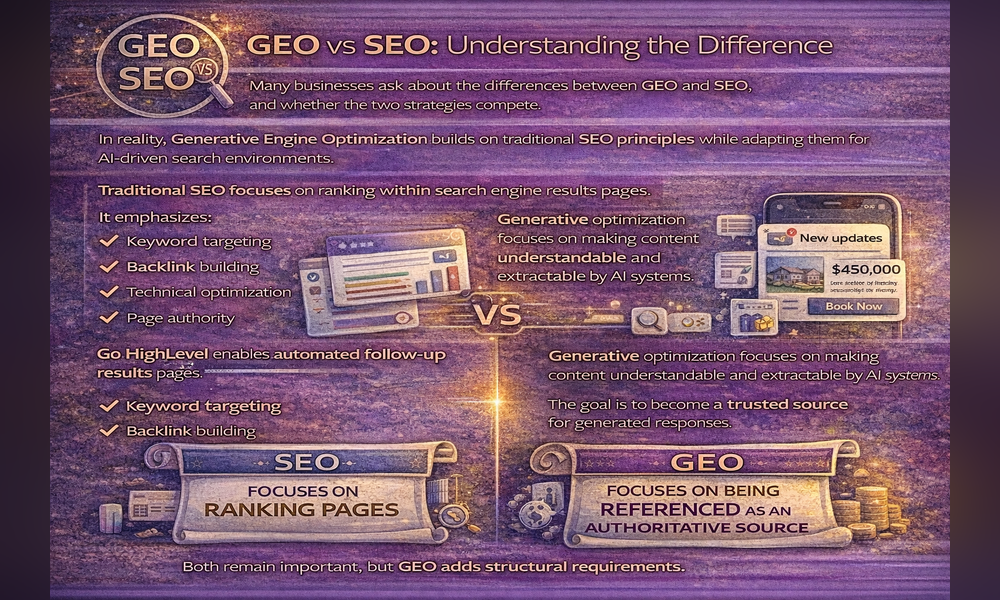
GEO vs SEO: Understanding the Difference
Many businesses ask about the differences between GEO and SEO, and whether the two strategies compete.
In reality, Generative Engine Optimization builds on traditional SEO principles while adapting them for AI-driven search environments.
Traditional SEO focuses on ranking within search engine results pages.
It emphasizes:
Keyword targeting
Backlink building
Technical optimization
Page authority
Generative optimization focuses on making content understandable and extractable by AI systems.
The goal is to become a trusted source for generated responses.
The distinction between GEO vs SEO can be summarized as follows.
SEO focuses on ranking pages.
GEO focuses on being referenced as an authoritative source.
Both remain important, but GEO adds structural requirements.
How AI Models Interpret Content
To understand the Generative Engine Optimization strategy, businesses must understand how AI models interpret information.
Generative AI systems evaluate content based on several factors.
Clarity of explanation
Structured formatting
Topical authority
Contextual relevance
Semantic relationships
AI systems prioritize content that provides direct answers to user questions.
If content is overly vague, poorly structured, or overly promotional, it becomes difficult for AI models to extract meaningful insights.
At Your Cloud Hub, we ensure clarity and structure are central to the development of content for generative discovery.
The Importance of Answer-First Content
Generative AI systems prioritize content that answers questions quickly.
Thus, answer-first content is a key component of strategy.
Answer-first content begins with a direct explanation before expanding into deeper detail.
For example, when users ask:
What is Generative Engine Optimization
The best content immediately defines the concept.
This structure enables AI systems to efficiently extract concise answers.
Early placement of explanations raises the chances of appearing in AI summaries.
Structuring Content for AI Extraction
AI models interpret content differently from human readers.
They scan pages for patterns that indicate clarity and authority.
An effective Generative Engine Optimization strategy includes:
Clear headings
Concise definitions
Logical content sections
Structured comparisons
Step-by-step explanations
These elements help AI systems quickly identify important information.
At Your Cloud Hub, we develop content frameworks built specifically for generative interpretation.
Topic Authority and Content Depth
AI systems often prefer content from sources that demonstrate strong topical expertise.
Instead of publishing isolated articles, businesses should develop topic clusters.
For example, a company discussing Generative Engine Optimization GEO may also publish content about:
AI search trends
Answer-first content strategies
AI-friendly website architecture
Content authority building
These interconnected topics signal expertise.
When multiple articles support each other, AI models gain confidence in the source.
The Role of Semantic Relationships
Traditional SEO often focused heavily on individual keywords.
Generative search systems analyze relationships between concepts.
For example, content discussing Generative Engine Optimization may naturally include related topics such as:
AI search engines
content summarization
information extraction
structured data
These relationships help AI systems understand the broader context of the topic.
A strong Generative Engine Optimization strategy prioritizes conceptual clarity so your content is understood and referenced by AI systems—rather than just repeating keywords.
The Importance of Credibility
AI systems prioritize reliable sources.
Content credibility depends on factors such as:
Expertise
Consistency
Accuracy
Domain authority
Businesses that publish well-researched content consistently are more likely to be referenced.
At Your Cloud Hub, credibility is among the most important factors influencing AI search visibility.
Content Designed for Human and AI Readers
Some businesses worry that optimizing for AI may reduce readability for human audiences.
However, an effective Generative Engine Optimization strategy improves clarity for both audiences.
Clear structure improves both human and machine understanding.
Content that explains concepts simply, logically, and thoroughly performs better across all search environments.
The Future of Search Visibility
The rise of generative search does not eliminate traditional search engines.
Instead, it changes how information is delivered.
Users may seek deeper insights from websites, but initial answers often come from AI summaries.
Businesses that adopt Generative Engine Optimization GEO early will gain significant advantages.
They will become trusted sources referenced within AI-generated explanations.
Implementing a Generative Engine Optimization Strategy
Organizations preparing for the future of search should consider several strategic actions.
Focus on answering real questions clearly.
Develop topic clusters that demonstrate expertise.
Structure content using clear headings and logical explanations.
Avoid unnecessary marketing language that reduces clarity.
Create content that educates rather than simply promotes.
At Your Cloud Hub, we guide businesses in applying these principles while reinforcing strong brand positioning.
Why Generative Visibility Matters for Businesses
Visibility within AI-generated responses can dramatically influence customer perception.
When a brand is referenced within AI explanations, it gains authority instantly.
Users often trust sources that appear within generated insights.
This creates opportunities for businesses that understand what Generative Engine Optimization is and implement it effectively.
The Strategic Role of Content Architecture
Content architecture plays a major role in generative optimization.
Information should be organized in ways that AI systems can easily interpret.
This includes:
Logical page hierarchy
Consistent terminology
Clear definitions
Well-structured paragraphs
These practices raise the likelihood that your information will be selected and cited by AI systems—making them essential to any GEO strategy.

The Role of Your Cloud Hub
The transition toward generative search requires businesses to rethink digital visibility.
Traditional optimization techniques remain valuable, but they must evolve alongside AI-driven search systems.
At Your Cloud Hub, we lead organizations through this transition by crafting strategies aligned with generative discovery.
Our approach focuses on clarity, authority, and structured information that AI systems can interpret effectively.
The New SEO Playbook
Search is no longer just about rankings.
It is about recognition within AI-generated knowledge systems.
Generative Engine Optimization represents the next stage of digital visibility.
Businesses that understand the difference between GEO and SEO will recognize that both strategies complement each other.
SEO helps content rank.
GEO helps content become a trusted source within generated answers.
Organizations that implement a strong Generative Engine Optimization strategy today will be better positioned for the future of search.
The companies that structure their information clearly and demonstrate real expertise will achieve the most visibility in the evolving AI-driven search landscape. Clear, authoritative content is the key to being referenced.
Advanced Generative Engine Optimization Strategy for AI Search Visibility
The rise of AI-powered search systems has changed how people discover information online. Instead of presenting a list of links for users to explore, generative engines now interpret questions and provide direct answers.
This transformation has created a new discipline, Generative Engine Optimization.
Businesses that understand what Generative Engine Optimization is and adapt their content accordingly will gain a significant advantage in the evolving search landscape.
In this section, we explore deeper frameworks, practical applications, and strategic implementation approaches for Generative Engine Optimization GEO.
Why Generative Engines Prefer Structured Knowledge
Generative search systems rely on structured information to generate accurate responses.
Unlike traditional search engines that simply index pages, generative engines analyze the meaning behind content.
They attempt to identify:
Clear explanations
Well-defined concepts
Logical content flow
Reliable sources of information
If content lacks clarity or structure, generative engines may struggle to interpret it effectively.
This is why a strong Generative Engine Optimization strategy focuses on presenting knowledge in an organized and easily understandable format.
At Your Cloud Hub, we emphasize knowledge architecture when building AI-friendly content systems.
The Importance of Topic Authority in GEO
Generative engines prioritize sources that demonstrate authority within specific subject areas.
Publishing a single article on a topic rarely establishes credibility.
Instead, businesses should develop clusters of content that explore related concepts in depth.
For example, organizations working on Generative Engine Optimization GEO may publish content covering topics such as:
AI search technology
Content structure optimization
Answer-first writing frameworks
AI search ranking signals
These interconnected resources help generative systems recognize the domain as an authoritative source.
Authority increases the likelihood that the content will be referenced in AI-generated responses.
Creating AI-Friendly Content Structures
One of the core elements of the Generative Engine Optimization strategy is structuring content to enable AI models to extract insights more easily.
Effective structures include:
Clear headings that reflect user questions
Short explanatory paragraphs
Definition-based introductions
Logical progression between sections
For example, when addressing a question like “What is Generative Engine Optimization?” the content should begin with a clear explanation rather than a lengthy background context.
This approach improves the probability that AI models will select the explanation when generating responses.
Answer-Based Content Design
Generative search systems are designed to respond directly to user questions.
As a result, answer-based content has become a central component of Generative Engine Optimization.
Answer-based content typically follows a simple framework.
Start with a concise answer to the question.
Then expand the explanation with deeper insights.
Finally, provide supporting examples or comparisons.
This structure helps generative engines quickly identify key information while still allowing readers to explore additional details.
At Your Cloud Hub, answer-based content design plays a major role in modern search optimization strategies.
The Relationship Between GEO and Content Quality
High-quality content has always been important for search visibility.
However, generative search systems place even greater emphasis on clarity and educational value.
Content optimized for Generative Engine Optimization GEO should focus on:
Explaining concepts clearly
Providing practical insights
Avoiding unnecessary marketing language
Maintaining logical information flow
Generative engines prefer content that teaches rather than content that simply promotes.
Educational depth improves both human understanding and AI interpretation.
The Role of Data and Examples in GEO
Generative systems often look for supporting context when synthesizing answers.
Content that includes examples, comparisons, or real-world scenarios helps AI models understand how concepts apply in practice.
For instance, explaining GEO vs SEO becomes clearer when examples illustrate how the two strategies differ.
Practical explanations improve content credibility and make it easier for generative engines to generate accurate responses.
This is why many Generative Engine Optimization strategy frameworks encourage the inclusion of illustrative examples.
Avoiding Common GEO Mistakes
As businesses begin exploring Generative Engine Optimization, several common mistakes appear.
One of the most frequent issues is treating GEO as simply another keyword strategy.
While keywords remain relevant, generative engines focus more on meaning than repetition.
Another mistake involves writing overly complex explanations that obscure key insights.
Generative engines prefer content that communicates ideas clearly and efficiently.
A third mistake is publishing isolated articles without building topic depth.
Authority requires consistent exploration of related topics.
At Your Cloud Hub, we help businesses avoid these pitfalls by developing comprehensive generative optimization frameworks.
The Role of Brand Authority in Generative Search
Brand authority influences generative visibility significantly.
AI models often prioritize information from sources that demonstrate consistent expertise and reliability.
Authority signals may include:
Regular publication of insightful content
Strong domain credibility
Consistent topical coverage
Businesses that invest in long-term knowledge development are more likely to appear in AI-generated summaries.
This reinforces the importance of maintaining a well-defined Generative Engine Optimization strategy.
GEO and the Future of Information Discovery
The rise of generative search signals a broader shift in how people interact with digital information.
Users increasingly expect:
Direct answers rather than lists of links
Clear explanations instead of fragmented information
Expert insights rather than generic summaries
Generative engines attempt to deliver these experiences by synthesizing information from reliable sources.
Businesses that align their content strategies with these expectations will remain visible in future search environments.
Understanding what Generative Engine Optimization is, therefore, is essential for long-term digital strategy.