


What Is Full Funnel Marketing
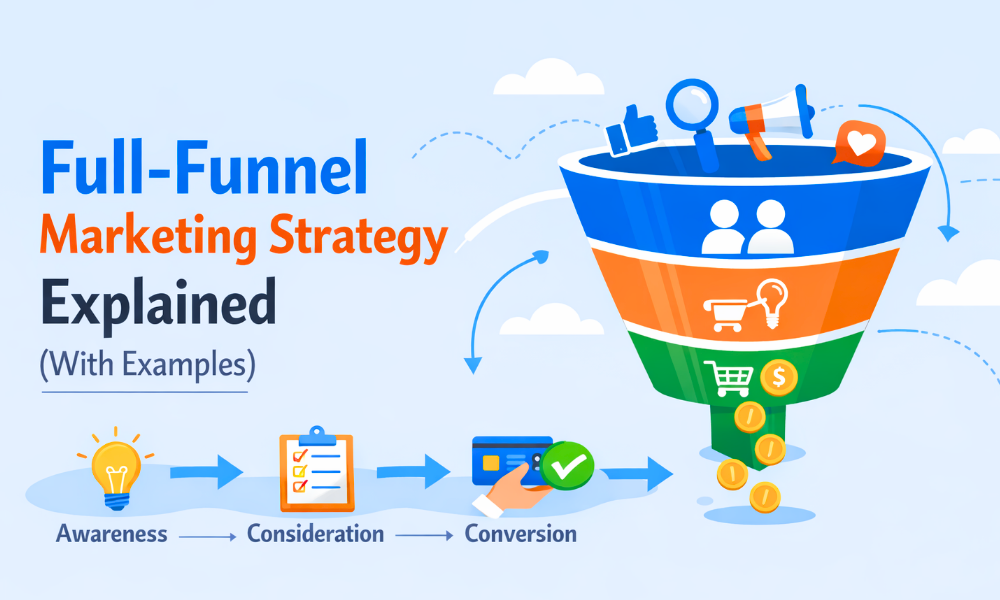
Full funnel marketing is an approach that guides potential customers through each phase of the buying journey, from initial awareness to purchase and long-term loyalty.
Rather than only acquiring leads or running ads, full funnel marketing addresses the customer journey at every stage: Awareness, Consideration, Conversion, Retention
By supporting prospects at each stage, businesses not only create more predictable revenue but also forge stronger, long-lasting customer relationships, ensuring sustained growth and competitive advantage.
At Your Cloud Hub, we help companies build systems that align marketing activities with the entire customer journey, rather than focusing solely on short-term lead generation.
Why Businesses Need a Full Funnel Marketing Strategy
Many companies invest heavily in lead generation but often face disappointing conversion rates, missing out on valuable growth opportunities.
The problem is often not the number of leads.
The problem is that marketing efforts are concentrated only at the top of the funnel.
Without nurturing prospects through the middle and bottom stages of the funnel, many leads never convert into paying customers.
This is where a full-funnel marketing explanation becomes important.
A complete strategy empowers marketing to address every stage of the buying process, maximizing every touchpoint and transforming prospects into loyal customers.
Instead of focusing on isolated campaigns, businesses build a connected system that moves prospects gradually toward a purchase decision.
Understanding the Marketing Funnel
To understand what full funnel marketing is, it helps to first understand the concept of a marketing funnel.
The funnel represents the stages customers go through before making a purchase.
Each stage represents different mindsets and information needs.
The typical funnel includes three major phases:
Top of the funnel
Middle of the funnel
Bottom of the funnel
A full-funnel marketing strategy guide empowers businesses to deliver content and messaging that inspire action at each stage.
Top of the Funnel: Awareness
The first stage of the funnel focuses on awareness.
At this stage, potential customers may not even realize they have a specific problem.
They are exploring information, researching ideas, or discovering new solutions.
The goal of top-of-funnel marketing is to capture attention, educate, and inspire future engagement with your brand.
Examples of top-of-funnel marketing include:
Educational blog posts
Industry reports
Social media content
Explainer videos
Search engine optimized articles
For example, a software company might publish a guide explaining common productivity challenges in businesses.
The goal is not to sell immediately but to win attention and credibility—setting the stage for a future customer relationship.
At Your Cloud Hub, top-of-funnel content strategies are designed to build authority while generating consistent organic traffic.
Middle of the Funnel: Consideration
Once prospects recognize their problem, they move into the consideration stage.
Here they begin evaluating possible solutions.
They may compare products, explore service providers, or research different approaches.
The middle of the funnel focuses on trust and credibility.
Examples of middle-of-funnel marketing include:
Case studies
Webinars
Product comparison guides
Email nurturing sequences
Detailed solution explanations
For instance, a consulting firm may provide case studies showing how their services helped previous clients achieve measurable improvements.
This stage is a crucial moment where prospects narrow their choices—and your influence can make all the difference.
A well-designed full-funnel marketing strategy ensures that potential customers receive relevant information at the right time.
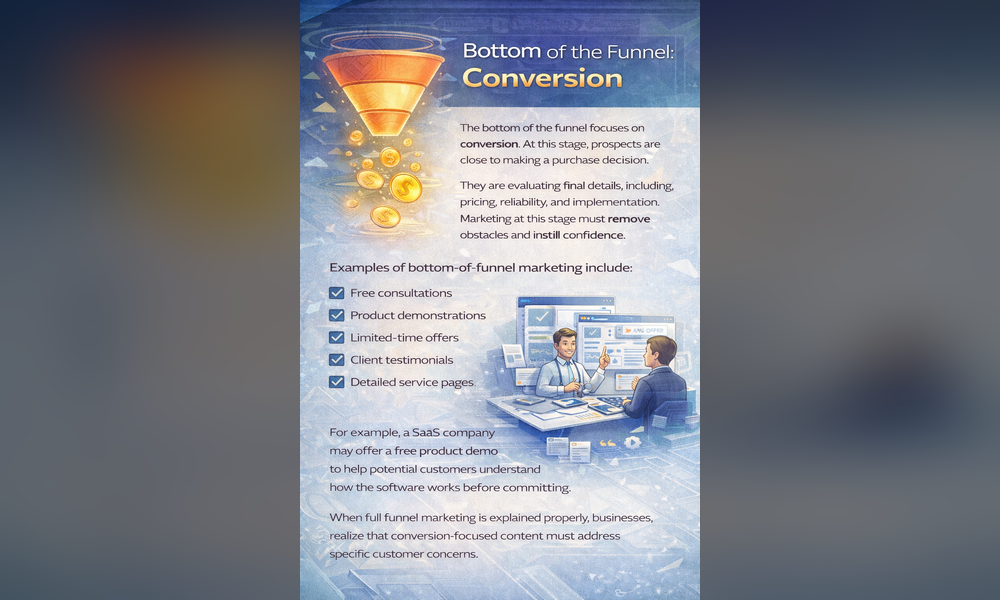
Bottom of the Funnel: Conversion
The bottom of the funnel focuses on conversion.
At this stage, prospects are close to making a purchase decision.
They are evaluating final details, including pricing, reliability, and implementation.
Marketing at this stage must remove obstacles and instill confidence.
Examples of bottom-of-funnel marketing include:
Free consultations
Product demonstrations
Limited-time offers
Client testimonials
Detailed service pages
For example, a SaaS company may offer a free product demo to help potential customers understand how the software works before committing.
When full funnel marketing is explained properly, businesses realize that conversion-focused content must address specific customer concerns.
Retention and Post-Purchase Engagement
Many discussions about funnels stop at the point of purchase.
However, modern full funnel marketing explained beyond the initial transaction.
Customer retention and repeat business are vital for sustainable growth.
Post-purchase marketing may include:
Customer onboarding
Educational resources
Product updates
Loyalty programs
Referral campaigns
Retained customers often become brand advocates, generating referrals and repeat business.
At Your Cloud Hub, we emphasize retention strategies as an essential part of any full funnel marketing strategy guide.
Why Full Funnel Marketing Improves Revenue
Businesses that focus only on lead generation often struggle with inconsistent revenue.
Full funnel marketing addresses this challenge by supporting prospects throughout their decision journey.
When implemented effectively, a full funnel marketing strategy offers several advantages.
Improved lead conversion rates
Better customer relationships
Higher lifetime customer value
More predictable sales pipeline. Rather than relying solely on new leads, companies nurture and convert existing prospects.
Example of Full Funnel Marketing in Action
Consider a home services company offering renovation services.
A full-funnel marketing strategy can be structured as follows:
Top-of-funnel content may include blog posts that explain renovation trends or common remodeling mistakes.
Middle-of-funnel resources may include downloadable renovation planning guides and project case studies.
Bottom-of-funnel offers may include free home renovation consultations.
After the project is completed, the company may send follow-up messages requesting reviews and referrals.
Each stage amplifies the next, creating a seamless journey that not only builds awareness but secures loyalty for continued business success.
At Your Cloud Hub, we help businesses design similar frameworks tailored to their industry.
Integrating Multiple Marketing Channels
Successful full funnel marketing requires integrating multiple channels.
Examples include:
Search engine optimization
Content marketing
Email campaigns
Paid advertising
Social media engagement. Each channel influences prospects’ progression through the funnel.
For example, search engine content may attract new visitors, while email campaigns nurture them toward a purchase. Integrated strategies outperform isolated campaigns.
Aligning Marketing and Sales Teams
A full-funnel marketing strategy guide must also address the relationship between the marketing and sales teams.
Marketing is responsible for generating and nurturing leads.
Sales teams convert those leads into customers.
When both teams align around the same funnel stages, conversion rates improve.
Clear communication ensures leads are handed off to sales at precisely the right moment, unlocking higher win rates and stronger customer satisfaction.
At Your Cloud Hub, we help organizations develop shared frameworks that align marketing activities with sales processes.
Measuring Full Funnel Performance
Tracking performance across the entire funnel is essential.
Important metrics may include:
Website traffic growth
Lead generation volume
Lead-to-customer conversion rates
Customer retention rates
Customer lifetime value
By analyzing these metrics, businesses can identify which parts of the funnel require improvement.
Data-driven insights enable organizations to continuously refine their strategies.
Common Mistakes in Funnel Marketing
Many businesses misunderstand what full funnel marketing is and make several common mistakes.
One common issue is focusing too heavily on awareness while ignoring nurturing stages.
Another mistake is using the same messaging for all audiences, regardless of their stage in the journey.
Finally, some companies fail to track performance metrics across the entire funnel. Avoiding these mistakes requires disciplined strategy and ongoing analysis.s.
The Role of Your Cloud Hub
Building an effective funnel requires a combination of content strategy, marketing automation, and performance analysis.
At Your Cloud Hub, we help organizations develop integrated marketing systems designed to support prospects at every stage of the customer journey.
Our approach focuses on aligning marketing channels, messaging, and customer experience into a cohesive framework.
This ensures that every marketing effort not only contributes to but also accelerates long-term business growth and market leadership.
Understanding what full-funnel marketing is is essential for businesses seeking sustainable growth. Lead generation alone cannot sustain growth. Prospects demand thoughtful guidance at each decision-making stage—help them move forward confidently, and your business will be rewarded.
When full funnel marketing is explained properly, it becomes clear that successful companies create systems that nurture relationships, build trust, and guide customers toward confident decisions.
A well-designed full-funnel marketing strategy ensures that marketing efforts support the entire customer journey rather than focusing solely on immediate results.
Businesses that implement a structured full-funnel marketing strategy position themselves for consistent revenue and stronger customer relationships.
Building and Implementing a Scalable Full Funnel Marketing System
Understanding what is full funnel marketing is only the first step. The real challenge for most businesses is implementing a system that consistently moves prospects through the funnel. Many organizations create content for awareness or run paid campaigns for lead generation, but they fail to connect each stage into a unified process.
A well-designed full funnel marketing strategy ensures that every marketing activity contributes to guiding potential customers from discovery to decision and ultimately to long-term loyalty.
At Your Cloud Hub, we help businesses design marketing frameworks that support the entire customer lifecycle instead of focusing only on individual campaigns.
Designing a Full Funnel Marketing Framework
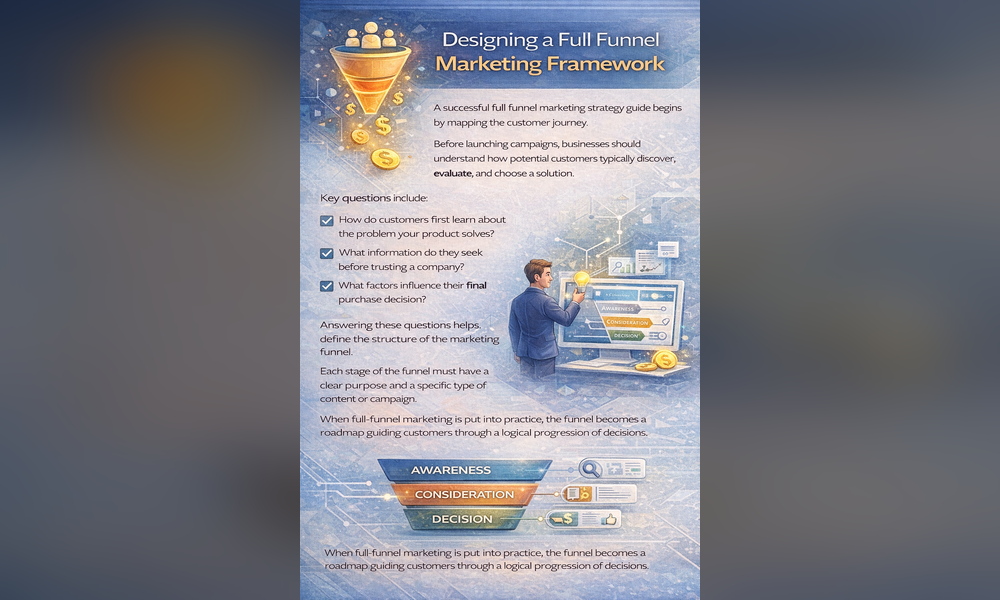
A successful full funnel marketing strategy guide begins by mapping the customer journey.
Before launching campaigns, businesses should understand how potential customers typically discover, evaluate, and choose a solution.
Key questions include:
How do customers first learn about the problem your product solves?
What information do they seek before trusting a company?
What factors influence their final purchase decision?
Answering these questions helps define the structure of the marketing funnel.
Each stage of the funnel must have a clear purpose and a specific type of content or campaign.
When full-funnel marketing is put into practice, the funnel becomes a roadmap guiding customers through a logical progression of decisions.
Creating Content for Every Stage of the Funnel
Content is the engine that drives full funnel marketing.
Different types of content are needed at different stages because customer intent evolves throughout the journey.
At the awareness stage, content should focus on education.
This might include blog articles, industry insights, or explanatory videos.
At the consideration stage, prospects want more detailed information about possible solutions.
Content at this stage may include comparison guides, webinars, or case studies.
At the decision stage, marketing materials should provide reassurance and clarity.
Examples include product demonstrations, testimonials, and free consultations.
When businesses align content with each stage, prospects move naturally toward conversion.
Building Lead Nurturing Systems
Many companies generate leads but fail to nurture them effectively.
Not every prospect is ready to purchase immediately.
Some leads require weeks or months of communication before making a decision.
Lead nurturing is therefore a critical component of a full-funnel marketing strategy.
Nurturing systems typically involve automated communication sequences such as:
Educational email series
Product update messages
Industry insights
Event invitations
These communications maintain engagement and gradually build trust.
At Your Cloud Hub, we often design nurturing workflows that adapt messaging based on prospect behavior and engagement levels.
Using Marketing Automation in Full Funnel Marketing
Automation plays a vital role in scaling full-funnel marketing.
Without automation, maintaining consistent communication across hundreds or thousands of leads becomes impossible.
Marketing automation tools allow businesses to:
Send personalized messages automatically
Segment audiences based on behavior
Trigger follow-ups after specific actions
Track engagement across channels
For example, if a visitor downloads a guide, the system can automatically send additional resources related to that topic.
Automation ensures that prospects receive relevant information without requiring constant manual effort.
Aligning Paid Advertising with the Funnel
Paid advertising is often used primarily for lead generation.
However, advertising campaigns can support every stage of a full funnel marketing strategy.
Top-of-funnel advertising may focus on brand awareness and educational content.
Middle-of-funnel ads may promote webinars, case studies, or detailed product information.
Bottom-of-funnel advertising may include retargeting campaigns that encourage prospects to schedule consultations or complete purchases.
Retargeting is particularly powerful because it allows businesses to reconnect with prospects who have already shown interest.
When advertising aligns with the funnel stages, marketing investment becomes more efficient.
Integrating Organic and Paid Channels
A strong full-funnel marketing strategy guide integrates both organic and paid channels.
Organic marketing builds authority and long-term visibility.
Paid marketing accelerates exposure and testing.
For example, blog articles optimized for search engines may attract new audiences over time.
Paid campaigns can amplify the reach of these articles and generate faster traffic.
Combining both channels creates a balanced marketing system.
At Your Cloud Hub, we frequently design strategies in which organic content supports authority-building while paid campaigns accelerate lead generation.
Personalization in Funnel Marketing
Modern marketing strategies increasingly rely on personalization.
Customers expect messages tailored to their needs and interests.
Personalization can be achieved by analyzing user behavior, such as:
Pages visited
Content downloaded
Emails opened
Products viewed
Based on this information, businesses can deliver targeted messages.
For instance, a prospect researching pricing options may receive a follow-up message offering a consultation.
Personalization strengthens engagement and improves conversion rates within full funnel marketing systems.
Optimizing the Conversion Stage
Conversion optimization focuses on removing friction at the bottom of the funnel.
Prospects who are close to making a decision often need reassurance.
Effective conversion strategies include:
Clear pricing explanations
Customer testimonials
Guarantees or risk-reduction offers
Product demonstrations
Simplifying the decision-making process helps prospects move from interest to commitment.
When full funnel marketing is explained in operational terms, the conversion stage is where trust becomes revenue.
Retention as a Funnel Extension
Retention strategies are often overlooked in marketing discussions.
However, retaining existing customers can be more profitable than acquiring new ones.
After the purchase stage, businesses should continue nurturing relationships through:
Customer onboarding programs
Educational resources
Exclusive offers
Community engagement
Satisfied customers are more likely to become repeat buyers and brand advocates.
Retention strategies extend the benefits of a full funnel marketing strategy beyond the initial sale.