

Artificial intelligence has moved from research labs into everyday business operations. Organizations are using machine learning to forecast demand, detect fraud, personalize customer experiences, automate workflows, and improve business decisions at scale. While building a machine learning model is an important milestone, it represents only a small part of the overall AI journey. The real challenge begins after the model is deployed into production, where it must remain accurate, reliable, secure, and cost-effective over time.
This is where MLOps, or Machine Learning Operations, becomes essential. MLOps brings together machine learning, software engineering, and operational best practices to help businesses manage the complete lifecycle of AI systems. Instead of treating machine learning as a one-time development project, MLOps creates repeatable processes for versioning models, monitoring performance, managing infrastructure, controlling costs, and ensuring AI continues delivering value as business requirements evolve.
As more organizations deploy AI across multiple departments, the need for structured MLOps strategies continues to grow. Businesses are discovering that successful AI is not determined only by model accuracy. Long-term success depends on how well those models are maintained, monitored, updated, and governed after deployment.
At Your Cloud Hub, we help businesses build scalable AI environments that extend beyond model development. Whether organizations choose to hire an AI engineer, collaborate with experienced AI specialists, work with AI developers for hire, hire machine learning experts, or expand their teams by hiring a machine learning developer, understanding MLOps is becoming one of the most important steps toward building enterprise-ready artificial intelligence.
Why Building an AI Model Is Only the Beginning
Many businesses assume that once a machine learning model achieves high accuracy during testing, the project is complete. In reality, deployment marks the beginning of a much longer journey. Real-world environments are constantly changing. Customer behavior evolves, market conditions shift, new products are introduced, and business processes improve over time. These changes directly influence how AI models perform after they enter production.
A model that performs exceptionally well today may gradually become less accurate if it continues using outdated data or operates under conditions that differ from its original training environment. Without proper management, organizations may continue relying on predictions that no longer reflect current business realities.
MLOps addresses this challenge by introducing structured processes that monitor model performance, identify problems early, and support continuous improvement throughout the entire lifecycle.
Businesses that hire AI engineer professionals increasingly recognize that successful AI requires ongoing operational management rather than occasional technical maintenance.
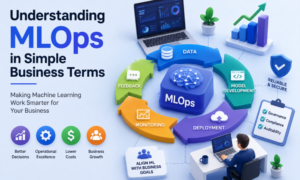
Understanding MLOps in Simple Business Terms
MLOps can sound highly technical, but its purpose is straightforward.
Imagine building a new manufacturing facility.
Constructing the building is only one part of the project.
The facility must also be maintained.
Equipment requires monitoring.
Processes need quality control.
Operations require continuous improvement.
Machine learning works the same way.
Creating the model is comparable to constructing a building.
MLOps keeps everything operating efficiently after deployment.
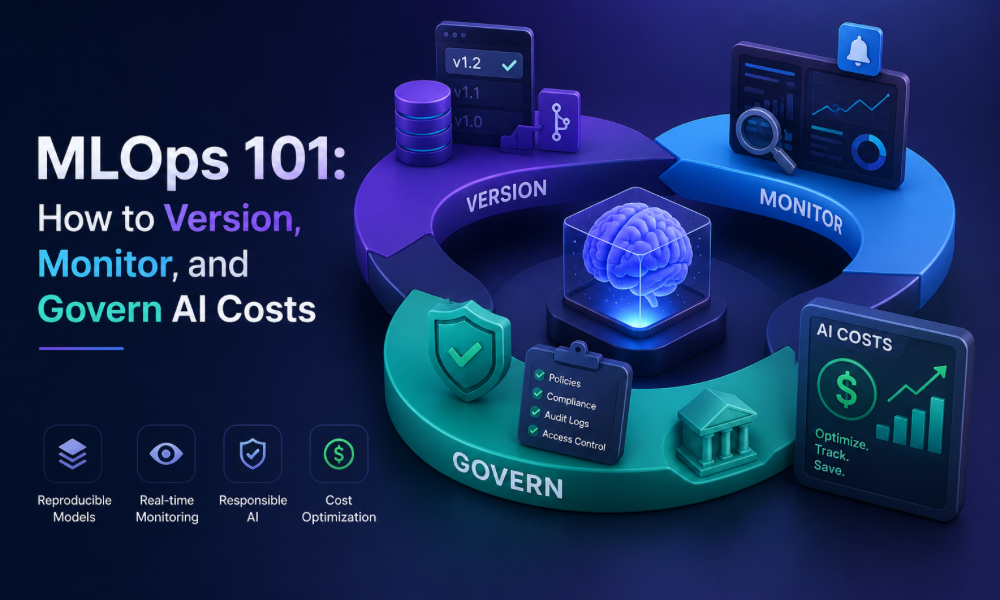
It introduces processes for managing model versions, monitoring predictions, updating datasets, improving performance, reducing operational risks, and controlling infrastructure costs.
Organizations working with experienced AI specialists frequently adopt MLOps because it transforms machine learning from isolated experiments into reliable business systems that support long-term growth.
Model Versioning Creates Stability and Accountability
One of the first principles of MLOps is version control.
Machine learning models evolve continuously.
Training data changes.
Algorithms improve.
Features are added.
Hyperparameters are adjusted.
Without proper versioning, businesses quickly lose track of which model is currently deployed and why previous versions performed differently.
Model versioning creates accountability by documenting every important change made throughout development.
Teams know exactly which dataset trained a specific model.
Which parameters were used?
When deployment occurred.
Who approved the release?
If performance declines after deployment, version history makes it much easier to identify the source of the problem and restore previous models if necessary.
Organizations that choose AI developers for hire often prioritize version control because it reduces operational risk while making collaboration across development teams significantly more efficient.
Monitoring AI Models Protects Business Performance
Unlike traditional software, machine learning models continue interacting with changing data long after deployment.
This means model performance should never be assumed.
It must be measured continuously.
Monitoring helps businesses evaluate prediction accuracy, response times, infrastructure health, data quality, and user interactions.
More importantly, monitoring identifies model drift.
Model drift occurs when incoming data gradually changes compared to the information used during training.
Customer preferences may evolve.
Economic conditions may shift.
Operational processes may change.
As these changes accumulate, prediction quality can decline.
Businesses investing to hire machine learning experts often implement continuous monitoring systems that detect these issues before they affect customer experiences or business decisions.
Rather than waiting until problems become visible, monitoring provides early warnings that allow organizations to retrain or update models proactively.
Managing AI Costs Is Becoming a Business Priority
As AI adoption expands, infrastructure costs have become one of the biggest concerns for business leaders.
Training large machine learning models requires significant computing resources.
Inference workloads consume cloud capacity.
Data storage continues growing.
API usage increases.
Without governance, AI expenses can rise much faster than expected.
MLOps introduces financial discipline by helping organizations understand where AI resources are being consumed and whether those resources generate measurable business value.
Businesses that hire machine learning developer professionals frequently build monitoring systems that track infrastructure utilization, cloud spending, model usage, and operational efficiency.
Instead of optimizing only technical performance, modern MLOps also focuses on optimizing financial performance.
AI should deliver a return on investment rather than simply consuming computational resources.
Automation Makes AI Easier to Maintain
One of the greatest advantages of MLOps is automation.
Manual deployment processes become increasingly difficult as organizations expand their AI initiatives.
Teams cannot realistically manage dozens or hundreds of machine learning models through manual processes alone.
Automation simplifies routine operational tasks.
Model deployment.
Testing.
Validation.
Performance monitoring.
Retraining.
Infrastructure scaling.
Notification systems.
Instead of relying on manual intervention, businesses build repeatable workflows that improve reliability while reducing operational workloads.
At Your Cloud Hub, we encourage organizations to automate operational processes wherever practical because consistent automation reduces human error while allowing technical teams to focus on innovation rather than repetitive maintenance.
Governance Builds Trust in Enterprise AI
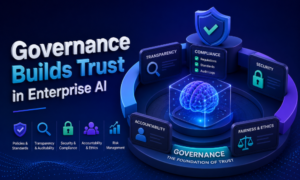
As artificial intelligence becomes responsible for increasingly important business decisions, governance has become essential.
Organizations need clear visibility into how models are developed, approved, deployed, monitored, and updated.
Governance also supports compliance, security, accountability, and responsible AI practices.
Business leaders need confidence that AI systems operate transparently and consistently.
Employees need confidence that recommendations remain reliable.
Customers expect fair, accurate, and secure AI experiences.
Strong governance frameworks help establish this trust while supporting sustainable AI adoption across the organization.
Businesses choosing to hire an AI engineer, collaborate with experienced AI specialists, work with AI developers for hire, invest to hire machine learning experts, or expand through a hire machine learning developer understand that governance is not an obstacle to innovation—it is the foundation that allows innovation to scale responsibly.
MLOps Is Becoming the Backbone of Enterprise AI
Artificial intelligence is no longer judged only by how intelligent a model appears during development. Businesses now evaluate AI based on reliability, scalability, operational efficiency, governance, and measurable business impact.
MLOps brings all of these elements together into one structured framework.
Versioning ensures every model change is documented.
Monitoring protects performance.
Governance builds trust.
Cost management supports long-term sustainability.
Automation improves operational efficiency.
At Your Cloud Hub, we believe MLOps represents the future of enterprise AI because it transforms machine learning from isolated projects into dependable business capabilities. Organizations that choose to hire an AI engineer, collaborate with experienced AI specialists, work with AI developers for hire, hire machine learning experts, or hire machine learning developer professionals will be better prepared to build AI systems that remain accurate, cost-effective, and scalable long after deployment.
Data Quality Is the Hidden Factor Behind Successful MLOps
When businesses discuss artificial intelligence, most conversations focus on algorithms, neural networks, or the latest machine learning frameworks. While these technologies are important, they often overshadow one of the biggest factors influencing AI performance: data quality. Even the most sophisticated machine learning model cannot consistently produce reliable predictions if the information it receives is incomplete, outdated, inconsistent, or inaccurate.
This is why MLOps places a strong emphasis on monitoring not only the model but also the data flowing into it. Businesses need to know whether customer behavior has changed, whether important fields are missing from incoming datasets, whether external data sources are still reliable, and whether new information follows the same patterns used during training. Detecting these issues early prevents declining model performance before it begins affecting customers or business operations.
Organizations that choose to hire AI engineer professionals understand that maintaining high-quality data is an ongoing responsibility rather than a one-time project. Data pipelines require continuous validation, regular audits, and automated quality checks to ensure that AI models continue receiving trustworthy information. At Your Cloud Hub, we often remind businesses that improving data quality frequently delivers greater long-term value than constantly replacing existing machine learning models. Reliable data creates reliable AI.
Continuous Monitoring Helps Businesses Stay Ahead of Problems
Unlike traditional software, machine learning models are influenced by the environment in which they operate. Customer preferences evolve, economic conditions shift, competitors introduce new products, and seasonal trends affect purchasing behavior. All of these changes influence the quality of predictions generated by AI systems.
Without continuous monitoring, organizations may continue relying on models that gradually become less accurate without realizing it. By the time poor performance becomes visible, valuable opportunities may already have been lost.
A mature MLOps strategy introduces continuous monitoring across every stage of production. Businesses monitor prediction accuracy, response times, infrastructure performance, data consistency, and user interactions simultaneously. Instead of waiting for customers to report problems, technical teams receive early warnings whenever unusual behavior begins appearing within the system.
Companies working with experienced AI specialists recognize that monitoring is not simply about identifying failures. It also provides valuable insights into how customers interact with AI applications, which features deliver the greatest business value, and where future improvements should be prioritized. Continuous visibility allows organizations to make proactive decisions rather than react after performance declines.
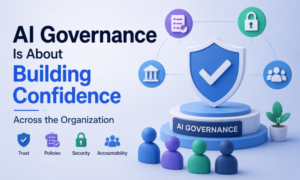
AI Governance Is About Building Confidence Across the Organization
Artificial intelligence is increasingly influencing important business decisions. Sales forecasts, financial planning, customer recommendations, fraud detection, healthcare analysis, and operational automation all depend on machine learning systems making reliable predictions. As AI becomes more deeply integrated into business operations, executives need confidence that these systems operate responsibly and transparently.
Governance within MLOps creates that confidence.
It establishes clear processes for approving new models before deployment, documenting changes, monitoring ongoing performance, controlling access to sensitive data, and ensuring that AI systems align with organizational policies. Instead of allowing AI development to happen without oversight, governance introduces accountability at every stage of the lifecycle.
Businesses that hire AI developers for hire often benefit from professionals who already understand these governance practices because enterprise AI projects require much more than technical implementation. Every model should be traceable, every deployment should be documented, and every significant change should follow structured review processes. This level of discipline protects businesses while making AI adoption more sustainable over the long term.
Managing Infrastructure Efficiently Reduces AI Costs
One of the fastest-growing concerns among organizations adopting artificial intelligence is operational cost. Cloud infrastructure, model training, GPU resources, storage, and inference requests all contribute to ongoing AI expenses. Without proper oversight, businesses may find that operational costs increase much faster than the value generated by their AI systems.
MLOps introduces cost governance by helping organizations understand how infrastructure is being used and whether those resources are delivering measurable business outcomes. Instead of running expensive computing environments continuously, businesses can optimize workloads, automate resource allocation, archive unused models, and schedule retraining only when necessary.
Organizations that hire machine learning experts frequently build dashboards that combine technical performance with financial metrics. This allows leadership teams to evaluate not only whether a model is accurate but also whether it remains economically sustainable. AI should improve efficiency, reduce manual work, and increase business value. Cost monitoring ensures these objectives remain aligned as AI adoption expands throughout the organization.
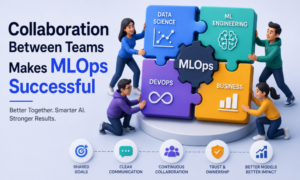
Collaboration Between Teams Makes MLOps Successful
Artificial intelligence projects rarely succeed when data scientists, software developers, infrastructure engineers, and business leaders work independently. Modern AI requires collaboration between multiple disciplines, each contributing unique expertise throughout the lifecycle of the solution.
Data scientists focus on developing and improving machine learning models. Software engineers integrate those models into production applications. Cloud architects ensure infrastructure remains scalable and reliable. Security teams protect sensitive information. Business stakeholders define objectives and measure success.
MLOps provides the framework that allows these diverse teams to work together efficiently. Shared workflows, version control, deployment pipelines, monitoring systems, and documentation help eliminate communication gaps while ensuring every team works toward common business goals.
Businesses choosing to hire machine learning developer professionals often look for individuals who understand both machine learning and production software development. These hybrid skills become increasingly valuable because successful AI requires more than building accurate models—it requires deploying, maintaining, and improving them within real business environments.