
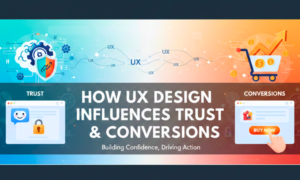
Design Is Not Decoration — It Is a Trust Mechanism
Most businesses think UX design is about aesthetics.
Color schemes.
Layouts.
Animations.
Modern visuals.
But in 2026, UX design plays a much deeper role.
It determines:
• Whether users trust you
• Whether they stay or leave
• Whether they convert or hesitate
• Whether they perceive professionalism or risk
At yourcloudhub, we consistently see that conversion problems are rarely traffic problems. They are trust problems. And trust is heavily shaped by user experience.
UX design is no longer optional polish. It is revenue infrastructure.
What UX Design Really Means in 2026
User Experience Design is not just a visual presentation. It includes:
• Navigation clarity
• Page speed
• Information structure
• Interaction feedback
• Mobile usability
• Form simplicity
• Content readability
UX is the feeling users get when interacting with your digital presence.
That feeling determines whether they move forward.
Trust Is Formed in Seconds
Research and behavioral data consistently show that users form impressions within moments of landing on a digital marketing, software development, website development,
They subconsciously evaluate:
• Is this site modern
• Is it organized
• Does it load quickly
• Does it feel stable
• Does it look credible
If the answer is unclear, hesitation begins.
At yourcloudhub, we treat UX as the first layer of trust-building, before content even gets read.
The Psychology Behind UX and Trust
Trust online is built through three psychological signals:
1. Competence
2. Stability
3. Clarity
UX influences all three.
Competence is reflected in structure and polish.
Stability is reflected in performance and consistency.
Clarity is reflected in layout and messaging flow.
Poor UX disrupts these signals immediately.
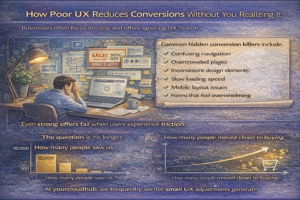
How Poor UX Reduces Conversions Without You Realizing It
Businesses often focus on copy and offers, ignoring UX friction.
Common hidden conversion killers include:
• Confusing navigation
• Overcrowded pages
• Inconsistent design elements
• Slow loading speed
• Mobile layout issues
• Forms that feel overwhelming
Even strong offers fail when users experience friction.
At yourcloudhub, we frequently see that small UX adjustments generate larger conversion lifts than messaging tweaks alone.
The Relationship Between UX and Perceived Risk
Every online decision carries perceived risk.
When users consider:
• Filling out a form
• Booking a call
• Entering payment details
They subconsciously assess safety.
UX design reduces perceived risk by:
• Using consistent visual patterns
• Providing clear next steps
• Showing transparency
• Avoiding aggressive pop-ups
• Maintaining structured spacing
A chaotic interface increases cognitive load and perceived danger.
Why Simplicity Converts Better
Cluttered design overwhelms users.
Simplicity:
• Reduces decision fatigue
• Improves comprehension
• Speeds up action
• Creates calm
High-converting UX is not flashy. It is intentional.
At yourcloudhub, we often remove elements rather than add them when optimizing for trust.
Clarity is persuasive.
Mobile UX Is Now the Primary Trust Layer
Most users first interact on mobile devices.
Mobile UX determines:
• Whether scrolling feels smooth
• Whether buttons are easy to tap
• Whether forms are readable
• Whether text is legible
If mobile UX is neglected, trust deteriorates instantly.
Yourcloudhub prioritizes mobile-first design because friction on smaller screens compounds faster.
Speed as a UX Trust Signal
Slow websites create doubt.
Users associate slow performance with:
• Poor maintenance
• Technical instability
• Lower reliability
Fast performance communicates competence.
UX design must integrate performance strategy rather than treat it as a separate concern.
Trust increases when interactions feel immediate and responsive.
Navigation Clarity and Decision Confidence
When users cannot find what they need quickly, uncertainty increases.
Effective navigation:
• Uses clear labels
• Avoids overwhelming menus
• Guides users logically
• Reduces search effort
Navigation is not about showing everything.
It is about guiding intention.
UX and Content Alignment
Even strong content fails when layout disrupts readability.
UX improves content impact by:
• Using clear heading hierarchy
• Structuring sections logically
• Limiting paragraph length
• Highlighting key points
• Maintaining visual breathing space
At yourcloudhub, content and UX are treated as integrated systems.
Design amplifies messaging.
Form UX and Conversion Psychology
Forms are critical trust checkpoints.
High-performing form UX includes:
• Minimal required fields
• Clear explanation of why data is requested
• Logical progression
• Visible progress indicators
• Immediate confirmation feedback
Complicated forms increase abandonment rates dramatically.
Trust increases when the user feels respected and guided.
Visual Consistency and Brand Authority
Inconsistent fonts, colors, and layouts reduce credibility.
Consistency communicates:
• Professionalism
• Attention to detail
• Organizational maturity
Yourcloudhub treats visual consistency as a strategic trust asset rather than a cosmetic preference.
Micro-Interactions and Emotional Reassurance
Subtle interaction feedback matters:
• Button animations
• Hover states
• Confirmation messages
• Loading indicators
These micro-interactions reassure users that the system is functioning.
Lack of feedback creates uncertainty.
UX and SEO Are Connected
Google evaluates user experience signals such as:
• Bounce rate
• Dwell time
• Page interaction
• Core Web Vitals
Poor UX reduces engagement, which, in turn, affects search performance.
Optimizing UX improves both conversion and visibility.
The Role of Transparency in UX Design
Trust increases when users see:
• Clear pricing structure
• Visible contact information
• Detailed service explanations
• Honest FAQs
• Accessible support options
Hidden information creates suspicion.
Clear UX design communicates openness.
UX and Sales Alignment
Strong UX reduces friction before sales conversations.
When users:
• Understand the offer clearly
• Navigate easily
• Experience smooth booking
Sales calls become more productive.
Sales teams often report better-qualified prospects when UX is optimized.
At yourcloudhub, UX optimization frequently shortens sales cycles.
Why Good UX Lowers Acquisition Costs
Better UX leads to:
• Higher conversion rates
• Lower bounce rates
• Increased return visits
• Higher engagement
This means:
• Paid ads become more efficient
• Organic traffic performs better
• Retargeting becomes more effective
UX amplifies marketing investment.
The Competitive Advantage of Trust-Based UX
Many competitors focus on visibility.
Few focus deeply on trust mechanics.
In crowded markets, UX can become a differentiator.
Users choose businesses that feel:
• Stable
• Clear
• Professional
• Easy to work with
These feelings are shaped primarily by design.
Measuring UX Impact
UX influence can be measured through:
• Conversion rate changes
• Reduced bounce rate
• Increased time on site
• Improved funnel completion
• Lower cart abandonment
UX improvements should tie directly to measurable outcomes.
At yourcloudhub, we connect design refinements to revenue performance, not aesthetic preference.
Common UX Mistakes That Destroy Trust
• Overuse of pop-ups
• Confusing call-to-action placement
• Hidden navigation
• Autoplay media
• Inconsistent branding
• Overcomplicated forms
Each of these adds friction.
Trust erodes gradually with every small frustration.
UX Is the Silent Salesperson
UX design speaks before your sales team does.
It answers:
• Are you credible
• Are you organized
• Are you trustworthy
• Are you easy to work with
In 2026, when attention is scarce and competition is intense, trust determines conversion.
At yourcloudhub, we believe UX is not just about making websites look good.
Why Most UX Improvements Fail to Deliver Business Impact
Many companies redesign their websites every two or three years.
They change colors.
They update layouts.
They modernize typography.
And then they expect conversions to improve.
When results stay flat, they assume design does not influence revenue.
The truth is different.
Redesigns fail when they focus on visual refreshes rather than behavioral clarity.
At yourcloudhub, we approach UX from a performance-first perspective. Design decisions must answer one question:
Does this reduce friction or increase confidence?
If the answer is unclear, the redesign will not meaningfully influence conversions.
The Trust Equation in Digital Experiences
Trust online is built through a combination of:
Clarity plus Consistency plus Predictability.
When users interact with your platform, they are constantly scanning for signals that answer:
Is this safe
Is this reliable
Is this professional
Is this aligned with what I need
UX design either strengthens or weakens these signals.
Every inconsistency introduces doubt.
Every moment of friction reduces confidence.
Cognitive Load and Decision Fatigue
One of the most powerful but overlooked UX principles is cognitive load.
Cognitive load refers to the mental effort required to process information.
When websites are overloaded with:
Too many choices
Too many navigation options
Dense text blocks
Multiple calls to action
Users experience fatigue.
Fatigue leads to hesitation.
Hesitation reduces conversions.
High-performing UX simplifies decision pathways.
At yourcloudhub, we often reduce on-page options before adjusting messaging, because clarity accelerates commitment.
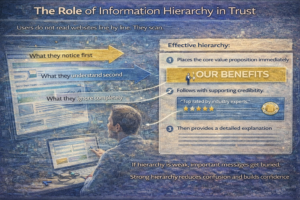
The Role of Information Hierarchy in Trust
Users do not read websites line by line.
They scan.
Information hierarchy determines:
What they notice first
What they understand second
What they ignore completely
Effective hierarchy:
Places the core value proposition immediately
Follows with supporting credibility
Then provides a detailed explanation
If hierarchy is weak, important messages get buried.
Strong hierarchy reduces confusion and builds confidence quickly.
Above-the-Fold Design and First Impressions
The first screen users see shapes perception instantly.
Above-the-fold elements should communicate:
Who you help
What problem do you solve
What action to take next
Common mistakes include:
Overly abstract headlines
Vague branding statements
Cluttered hero sections
Excessive animation
Users should never have to interpret what your company does.
Clarity builds trust faster than creativity.
At yourcloudhub, we emphasize direct communication over decorative complexity.
Micro-Commitments and Momentum Building
Conversion is rarely a single leap.
It is a series of small agreements.
UX can guide users through micro-commitments such as:
Scrolling
Clicking to expand details
Viewing testimonials
Starting a form
Each completed micro-action increases psychological commitment.
Design should encourage momentum, not stall it.
This is especially critical for high-ticket services where buyers require reassurance before committing.
Social Proof Placement and Trust Amplification
Testimonials and case studies increase trust, but placement matters.
Poor placement reduces impact.
Effective UX integrates social proof:
Near pricing
Near call-to-action buttons
Within objection-heavy sections
Users need reassurance at moments of uncertainty.
Random testimonial placement weakens persuasive power.
At yourcloudhub, we strategically map trust signals rather than scatter them across pages.
Visual Stability and Perceived Professionalism
Layout shifts, flashing elements, and unexpected movement reduce perceived stability.
Stability signals reliability.
Inconsistent alignment, spacing issues, and irregular typography subconsciously communicate a lack of precision.
Professional design feels stable and intentional.
Trust grows when the interface feels controlled and predictable.
Transparency as a UX Strategy
Trust increases when users feel informed rather than persuaded.
UX transparency includes:
Clear pricing explanations
Straightforward service descriptions
Direct answers to common objections
Visible contact information
Hidden information increases skepticism.
Clear navigation to details reduces suspicion.
Yourcloudhub encourages radical clarity because clarity converts.
UX and Emotional Friction
Emotional friction occurs when users feel:
Confused
Overwhelmed
Pressured
Uncertain
Design decisions influence emotional states.
For example:
Aggressive countdown timers create pressure
Excessive pop-ups create annoyance
Complex forms create overwhelm
Trust-based UX reduces emotional stress rather than artificially increasing urgency.
Sustainable conversions are built on confidence, not pressure.
Form UX as a Conversion Gatekeeper
Forms represent one of the highest-friction points in digital journeys.
Improving the form UX can significantly increase conversion rates.
Best practices include:
Clear field labels
Minimal required inputs
Inline validation
Progress indicators for multi-step forms
Immediate confirmation feedback
Users should feel guided, not interrogated.
At yourcloudhub, form optimization often delivers measurable ROI improvements faster than content changes.
The Relationship Between UX and Brand Authority
Authority is reinforced visually.
Strong authority signals include:
Clean typography
Consistent branding
Structured layouts
High-quality visuals
Logical flow
Disorganized design weakens authority perception.
In competitive markets, authority determines who receives inquiries.
UX influences authority more than most businesses realize.
UX Testing and Continuous Optimization
Design should never be static.
Behavioral testing reveals:
Where users drop off
Where they hesitate
Where confusion increases
Where engagement improves
Continuous testing might include:
Adjusting button placement
Simplifying navigation
Shortening content sections
Repositioning testimonials
Optimization is incremental.
At yourcloudhub, we treat UX as a living system that evolves with audience behavior.
The Link Between UX and Retention
Trust-based UX not only improves first-time conversions but also drives repeat purchases.
It increases retention.
When clients experience:
Clear onboarding
Easy navigation
Structured support access
Consistent communication
They are more likely to return.
Retention reduces acquisition pressure.
UX is part of a long-term customer lifetime value strategy.
UX and Perceived Value
Design influences how expensive or affordable a service feels.
Premium design increases perceived value.
Poor design decreases willingness to invest.
Perception shapes pricing flexibility.
Businesses with strong UX often command higher pricing without resistance.
At yourcloudhub, we align UX improvements with positioning strategy to strengthen perceived value.
Eliminating Friction Across the Funnel
Trust must remain consistent across:
Landing pages
Service pages
Booking pages
Checkout flows
Confirmation pages
Inconsistency between steps creates doubt.
Each stage should reinforce the same professionalism and clarity.
Funnel consistency improves conversion stability.
Mobile Trust Signals
On mobile, trust signals become more sensitive.
Small screens magnify design flaws.
Elements must be:
Readable
Accessible
Properly spaced
Quick to load
Mobile UX should feel effortless.
If mobile experience is neglected, conversion potential shrinks dramatically.
UX as a Competitive Moat
Most businesses focus on traffic acquisition.
Few invest deeply in friction reduction.
This creates opportunity.
Superior UX becomes difficult for competitors to replicate quickly.
It requires discipline, testing, and alignment.
At yourcloudhub, we view UX as a long-term competitive asset rather than a one-time upgrade.
Measuring UX Influence on Revenue
To connect UX with business outcomes, track:
Conversion rate before and after adjustments
Average session duration
Form completion rate
Bounce rate reduction
Sales cycle compression
UX improvements should correlate with measurable shifts.
Design decisions must link to data.
Trust Is Built Through Experience
Users do not evaluate businesses solely by words.
They evaluate by experience.
Does the site feel stable?
Does navigation make sense
Does the interaction feel smooth
Does design feel intentional
Trust forms in moments.
Conversion follows trust.
At yourcloudhub, UX is treated as a strategic growth lever, not a cosmetic exercise.