
Organic vs Paid Marketing in 2026
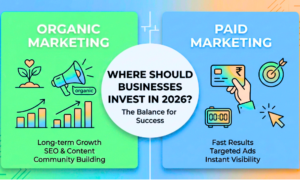
In 2026, businesses should recognize that organic and paid marketing are most powerful when used together. Combining these strategies drives stronger, more sustainable growth.
Paid marketing generates immediate visibility and rapid lead flow. Organic marketing builds long-term authority, trust, and predictable traffic.
Industry leaders invest in paid channels for acceleration and organic channels for sustained growth.
At yourcloudhub, we counsel businesses to leverage paid marketing as a tactical growth engine and organic marketing as a strategic visibility asset.
A thorough understanding of each channel’s behavior in the modern AI-driven search environment is indispensable before allocating budget.
The Marketing Landscape Has Changed
The marketing environment of 2026 is very different from five years ago.
Several major shifts are influencing how businesses attract customers:
AI search summaries are reducing clicks
Rising advertising costs
Fragmented attention across platforms
Greater importance of brand authority
Higher competition in every niche
Because of these changes, simply choosing one marketing approach is rarely effective.
Businesses must understand when organic growth compounds and when paid traffic accelerates.
At yourcloudhub, we architect marketing systems that harmonize immediate demand generation with long-term brand visibility.
What Organic Marketing Means in 2026
Organic marketing refers to visibility that does not require direct payment for each interaction.
Some examples are search engine optimization, content marketing, authority building, organic social media reach, email list growth, and community engagement. Organic growth relies on trust and authority rather than immediate campaign results. Unlike paid efforts, momentum takes time to develop. However, once organic visibility is established, it delivers leads with minimal extra cost.
The Real Strength of Organic Marketing
Organic marketing builds a durable market presence.
When your business consistently appears in:
Search results
Industry discussions
Educational content
AI-generated summaries
You become recognized as a trusted source.
Authority compounds over time.
Organic marketing also increases:
Brand recall
Direct website traffic
Referral mentions
Long-term lead quality
At yourcloudhub, we emphasize that organic growth is fundamentally about constructing a resilient and enduring digital presence.
The Limitations of Organic Marketing
Organic marketing is powerful, but it has limitations.
Achieving results with organic marketing takes time, consistency, significant content investment, ongoing technical optimization, and strategic patience.
New businesses often struggle with organic visibility because search engines and audiences require proof of authority before ranking content prominently.
This delay creates a challenge.
Businesses need leads now, not just in twelve months.
This is where paid marketing enters the strategy.
Understanding Paid Marketing
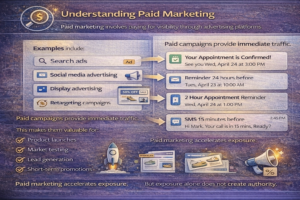
Paid marketing involves paying for visibility through advertising platforms.
Examples include:
Search ads
Social media advertising
Display advertising
Retargeting campaigns
Sponsored placements
Paid campaigns provide immediate traffic.
This makes them valuable for:
Product launches
Market testing
Lead generation
Short-term promotions
Paid marketing accelerates exposure.
But exposure alone does not create authority.
The Strength of Paid Marketing
Paid campaigns offer speed.
Businesses can launch ads today and generate leads immediately.
Fast market validation, immediate lead flow, audience testing, and campaign experimentation are all key advantages. Paid advertising further enables precise targeting.
Companies can reach audiences based on:
Location
Interests
Behavior
Search intent
When executed properly, paid marketing becomes a powerful demand generation tool.
The Weakness of Paid Marketing
Despite its speed, paid marketing has major limitations.
The biggest limitation is dependency.
When advertising stops, traffic stops.
Unlike organic visibility, paid traffic does not compound over time.
Advertising costs also increase continuously due to competition.
Many industries now face rising:
Cost per click
Cost per lead
Cost per acquisition
Businesses relying exclusively on paid traffic often face unstable marketing economics.
At yourcloudhub, we frequently see companies struggle when paid channels become their only source of growth.
The Cost Dynamics of Modern Marketing
Marketing investment should be evaluated through cost sustainability.
Organic marketing typically requires:
Content production
SEO optimization
Technical infrastructure
Strategic planning
But once authority grows, the cost per lead decreases significantly.
Paid marketing works differently.
With paid marketing, every lead requires ongoing advertising spend.
If the cost per acquisition exceeds lifetime customer value, campaigns become unsustainable.
Businesses must balance short-term speed with long-term efficiency.
Why Organic Authority Matters More in AI Search
AI search is changing discovery behavior.
Users increasingly receive summarized answers directly from AI systems.
These summaries often reference authoritative sources rather than listing dozens of websites.
This means authority matters more than ranking position alone.
Businesses that build trusted content ecosystems are more likely to appear in AI-generated responses.
At yourcloudhub, we guide companies to create authority-driven content strategies rather than relying solely on keyword targeting.
The Compounding Advantage of Organic Growth
Organic visibility behaves like compound interest.
Each article, guide, or insight strengthens domain authority.
Over time, businesses benefit from:
Increasing traffic stability
Higher quality leads
Lower acquisition cost
Stronger brand credibility
Unlike paid ads, organic growth continues working even when campaigns pause.
This long-term effect makes organic marketing essential for sustainable growth.
When Paid Marketing Makes Strategic Sense
Paid marketing is most valuable when speed matters.
Examples include:
Launching a new product
Entering a new market
Testing new offers
Generating early traction
Paid campaigns allow businesses to gather data quickly.
They help answer important questions such as:
Which audience converts best
Which messaging resonates
Which pricing structure performs strongest
These insights can then inform organic content strategy.
The Hybrid Growth Model
The most effective strategy is not organic versus paid.
It is organic plus paid.
Paid marketing accelerates visibility.
Organic marketing builds long-term authority.
A hybrid system allows businesses to:
Generate leads today
Build authority for tomorrow
Reduce long-term acquisition costs
At yourcloudhub, we design integrated marketing strategies in which paid campaigns propel organic growth, never merely substitute for it.
Building Infrastructure for Both Channels
Marketing success also depends on infrastructure.
A poorly structured website reduces performance for both organic and paid channels.
Strong alignment between website development, Software development, and Digital marketing ensures that traffic converts effectively.
Technical performance influences:
Search ranking
User engagement
Ad conversion rates
Page speed performance
Infrastructure must support growth before scaling traffic.
Strategic Budget Allocation in 2026
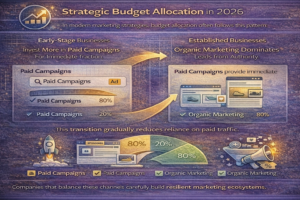
In modern marketing strategies, budget allocation often follows this pattern:
Early-stage businesses invest more in paid campaigns for immediate traction.
As authority grows, organic marketing becomes the dominant source of leads.
This transition gradually reduces reliance on paid traffic.
Companies that balance these channels carefully build resilient marketing ecosystems.
Growth Requires Both Speed and Stability
Paid marketing delivers speed.
Organic marketing delivers stability.
Businesses that rely only on paid traffic face rising costs and unpredictable performance.
Businesses that rely solely on organic growth often wait too long for traction.
The most effective strategy combines both.
At yourcloudhub, we help businesses design marketing systems that combine organic authority and paid acceleration.
Why Budget Allocation Matters More Than Channel Choice
One of the most common mistakes businesses make when discussing marketing investment is treating organic and paid marketing as isolated channels.
In reality, both channels influence each other.
Paid campaigns generate immediate demand and market data.
Organic marketing converts that data into long-term authority.
The challenge for most companies is not choosing between organic and paid marketing. The challenge is deciding how much to invest in each stage of growth.
At yourcloudhub, we instruct businesses to approach marketing budgets methodically. The optimal allocation is defined by business maturity, market landscape, and growth objectives.
The Three Stages of Marketing Investment
Businesses typically pass through three marketing stages.
Early growth
Expansion
Authority scale
Understanding these stages helps determine how organic and paid strategies should evolve.
Stage One: Early Growth
In the early stage, businesses often lack authority and visibility.
Search engines do not yet recognize the brand.
Content has not accumulated enough credibility.
Organic traffic remains limited.
During this phase, paid marketing plays a crucial role.
Advertising allows businesses to:
Test market demand
Identify high-converting audiences
Refine messaging
Generate initial revenue
Paid campaigns provide immediate feedback.
However, even at this stage, organic marketing should not be ignored.
Businesses should begin building:
Foundational content
SEO optimized pages
Educational resources
At yourcloudhub, we urge early-stage businesses to deploy paid campaigns for traction while systematically establishing organic foundations.
Stage Two: Expansion
As businesses begin gaining traction, their marketing strategy must evolve.
Organic visibility starts improving.
Content begins ranking in search results.
Brand awareness slowly increases.
During this stage, the goal is to reduce dependency on paid traffic.
Companies should focus on:
Content authority
Topic clusters
Long-form guides
Industry thought leadership
Paid campaigns should shift toward strategic acceleration rather than basic lead generation.
This means using ads for:
Retargeting
Product launches
Audience expansion
Balanced investment becomes critical during expansion.
At yourcloudhub, we help companies gradually shift marketing weight toward organic channels while maintaining paid momentum.
Stage Three: Authority Scale
In the authority stage, businesses have strong organic visibility.
They appear frequently in search results.
Their content receives backlinks and citations.
Brand search volume increases.
At this stage, organic marketing becomes the primary driver of growth.
Paid marketing still plays a role, but it becomes more targeted.
Instead of broad acquisition campaigns, paid channels focus on:
Retargeting high-intent visitors
Amplifying top-performing content
Launching new offers
Companies that reach this stage experience significantly lower acquisition costs.
Organic authority compounds.
The Impact of AI Search on Organic Strategy
Search engines are changing rapidly due to artificial intelligence.
AI systems now generate summaries that directly answer user questions.
This creates new challenges for organic traffic.
Some users receive answers without having to click through to websites.
However, this shift also creates opportunities.
AI systems prioritize trusted sources when generating responses.
Businesses that build authority and produce high-quality educational content are more likely to be referenced.
At yourcloudhub, we help organizations adapt content strategies for AI search by focusing on:
Answer-first content
Clear definitions
Structured explanations
Authority signals
Organic strategy must evolve alongside search technology.
Paid Advertising in an AI-Driven Market
While organic visibility faces new competition from AI summaries, paid advertising also faces challenges.
Advertising platforms are becoming more competitive.
Costs are rising because more businesses rely on ads for immediate traffic.
In many industries, cost per click has increased significantly.
Businesses that depend entirely on paid marketing face unstable economics.
When acquisition costs rise faster than revenue growth, profitability becomes difficult.
This is why organic authority is increasingly valuable.
It reduces long-term reliance on paid traffic.
How Paid Campaigns Should Support Organic Growth
Paid advertising should not operate independently from organic strategy.
Instead, it should support organic growth.
One powerful approach is to use paid campaigns to identify winning topics.
For example:
If a paid campaign promoting a specific article generates strong engagement, that topic may deserve deeper organic content.
Similarly, ads can reveal:
Which questions do audiences ask most often
Which messaging resonates
Which solutions attract interest
These insights guide organic content creation.
At yourcloudhub, we integrate paid campaign data into SEO strategy to accelerate authority building.
Retargeting: The Bridge Between Organic and Paid
Retargeting is one of the most effective ways to combine both marketing channels.
When visitors discover your brand through organic search, they may not convert immediately.
Retargeting ads help businesses reconnect with visitors.
This strategy increases conversion probability without constantly chasing new traffic.
Retargeting campaigns typically deliver higher ROI because they target users who are already familiar with the brand.
Organic traffic feeds retargeting audiences.
Paid campaigns nurture those audiences.
This synergy strengthens marketing efficiency.
Content as the Foundation of Organic Growth
Organic marketing ultimately depends on content quality.
Content must do more than attract search traffic.
It must demonstrate expertise.
Strong content answers real questions, explains complex topics clearly, and provides genuine insight.
At yourcloudhub, we encourage businesses to prioritize:
Deep educational guides
Practical frameworks
Industry insights
Thought leadership
Content that builds trust performs better in both traditional search and AI-driven discovery.
Measuring Marketing Effectiveness
Businesses must evaluate marketing investment using meaningful metrics.
For organic marketing, important indicators include:
Search visibility growth
Organic traffic trends
Backlink authority
Engagement time
For paid marketing, performance indicators include:
Cost per lead
Conversion rate
Return on ad spend
Customer acquisition cost
However, businesses should not evaluate these channels independently.
Instead, they must analyze how both channels contribute to overall revenue growth.
Integrated reporting provides clearer insights.
Long-Term Marketing Sustainability
Sustainable marketing strategies prioritize stability.
Businesses that rely exclusively on paid campaigns often face volatile growth.
Algorithm changes, rising ad costs, or platform restrictions can disrupt performance.
Organic marketing provides resilience.
Even if advertising campaigns pause, organic traffic continues delivering leads.
At yourcloudhub, we design marketing systems that remain stable even when individual channels fluctuate.
Diversification protects growth.
The Strategic Advantage of Brand Authority
One often overlooked benefit of organic marketing is brand authority.
When businesses consistently publish high-quality content, they become recognized experts in their field.
Authority produces several advantages:
Higher conversion rates
Greater trust from prospects
Stronger referral traffic
Increased partnership opportunities
Paid advertising alone rarely builds this level of credibility.
Organic presence establishes market leadership.
When Businesses Should Increase Paid Investment
Although organic marketing offers long-term benefits, there are moments when increasing paid investment makes sense.
Examples include:
Launching new products
Entering new geographic markets
Testing new positioning
Accelerating growth after funding rounds
Paid campaigns provide speed and experimentation.
But these campaigns should complement, not replace, organic authority building.
Building a Balanced Marketing Ecosystem
The most resilient businesses build balanced ecosystems.
Organic marketing produces steady demand.
Paid marketing amplifies opportunities.
Content attracts search traffic.
Retargeting converts hesitant visitors.
Authority increases trust.
When these elements work together, growth becomes predictable.
At yourcloudhub, we view marketing not as isolated campaigns but as interconnected systems.
Each channel supports the others.