


What Worked Yesterday Is Becoming a Liability
For the last decade, performance digital marketing has been the growth engine for countless SMEs. Paid ads, funnels, retargeting, and short-term ROI metrics helped businesses scale faster than ever before.
But as we move into 2026, a hard truth is becoming impossible to ignore:
Performance marketing alone is no longer a growth strategy — it’s a vulnerability.
At Your Cloud Hub, we see this shift across industries. Businesses that rely almost entirely on paid performance channels are facing rising costs, declining trust, algorithm dependency, and fragile growth models.
This article explains why performance marketing by itself is risky in 2026, what has fundamentally changed, and how SMEs can build more resilient, AI-ready growth systems without abandoning performance altogether.
Section 1: The Hidden Fragility of Performance-Only Growth Models
Performance Marketing Was Never Meant to Stand Alone
Performance marketing was designed as an accelerator, not a foundation.
Originally, it worked best when layered on top of:
• Strong brand trust
• Clear positioning
• Existing demand
• Organic visibility
Over time, many SMEs inverted this model. Performance marketing became the only growth engine — while brand, content, and authority were deprioritized.
That imbalance is now being exposed.
Rising Costs Are Not a Temporary Problem
One of the most obvious risks in 2026 is cost inflation.
Across platforms:
• Cost per click continues to rise
• Cost per lead fluctuates unpredictably
• Competition increases with AI-driven advertisers
But the deeper issue is this:
When performance marketing is your only channel, you have no pricing power.
Your Cloud Hub sees this pattern repeatedly — businesses forced to spend more just to maintain the same results, with no leverage to push back.
Algorithm Dependency Is a Strategic Risk
Performance marketing lives and dies by algorithms you do not control.
In 2026, platforms are:
• Changing targeting rules
• Limiting data visibility
• Prioritizing their own AI systems
• Shifting attribution models
A single algorithm update can:
• Break funnels overnight
• Destroy ROAS
• Cut lead volume without warning
When 80–90% of growth depends on paid performance, this isn’t just inconvenient — it’s dangerous.
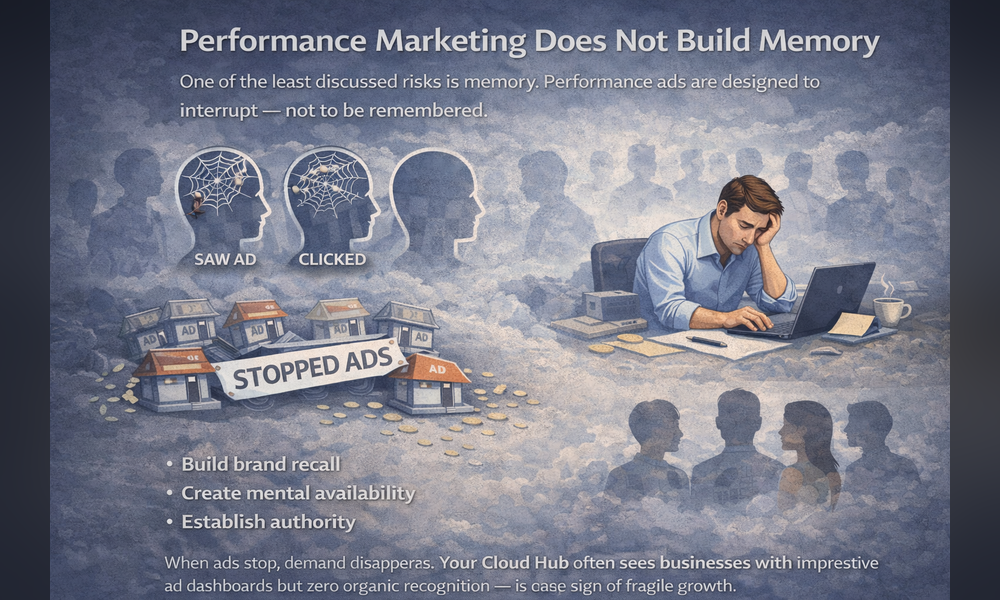
Performance Marketing Does Not Build Memory
One of the least discussed risks is memory.
Performance ads are designed to interrupt — not to be remembered.
Many SMEs generate leads but fail to:
• Build brand recall
• Create mental availability
• Establish authority
When ads stop, demand disappears.
Your Cloud Hub often sees businesses with impressive ad dashboards but zero organic recognition — a clear sign of fragile growth.
Trust Has Become the Real Conversion Factor
In 2026, buyers are more skeptical than ever.
They:
• Research across AI tools
• Compare multiple sources
• Avoid aggressive sales messaging
• Trust brands that educate, not push
Performance marketing alone struggles in low-trust environments because:
• Ads are assumed to be biased
• Claims are questioned
• Buyers seek third-party validation
Without authority and depth of content, conversion costs rise sharply.
AI Search Has Changed How Buyers Discover Brands
A major shift since 2024 is the rise of AI-mediated discovery.
Buyers increasingly:
• Ask ChatGPT or Gemini for recommendations
• Consume summarized answers instead of ads
• Trust synthesized expertise over sponsored messages
Performance ads are often invisible in these contexts.
If your brand does not exist outside paid placements, AI systems simply don’t surface you.
This is one of the biggest risks Your Cloud Hub helps businesses address.
Performance Metrics Can Create False Confidence
Dashboards look reassuring:
• CTRs
• CPLs
• ROAS
But these metrics often hide structural weakness.
They don’t show:
• Brand dependency on ads
• Declining trust signals
• Lack of organic authority
• Fragile demand generation
When performance dips, there is nothing underneath to catch the fall.
Short-Term Optimization Undermines Long-Term Growth
Performance marketing incentivizes:
• Quick wins
• Narrow targeting
• Aggressive messaging
• Funnel hacking
Over time, this can:
• Narrow audience perception
• Reduce brand credibility
• Burn out demand
Businesses optimized only for immediate conversion often struggle to expand later.
Customer Acquisition Without Retention Is Unsustainable
Another hidden risk is leaky growth.
Performance marketing excels at acquisition — but not at:
• Long-term engagement
• Loyalty
• Advocacy
When every sale requires another paid click, margins compress and growth stalls.
Your Cloud Hub frequently finds that performance-only businesses are stuck on a treadmill — running harder without moving forward.
Data Loss and Privacy Restrictions Are Accelerating
By 2026, privacy constraints have:
• Reduced tracking accuracy
• Weakened attribution
• Increased reliance on modeled data
Performance decisions are now based on estimates rather than certainty.
This makes performance-only strategies increasingly speculative.
When Performance Marketing Fails, It Fails Fast
The final risk is speed.
When performance breaks:
• It breaks immediately
• There is no buffer
• Recovery is expensive
Businesses with diversified growth systems adapt.
Performance-only businesses panic.
What Smart SMEs Are Doing Instead in 2026
Performance Marketing Is Still Valuable — But Only as a Layer
The takeaway is not to abandon performance marketing.
It is to demote it from a foundation to an accelerator.
High-resilience SMEs treat performance as:
• A distribution layer
• A testing mechanism
• A demand amplifier
Not as the sole source of growth.
Authority Has Become the New Moat
In 2026, authority compounds.
Authority means:
• Being referenced by AI tools
• Being recognized without ads
• Being trusted before the click
Your Cloud Hub emphasizes authority-building because it:
• Lowers acquisition costs
• Improves conversion quality
• Reduces platform dependency
Authority doesn’t fluctuate with algorithms — it compounds with time.
Content Is No Longer Optional — It Is Infrastructure
Modern content is not “blogging for SEO.”
It is:
• Decision support
• Buyer education
• Trust formation
• AI discoverability
Content gives performance marketing something to land on besides a pitch.
Without it, ads do all the work — and fail under pressure.
Brand Consistency Outperforms Funnel Tricks
Funnels change. Platforms change. Audiences evolve.
Brand consistency provides:
• Recognition across channels
• Familiarity across time
• Trust across decisions
Your Cloud Hub helps businesses align messaging across paid, organic, and AI-driven discovery so performance ads reinforce — not replace — brand equity.
AI Visibility Is Now a Growth Requirement
In 2026, if AI systems don’t recognize your brand:
• You don’t exist for a growing segment of buyers
AI visibility depends on:
• Clear positioning
• Educational depth
• Consistent topical focus
Performance ads cannot buy this.
Smart SMEs Build Demand, Not Just Capture It
Performance marketing captures existing demand.
But growth leaders also create demand by:
• Teaching the market
• Shaping conversations
• Defining categories
This makes future performance marketing more cost-effective and effective.
Your Cloud Hub delivers the strongest results when performance sits atop demand creation—not in place of it.
Owned Channels Reduce Risk Exposure
Email lists, content libraries, brand searches, and direct traffic are risk buffers.
They:
• Absorb shocks when ads fluctuate
• Provide leverage in negotiations
• Enable experimentation
Performance-only businesses lack these buffers.
Performance Marketing Works Best When Buyers Already Trust You
Ads convert best when:
• Buyers recognize the name
• Buyers have seen the content
• Buyers feel informed
This is why authority and education increase ROAS rather than compete with it.
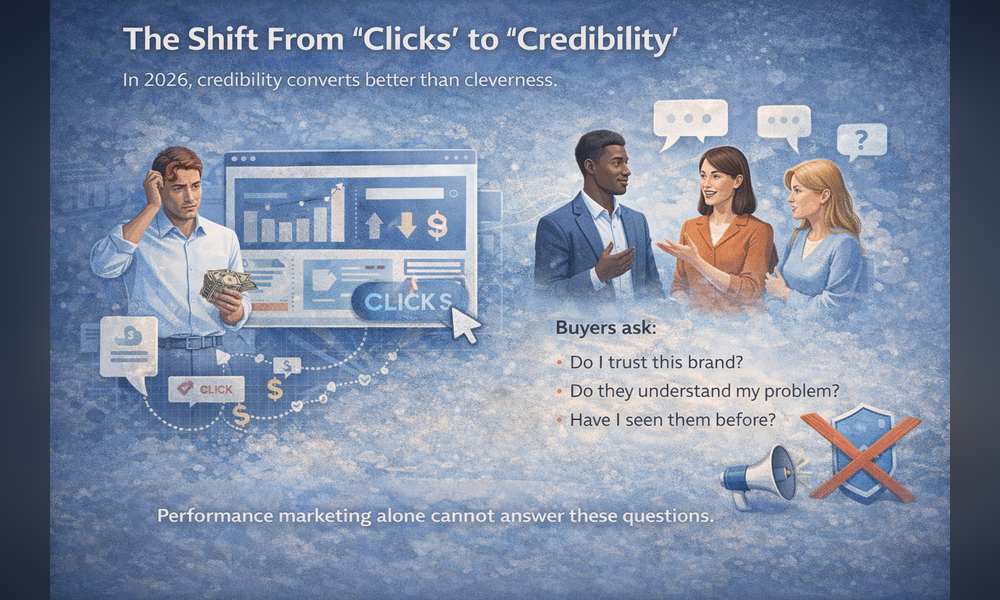
The Shift From “Clicks” to “Credibility”
In 2026, credibility converts better than cleverness.
Buyers ask:
• “Do I trust this brand?”
• “Do they understand my problem?”
• “Have I seen them before?”
Performance marketing alone cannot answer these questions.
The Most Dangerous Assumption in 2026
The riskiest belief is:
“Performance marketing will always work if we optimize hard enough.”
History shows otherwise.
Channels saturate. Costs rise. Trust erodes.
Resilient SMEs prepare before the break — not after.
What a Balanced Growth Model Looks Like
At Your Cloud Hub, balanced growth means:
• Performance marketing for acceleration
• Content for authority
• Brand for trust
• AI visibility for discovery
Each layer supports the others.
Remove one, and the system weakens.
Performance Marketing Is a Tool — Not a Strategy
Performance marketing is not broken.
But using it alone is.
In 2026, sustainable growth belongs to businesses that:
• Build authority before buying attention
• Earn trust before demanding action
• Design systems before scaling spend
Your Cloud Hub helps SMEs move beyond fragile, performance-only models toward growth strategies that survive algorithm changes, AI disruption, and market uncertainty.
The future belongs to brands that are recognized, trusted, and remembered — not just clicked.
The Real Fear: “If We Reduce Ads, Growth Will Stop”
For many SMEs, performance marketing doesn’t just feel important — it feels existential.
Leads come from ads.
Sales depend on ads.
Forecasts are built around ads.
So when the risks of performance-only growth are discussed, the natural response is fear:
“If we reduce performance marketing, everything stops.”
At Your Cloud Hub, this is one of the most common concerns we hear — and it’s understandable. But reducing risk does not mean switching ads off. It means changing the role ads play inside your growth system.
The Goal Is Not Less Performance — It’s Less Dependence
The smartest SMEs in 2026 are not anti-performance marketing. They are anti-dependence.
They aim to:
• Keep performance marketing active
• Reduce how fragile their business becomes if performance dips
• Build layers that absorb volatility
The question shifts from:
“How do we get more from ads?”
to:
“What happens if ads underperform for 30 days?”
If that question has no safe answer, the risk is already high.
Why Sudden Transitions Fail (and Gradual Ones Work)
Many businesses make one of two mistakes:
- They ignore the risk entirely
- They overcorrect too fast.
Both are dangerous.
Sudden shifts away from performance marketing can:
• Break cash flow
• Disrupt sales pipelines
• Create internal panic
The right approach is parallel building—strengthening unpaid growth channels while performance marketing continues to run.
Your Cloud Hub consistently delivers the best results when businesses transition in layers, not in leaps.
Step 1: Decouple Revenue Confidence From Daily Ad Performance
The first structural change SMEs must make is psychological.
When leadership checks ad dashboards multiple times a day, the business is already under stress.
To reduce risk:
• Shift reporting from daily to weekly patterns
• Focus on trends, not fluctuations
• Separate marketing performance from business health
This mindset shift creates space to build longer-term assets without emotional decision-making.
Step 2: Identify Where Performance Marketing Is Doing Too Much Work
In performance-only businesses, ads often compensate for deeper issues:
• Weak positioning
• Low trust
• Poor clarity
• Lack of authority
Instead of asking:
“How do we improve ROAS?”
Ask:
“What is the ad doing that the business itself should be doing?”
If ads are:
• Explaining your value
• Educating buyers
• Creating trust
• Defining your category
Then the business is structurally fragile.
Step 3: Move Education and Trust Outside the Ad Layer
One of the most effective risk-reduction strategies is offloading education from ads.
Ads should:
• Capture attention
• Direct interest
They should not:
• Do all the explaining
• Carry all the persuasion
• Overcome all skepticism
At Your Cloud Hub, we see performance stabilize when:
• Website development
• Content answers real buyer questions
• Brand messaging reinforces trust before the click
This reduces pressure on ads and improves conversion quality.
Step 4: Build “Pre-Sold” Traffic Instead of Cold Traffic
In 2026, cold traffic is expensive and fragile.
Pre-sold traffic:
• Converts faster
• Requires less persuasion
• Is less sensitive to algorithm changes
Pre-sold traffic comes from:
• Educational content
• Brand recognition
• Repeat exposure
• AI-driven discovery
Performance marketing works best when it activates familiarity, not introduces strangers.
Step 5: Stop Treating Content as a Cost Center
One reason SMEs over-rely on ads is that content is viewed as:
• Slow
• Hard to measure
• “Nice to have”
This framing is outdated.
In 2026, content is:
• A demand creation engine
• An AI discovery asset
• A trust accelerator
• A performance multiplier
Your Cloud Hub treats content as infrastructure — not campaigns. Infrastructure compounds. Campaigns expire.
Step 6: Use Performance Data to Inform Authority Building
Ironically, performance marketing provides some of the best insights for reducing its own dependency.
High-performing SMEs analyze:
• Which questions convert best
• Which objections delay decisions
• Which messages resonate long-term
Then they:
• Turn those insights into educational content
• Address objections before ads ever appear
• Reduce friction across the entire journey
Performance data should feed authority-building — not replace it.
Step 7: Prepare for AI-Mediated Buyer Journeys
By 2026, many buyers will never see your ads before forming an opinion.
They will:
• Ask AI tools for recommendations
• Consume summarized insights
• Compare options invisibly
If your brand is not present in those contexts, performance marketing becomes the first impression — an expensive and risky role.
Your Cloud Hub emphasizes AI visibility because it:
• Builds trust before ads
• Shapes perception early
• Reduces reliance on paid exposure
Step 8: Diversify Discovery, Not Just Channels
Many SMEs attempt diversification by adding:
• One more ad platform
• One more campaign type
This is not diversification — it’s still dependency.
True diversification means:
• Multiple discovery paths
• Owned attention
• Earned visibility
• AI recognition
When discovery is diversified, software development becomes optional leverage — not survival fuel.
Step 9: Redefine What “Performance” Actually Means
In performance-only models, performance equals:
• Clicks
• Leads
• Short-term ROAS
In resilient models, performance includes:
• Brand search growth
• Lead quality improvement
• Sales cycle reduction
• Conversion consistency
These metrics indicate structural strength, not just tactical success.
Step 10: Build Slack Into the System
Healthy systems have slack.
Slack means:
• You can pause ads briefly without panic
• You can test without existential risk
• You can adapt to platform changes calmly
Performance-only systems have no slack — every fluctuation feels like a threat.
Your Cloud Hub helps SMEs design growth systems with buffers, not brittleness.