


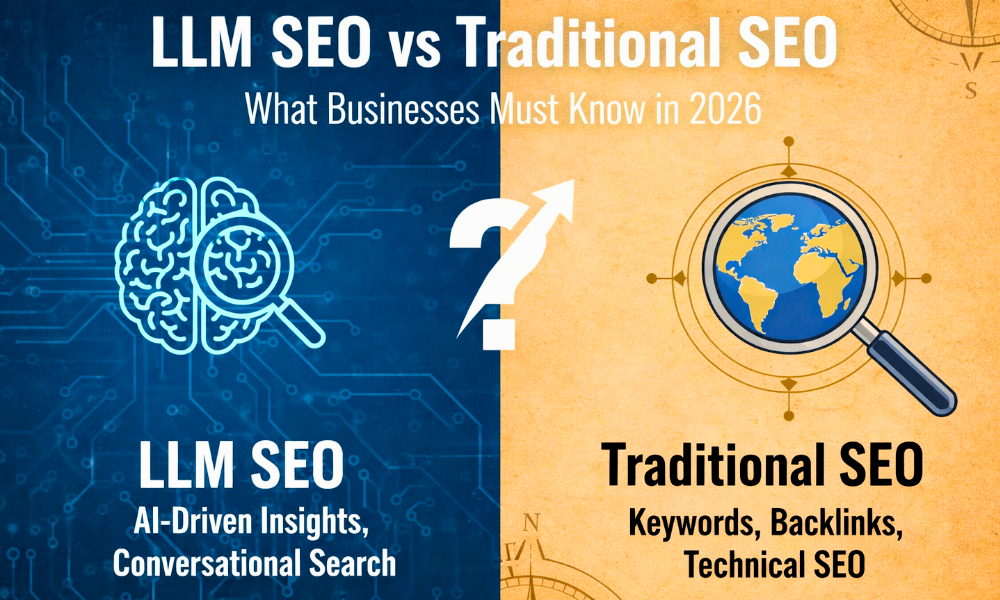
SEO Has Split Into Two Different Games
For years, businesses treated SEO as a single discipline. You optimized pages, built backlinks, tracked rankings, and waited for traffic.
That model is breaking.
By 2026, SEO will have effectively split into two parallel systems:
• Traditional SEO – optimizing for search engine result pages (SERPs)
• LLM SEO – optimizing for Large Language Models like ChatGPT, Gemini, Claude, and AI-powered search experiences
Most businesses still operate as if only the first one exists.
At yourcloudhub, we see the consequences of this every day: companies ranking well in Google but invisible in AI-driven discovery, while competitors with lower rankings are being recommended, summarized, and trusted by AI tools.
Understanding the difference between LLM SEO and traditional SEO is no longer optional. In 2026, it determines who gets discovered and who gets ignored.
What Traditional SEO Optimizes For (And Why It’s No Longer Enough)
Traditional SEO was built for an era where:
• Users typed keywords
• Search engines returned lists of links
• Rankings decided visibility
Its core focus areas include:
• Keywords and keyword density
• Backlinks and domain authority
• Technical optimization
• On-page SEO
• Page speed and indexing
Traditional SEO still matters. But its role has changed.
The problem is not that traditional SEO stopped working — it’s that it no longer controls the entire discovery funnel.
What LLM SEO Actually Is (And Why It’s Different)
LLM SEO is not about ranking pages.
It’s about being:
• Understood
• Trusted
• Referenced
• Synthesized
Large Language Models don’t “rank” content the way Google does.
They:
• Learn patterns from vast data
• Infer authority and clarity
• Generate answers, not links
• Recommend businesses contextually
When someone asks:
“Who should I hire for this?”
“What’s the best approach?”
“Which company understands this problem?”
LLMs respond with summarized knowledge, not search results.
If your business is not structured for LLM understanding, you simply don’t exist in those answers.
The Core Difference in One Sentence
Traditional SEO optimizes for algorithms.
LLM SEO optimizes for understanding.
That difference changes everything.
How Discovery Actually Happens in 2026
By 2026, buyers don’t follow a straight path:
1. Google search
2. Click website
3. Contact business
Instead, discovery looks like this:
• Ask an AI tool for recommendations
• Read summarized explanations
• Compare approaches without visiting sites
• Shortlist businesses before clicking anything
This shift means your website is no longer the first touchpoint.
At yourcloudhub, we help businesses adapt to this new reality by designing content and systems that work before the click, not just after it.
Why Traditional SEO Alone Creates a False Sense of Security
Many businesses say:
“We rank well, so we’re fine.”
That confidence is dangerous.
Traditional SEO metrics don’t show:
• Whether AI tools understand your expertise
• Whether your brand is being referenced
• Whether your thinking is being trusted
• Whether buyers see you as an authority
You can rank #1 and still lose deals to companies that AI tools explain better.
How LLMs Decide Which Businesses to Trust
LLMs evaluate trust differently from search engines.
They look for:
• Clear explanations
• Consistent viewpoints
• Depth over breadth
• Practical insight
• Coherent positioning
They avoid:
• Thin content
• Over-promotional language
• Generic advice
• Keyword-stuffed pages
This is why many SEO-optimized blogs fail in AI contexts — they were written to rank, not to explain.
Content That Works for Traditional SEO vs LLM SEO
Traditional SEO Content Tends to:
• Target one keyword
• Repeat phrases
• Optimize headings mechanically
• Chase rankings
LLM SEO Content Must:
• Answer real questions clearly
• Explain reasoning and tradeoffs
• Provide context
• Show expertise, not just claims
At yourcloudhub, we encourage businesses to stop asking:
“What keyword should this page rank for?”
And start asking:
“What question should this page answer better than anyone else?”
Why EEAT Is Non-Negotiable in LLM SEO
Experience, Expertise, Authoritativeness, and Trustworthiness (EEAT) are no longer guidelines — they are filters.
LLMs heavily favor:
• First-principles thinking
• Real-world explanations
• Consistency across content
• Clear ownership and identity
If your site lacks clear authorship, positioning, and expertise signals, LLMs struggle to trust it.
The Role of Brand in LLM SEO (Much Bigger Than Before)
Traditional SEO allowed anonymous content to rank.
LLM SEO does not.
AI systems care about:
• Who is speaking
• What they consistently talk about
• Whether their perspective is stable
This means brand clarity is now an SEO factor.
Businesses that want AI visibility must:
• Define what they stand for
• Own a clear domain of expertise
• Speak with a consistent voice
Where Most Businesses Go Wrong in 2026
The most common mistake we see at yourcloudhub is businesses trying to “add AI SEO” as a tactic.
They:
• Keep the same content
• Add a few AI buzzwords
• Expect visibility
LLM SEO is not an add-on.
It’s a shift in how content is conceived.
Why LLM SEO Rewards Long-Term Thinking
Traditional SEO rewarded short-term tactics:
• Quick link building
• Keyword arbitrage
• Content volume
LLM SEO rewards:
• Clarity over time
• Depth built gradually
• Thought leadership
• Educational consistency
This is why businesses investing now will dominate later — while late adopters scramble.
The Hidden Connection Between LLM SEO and Talent Strategy
Here’s something most SEO discussions ignore:
As AI-driven discovery increases, buyers do deeper due diligence before contacting you.
They want to know:
• How do you think
• How you operate
• Whether you understand complexity
This is especially critical for companies offering services that rely on expertise, teams, and execution.
That’s why many businesses using yourcloudhub also focus on how they hire remote staff who can support content creation, research, and operational scale.
LLM SEO requires sustained output — not one-off blog posts.
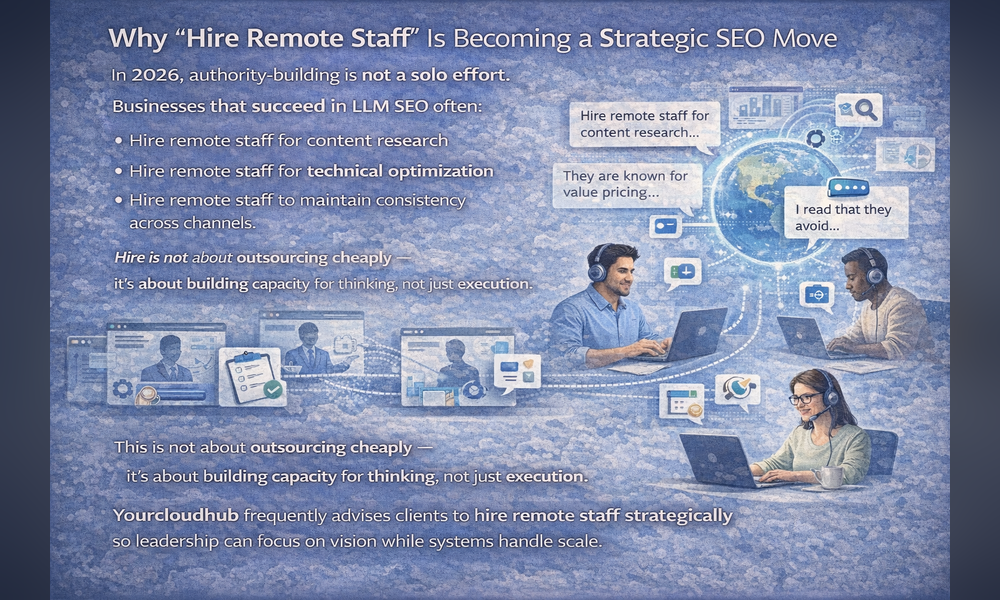
Why “Hire Remote Staff” Is Becoming a Strategic SEO Move
In 2026, authority-building is not a solo effort.
Businesses that succeed in LLM SEO often:
• Hire remote staff for content research
• Hire remote staff for technical optimization
• Hire remote staff to maintain consistency across channels
• Hire remote staff to support long-term publishing
This is not about outsourcing cheaply — it’s about building capacity for thinking, not just execution.
Yourcloudhub frequently advises clients to hire remote staff strategically so leadership can focus on vision while systems handle scale.
Traditional SEO Still Matters — But Its Role Has Changed
This is not a replacement story. It’s a rebalancing.
Traditional SEO is now best for:
• Capturing existing demand
• Technical accessibility
• Baseline visibility
LLM SEO is critical for:
• Demand creation
• Early discovery
• Trust formation
• Authority positioning
Businesses that rely on only one will struggle.
What a Balanced SEO Strategy Looks Like in 2026
Modern SEO stacks look like this:
• Traditional SEO for structure and crawlability
• LLM SEO for explanation and authority
• Brand clarity for trust
• Operational support to sustain output
This is where many companies choose to hire remote staff — not to write fluff, but to support systems that compound.
How This Impacts Service-Based Businesses the Most
For service businesses, visibility without trust is useless.
AI tools increasingly recommend:
• Approaches
• Frameworks
• Types of providers
If your business is not part of those explanations, you lose before the conversation begins.
This is why aligning LLM SEO with services like Website Development, Digital Marketing, and Software Development must focus on how you think, not just what you sell.
Measuring Success in LLM SEO (Different Metrics)
You won’t always see:
• Immediate traffic spikes
• Clear rankings
Instead, you’ll notice:
• Better-informed leads
• Shorter sales cycles
• Higher trust at first contact
• More qualified conversations
These are stronger signals than vanity metrics.
SEO in 2026 Is About Being Understood, Not Found
Traditional SEO helped businesses get found.
LLM SEO helps businesses get chosen.
In 2026, the winners will not be those who game algorithms — but those who teach, explain, and lead.
At yourcloudhub, we believe the future belongs to businesses that:
• Build clarity before traffic
• Invest in authority before ads
• Hire remote staff to support long-term thinking
• Design systems for AI understanding, not just rankings
SEO is no longer a marketing trick.
It’s a knowledge strategy.
How Businesses Must Operationalize LLM SEO in 2026 (Or Fall Behind Quietly)
The Real Gap Isn’t Knowledge — It’s Execution
By 2026, most business leaders will know that AI search and LLMs matter. The real separator won’t be awareness — it will be execution capability.
At yourcloudhub, we see a clear divide emerging:
• Businesses that understand LLM SEO
• Businesses that can actually operate it at scale
LLM SEO is not a campaign. It is not a one-time optimization. It is an ongoing knowledge-production system.
And that is where most organizations struggle.
Why LLM SEO Breaks Traditional Marketing Structures
Traditional SEO could live inside a marketing department:
• Keyword research
• Content briefs
• Publishing schedules
LLM SEO cuts across:
• Strategy
• Expertise
• Operations
• Knowledge management
• Brand positioning
It requires input from:
• Subject-matter experts
• Leadership
• Content strategists
• Technical teams
This cross-functional demand is why many businesses stall after their first few “AI-optimized” articles.
LLM SEO Is a Thinking Problem Before It’s a Writing Problem
One of the biggest misconceptions is that LLM SEO is about “writing better blogs.”
In reality, it’s about:
• Structuring how your company thinks publicly
• Making decision logic explicit
• Explaining tradeoffs and reasoning
• Clarifying your worldview
LLMs don’t just extract facts — they extract patterns of thinking.
If your content doesn’t reflect how you reason about problems, LLMs have nothing meaningful to reuse.
Why Many Businesses Plateau After Initial AI Content Wins
A common pattern in 2026:
1. Business publishes a few deep AI-friendly articles.
2. Visibility improves slightly
3. Momentum stalls
Why?
Because LLM SEO rewards consistency and depth over time, not one-off efforts.
This is where operational capacity becomes the bottleneck.
The Operational Reality: LLM SEO Requires Sustained Output
To remain visible in AI-driven discovery, businesses must:
• Publish consistently
• Update existing content
• Maintain topical focus
• Reinforce authority across multiple angles
This level of output is difficult to sustain internally without burning out teams.
That’s why many companies working with yourcloudhub choose to hire remote staff as part of their LLM SEO strategy.
Not for volume — but for continuity.
Why “Hire Remote Staff” Is an Execution Advantage in LLM SEO
LLM SEO is not about speed — it’s about endurance.
Businesses that hire remote staff strategically can:
• Maintain publishing cadence without overload
• Support research-heavy content
• Document internal knowledge
• Keep content updated as AI models evolve
This allows leadership to stay focused on strategy while the system runs in the background.
In 2026, this is becoming a competitive advantage — not a cost-cutting tactic.
LLM SEO Punishes Inconsistency More Than Traditional SEO Ever Did
Traditional SEO allowed some inconsistency:
• Random blog topics
• Disconnected pages
• Multiple tones of voice
LLMs are far less forgiving.
They look for:
• Stable positioning
• Consistent terminology
• Repeated conceptual framing
• Clear expertise boundaries
If your content contradicts itself or shifts focus frequently, AI systems struggle to trust it.
Operational discipline matters more than ever.
Why Knowledge Documentation Is Now an SEO Asset
One of the most underappreciated shifts in 2026 is this:
Internal knowledge, when externalized properly, becomes SEO leverage.
Businesses that:
• Document processes
• Explain methodologies
• Share frameworks
• Clarify decision rules
Give LLMs rich material to work with.
At yourcloudhub, we often advise clients to treat internal documentation as raw material for LLM SEO.
This is another reason companies hire remote staff — to help translate internal knowledge into structured, public-facing content.
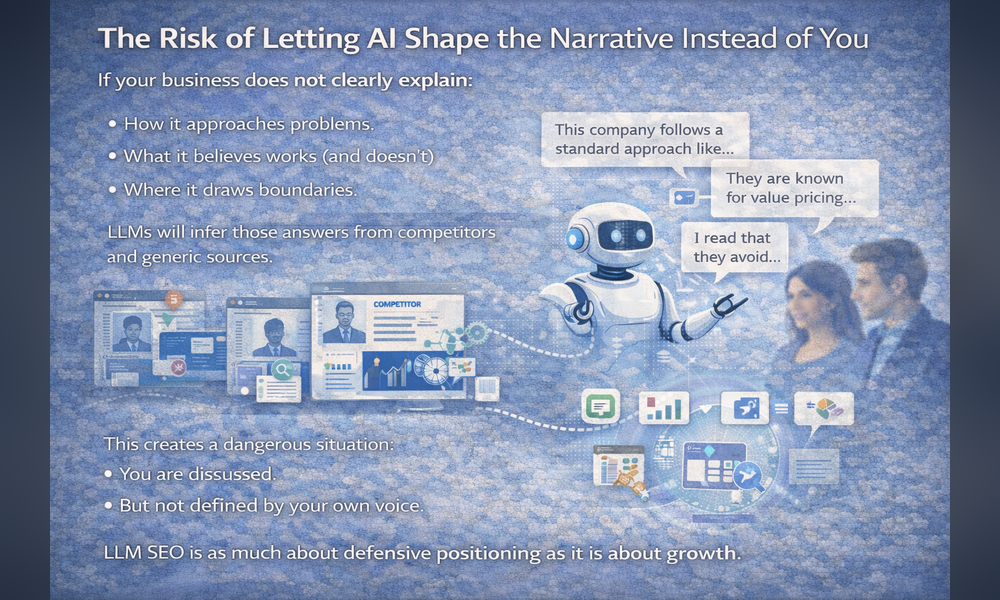
The Risk of Letting AI Shape the Narrative Instead of You
If your business does not clearly explain:
• How it approaches problems
• What it believes works (and doesn’t)
• Where it draws boundaries
LLMs will infer those answers from competitors and generic sources.
This creates a dangerous situation:
• You are discussed
• But not defined by your own voice
LLM SEO is as much about defensive positioning as it is about growth.
Why Generic Content Is Now a Liability
In traditional SEO, generic content could still rank.
In LLM SEO, generic content:
• Adds no value
• Signals low expertise
• Gets ignored or summarized away
If your content sounds like everyone else’s, AI systems have no reason to reference you.
Differentiation is not optional anymore.
The Shift From “Content Teams” to “Knowledge Systems”
Forward-thinking businesses in 2026 are changing how they think about content.
They are moving from:
• Blog calendars
to
• Knowledge systems
These systems include:
• Topic ownership
• Consistent terminology
• Update cycles
• Authority reinforcement
This is difficult to maintain without additional capacity, which is why many teams hire remote staff to support these systems in the long term.
Why LLM SEO Makes Shortcuts More Dangerous
In the past, shortcuts sometimes worked:
• Content spinning
• Keyword padding
• Shallow outsourcing
LLMs detect these patterns easily.
Low-quality content doesn’t just fail—it can actively undermine trust signals.
Quality control is non-negotiable in 2026.
How Businesses Should Sequence Their LLM SEO Efforts
One mistake businesses make is trying to do everything at once.
A better sequence:
1. Clarify positioning and expertise boundaries.
2. Identify core questions your buyers ask.
3. Publish foundational, in-depth content.
4. Reinforce with supporting articles.
5. Update and expand consistently.
This approach compounds.
Rushing leads to fragmentation.
Why Leadership Involvement Still Matters
LLM SEO cannot be fully delegated.
Leadership must:
• Define perspective
• Approve positioning
• Set boundaries of expertise
Execution can be supported by teams — especially when you hire remote staff —, but direction must come from the top.
LLMs amplify whatever thinking you publish. Make sure it’s intentional.