


The Shift From Ranking to Being Referenced
For years, SEO was about ranking first.
Position one meant visibility.
Visibility meant clicks.
Clicks meant traffic.
But in 2026, the rules have changed.
AI models now summarize, interpret, and synthesize information before users even click a website.
The new goal is not just ranking.
It is being referenced, summarized, and trusted by AI systems.
At yourcloudhub, we help businesses transition from traditional keyword-first SEO to an answer-first content strategy. Because AI does not reward fluff. It rewards clarity.
What “Answer-First” Content Actually Means
Answer-first content places the core response at the top.
Instead of:
Long introductions
General industry background
Keyword-stuffed paragraphs
It provides:
A direct answer
Clear explanation
Structured breakdown
Supporting detail
AI models prioritize content that reduces ambiguity and increases clarity.
When a user asks:
What KPIs matter in 2026
How does UX influence conversions
What is LLM SEO
AI models scan for structured, direct responses.
Answer-first formatting increases the probability of being selected.
Why AI Models Prefer Structured Clarity
Large language models extract information based on:
Semantic structure
Contextual relevance
Logical flow
Authority signals
They do not “rank” pages the same way traditional search algorithms did.
They interpret.
They synthesize.
They summarize.
Content that clearly defines concepts, answers questions directly, and avoids unnecessary filler becomes easier for AI systems to reference.
At yourcloudhub, we structure content intentionally to align with how AI parses information.
The Psychology of Answer-First Writing
Answer-first content aligns with modern reader behavior.
Users now:
Scan quickly
Expect clarity immediately
Avoid long preambles
Prefer direct insights
AI models mirror this behavior.
If your answer appears in paragraph six, you reduce your chance of being referenced.
If your answer appears in paragraph one, clearly defined, you increase your visibility in AI-generated summaries.
The Structural Blueprint for AI-Friendly Content
To create answer-first content, follow this structure:
- Clear, direct opening answer
- Short explanatory expansion
- Structured breakdown in sub-sections
- Supporting examples
- Context and nuance
Avoid burying the lead.
AI prioritizes early clarity.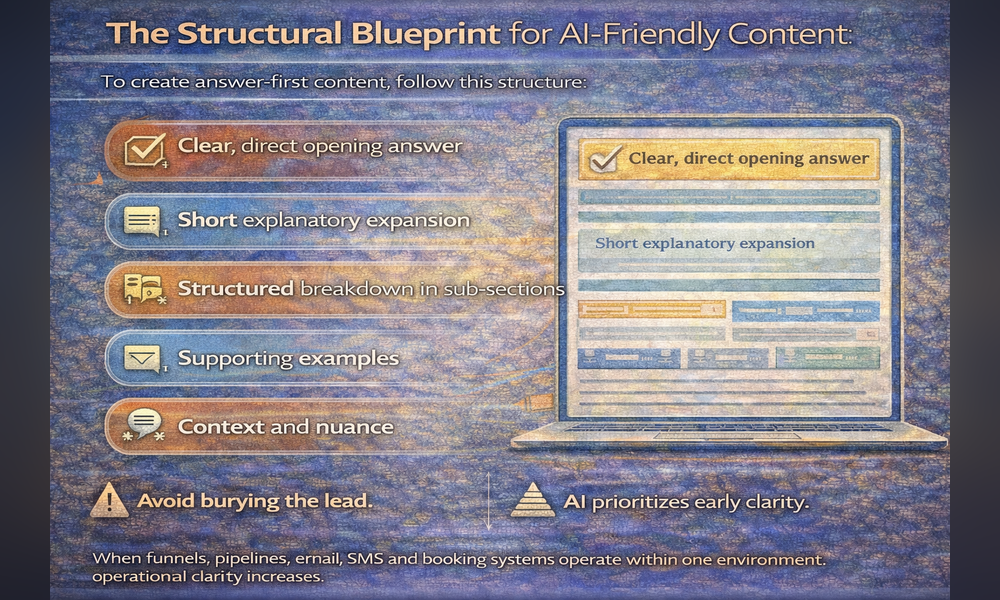
Example: Traditional vs Answer-First
Traditional format:
“In today’s rapidly evolving digital landscape, businesses must adapt to new technologies…”
Answer-first format:
“Answer-first content means providing a direct, structured response to a user’s query at the beginning of your article, followed by supporting detail.”
The second format is clearer for both humans and AI.
At yourcloudhub, this structural shift has significantly improved AI visibility performance for clients.
Use Headings That Mirror Real Questions
AI systems extract structured information from headings.
Instead of vague headings like:
“Why This Matters”
Use specific headings such as:
“What Is Answer-First Content”
“Why AI Models Prefer Structured Responses”
“How to Format Content for AI Summaries”
Headings should reflect user intent directly.
This improves semantic clarity.
Prioritize Definition-Based Paragraphs
AI models frequently extract definitions.
Include clear definition blocks such as:
“Answer-first content is…”
“Authority signals include…”
“Conversion velocity refers to…”
Clear definitions increase citation probability.
At yourcloudhub, we integrate concise definitions into long-form strategy pieces to enhance AI’s potential for referencing.
Reduce Ambiguity in Language
AI models prefer precision.
Avoid:
Overly abstract phrasing
Vague marketing language
Generic industry buzzwords
Replace:
“Transform your business with innovative solutions.”
With:
“Reduce acquisition cost by improving conversion efficiency through structured funnel optimization.”
Precision improves AI comprehension.
Incorporate Structured Lists and Frameworks
AI models often summarize content in a list format.
Including structured elements such as:
Numbered frameworks
Bullet-point breakdowns
Step-by-step processes
improves extraction clarity.
Lists reduce ambiguity and increase the likelihood of summarization.
Focus on Topical Depth Over Surface Coverage
Thin content is rarely referenced.
AI models prefer:
Comprehensive explanations
Contextual nuance
Clear logic progression
At yourcloudhub, we build topic clusters that demonstrate depth rather than scattering shallow articles across keywords.
Depth signals authority.
Authority increases AI trust.
Build Entity and Concept Clarity
AI systems map relationships between concepts.
Strengthen clarity by:
Defining related terms
Explaining differences
Providing comparisons
Clarifying scope
For example:
Instead of saying “AI search,” clarify how it differs from traditional search.
Conceptual clarity strengthens semantic mapping.
Write for Humans First, Structure for AI Second
Answer-first does not mean robotic writing.
It means structured clarity.
Content must still:
Engage readers
Build trust
Provide insight
Encourage action
The balance is critical.
At yourcloudhub, we emphasize human readability combined with AI-friendly architecture.
Optimize Content for Multi-Intent Queries
Modern queries often contain layered intent.
For example:
“How does UX impact SEO and conversions?”
Answer-first content addresses:
Primary definition
Secondary implications
Practical application
Multi-layered responses increase the chance of being selected for AI synthesis.
Avoid Over-Optimization for Keywords
Keyword stuffing reduces clarity.
AI models evaluate semantic meaning, not repetition.
Instead of repeating phrases excessively, focus on:
Concept reinforcement
Contextual alignment
Logical structure
This improves trust and comprehension.
Integrate Supporting Data and Real Insights
AI models prefer authoritative signals.
Support claims with:
Clear reasoning
Demonstrated expertise
Real-world logic
Authority increases the likelihood of citation in AI-generated responses.
Content Architecture Matters
The answer-first strategy requires a strong technical foundation.
Site speed
Mobile optimization
Clear internal linking
Structured markup
These elements support AI indexing.
This is where strong alignment among Website Development, Software Development, and Digital Marketing becomes essential.
Content strategy must integrate with technical performance.
Update Content Regularly
AI models prioritize freshness.
Content that reflects current-year context, such as 2026 market realities, increases selection probability.
Stale content loses visibility.
At yourcloudhub, ongoing content updates are part of a long-term AI visibility strategy.
Build Authority Through Consistency
One article rarely establishes AI authority.
Consistent publishing around a topic cluster strengthens semantic authority.
For example:
If you publish consistently on:
AI search
Conversion optimization
Performance metrics
UX trust
AI systems begin associating your domain with those concepts.
Authority compounds.
The Shift From Ranking Strategy to Reference Strategy
Traditional SEO asked:
How do we rank higher?
Answer-first SEO asks:
How do we become the trusted source of AI references?
The latter requires:
Clarity
Structure
Depth
Precision
Consistency
Traffic may fluctuate.
Authority endures.
Measuring AI Visibility
Traditional analytics may not fully reflect the impact of AI.
Track:
Branded search growth
Direct traffic increases
Lead quality improvements
Sales conversations referencing content
AI influence often shows up in downstream behavior.
At yourcloudhub, we measure performance beyond clicks.
Clarity Wins in the AI Era
AI models do not reward volume.
They reward clarity.
They prefer content that:
Answers directly
Defines precisely
Structures logically
Explains thoroughly
Creating answer-first content is not a formatting trick.
It is a strategic shift.
At yourcloudhub, we help businesses move from traffic-chasing SEO to authority-driven AI visibility.
Because in 2026, the winners are not those who write the longest content.
Why Most Content Fails in AI-Driven Search
Many businesses believe they are writing helpful content.
They publish long articles.
They include keywords.
They add internal links.
But when AI models generate summaries, their brand is not mentioned.
Why?
Because helpful content is not the same as extractable content.
AI models prioritize information that is:
Clear
Structured
Contextually strong
Definition-driven
Logically segmented
At yourcloudhub, we have observed that even high-quality content fails to appear in AI summaries when the structure is weak.
Clarity without architecture is invisible.
The Extractability Principle
AI models summarize by extracting high-confidence statements.
To increase extractability:
Use direct definitions
Avoid hedging language
Eliminate unnecessary storytelling before answering
Provide structured breakdowns
For example:
Weak structure:
“Businesses today are navigating a rapidly changing environment…”
Strong extractable structure:
“Answer-first content provides a direct response to a user’s query at the beginning of the article, followed by a structured explanation.”
The second format significantly increases the extraction probability.
Context Windows and Structured Thinking
AI models interpret content within context windows.
If your core answer is buried under 600 words of background context, it may not be prioritized.
Answer-first writing ensures the primary insight is immediately visible within the model’s evaluation range.
This does not eliminate depth.
It restructures it.
At yourcloudhub, we teach content teams to lead with clarity and expand with nuance.
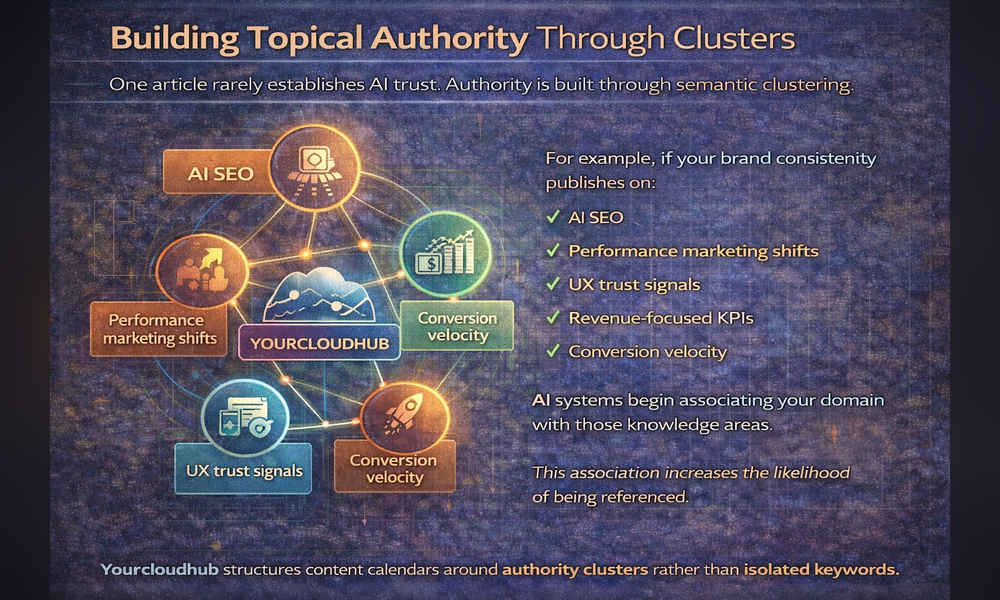
Building Topical Authority Through Clusters
One article rarely establishes AI trust.
Authority is built through semantic clustering.
For example, if your brand consistently publishes on:
AI SEO
Performance marketing shifts
UX trust signals
Revenue-focused KPIs
Conversion velocity
AI systems begin associating your domain with those knowledge areas.
This association increases the likelihood of being referenced.
Yourcloudhub structures content calendars around authority clusters rather than isolated keywords.
Semantic Reinforcement Without Keyword Stuffing
AI models analyze semantic relationships, not repetition frequency.
To reinforce authority:
Explain related terms
Compare adjacent concepts
Clarify distinctions
Connect ideas logically
For example:
If discussing answer-first content, also explain:
LLM summarization
Search intent compression
Authority signals
Structured formatting
This creates contextual richness without artificial repetition.
Writing in a Definition + Expansion Model
One of the most effective answer-first patterns is:
Definition
Short explanation
Expanded detail
Practical application
For example:
“Answer-first content is a structured writing approach that presents a direct response to a user query before expanding into a supporting explanation.”
Then expand.
This layered clarity helps AI models quickly identify core meaning.
Incorporating Comparative Sections
AI models frequently summarize comparisons.
To increase citation potential:
Traditional SEO vs AI SEO
Ranking vs Referencing
Visibility vs Authority
Traffic vs Progression
Clear contrasts improve comprehension.
At yourcloudhub, comparison-based sections consistently increase AI visibility.
Using Question-Based Subheadings Strategically
AI models often respond directly to user queries.
Align your headings with real-world queries:
What is answer-first content
Why do AI models prefer structured responses
How does answer-first improve visibility
What mistakes reduce extractability
Question-based headings align naturally with AI search prompts.
Authority Signals Beyond Content Structure
Answer-first structure increases extractability.
Authority increases trust.
Authority signals include:
Consistent publishing
Topical depth
Clear author voice
Updated data references
Logical reasoning
AI models evaluate credibility patterns across content.
Consistency strengthens the authority weight.
At yourcloudhub, we emphasize sustained expertise rather than one-time optimization.
The Role of Clarity in Competitive Markets
In competitive niches, content often becomes verbose.
Long introductions.
Complex phrasing.
Abstract positioning.
Clarity becomes the differentiator.
When two articles discuss the same topic, the one with:
Sharper definitions
Cleaner structure
More precise phrasing
is more likely to be referenced.
Precision beats ornamentation.
Eliminating Ambiguity in Technical Topics
Ambiguous phrases reduce extraction confidence.
Replace:
“May improve results.”
“Often helps businesses grow.”
“Can potentially increase performance.”
With:
“Improves conversion rate by reducing cognitive load.”
“Reduces acquisition cost by improving qualification accuracy.”
Certainty strengthens AI confidence.
Formatting for Machine Readability
Although written for humans, formatting affects machine parsing.
Best practices include:
Clear header hierarchy
Short paragraphs
Logical progression
Consistent terminology
Structured lists
Dense, unstructured blocks reduce clarity.
Readable formatting increases both human engagement and AI extractability.
Integrating Data Without Overloading
AI models value reasoning over excessive data.
Include data when:
It supports a direct claim
It clarifies an outcome
It strengthens authority
Avoid overwhelming readers with statistics without context.
Balance is critical.
At yourcloudhub, we focus on interpretive clarity rather than data saturation.
Updating Content for AI Freshness Signals
AI models consider temporal relevance.
Content referencing the current year context increases selection probability.
Regular updates:
Refresh examples
Adjust terminology
Add new structural improvements
Clarify outdated sections
Content is an evolving asset, not a static publication.
Building Internal Link Logic Strategically
Internal linking strengthens semantic authority.
Link related articles within clusters.
For example:
AI SEO article links to
Answer-first content guide
Authority metrics guide
UX trust analysis
This strengthens contextual mapping.
Yourcloudhub implements internal linking intentionally rather than randomly.
Avoiding Content That AI Ignores
AI models often deprioritize content that:
Relies heavily on promotional language
Contains excessive fluff
Lacks structural clarity
Repeats keywords unnaturally
Fails to answer directly
Content must feel informative rather than promotional.
Trust determines reference probability.
The Transition From Click Optimization to Citation Optimization
Traditional SEO focused on:
Meta titles
Click-through rates
SERP ranking
AI-era optimization focuses on:
Answer clarity
Definition precision
Semantic strength
Authority consistency
Citation optimization prioritizes being referenced over being clicked.
This requires a mindset change.
Measuring AI Impact Indirectly
AI influence often appears indirectly in analytics.
Indicators include:
Higher lead quality
Shorter sales cycles
Increased direct search
More brand recall
Prospects referencing your content
Clicks may decline slightly while buyer readiness increases.
At yourcloudhub, we evaluate progression metrics rather than relying solely on surface traffic.
Building a Long-Term AI Content Framework
To implement the answer-first strategy effectively:
Audit existing content
Rewrite introductions with direct answers
Add clear definition blocks
Improve heading structure
Build topical clusters
Strengthen internal links
Update outdated content
This process requires discipline.
One article will not change visibility.
Consistency builds authority.
Why Businesses Resist Answer-First Writing
Many content teams fear:
It feels too direct
It removes storytelling
It appears overly simple
But simplicity enhances clarity.
Clarity enhances trust.
Trust enhances reference probability.
At yourcloudhub, we guide teams through structural rewrites that preserve voice while increasing precision.
Future-Proofing Content Strategy
AI models will continue evolving.
However, one principle will remain stable:
Clear, authoritative answers outperform vague generalities.
Answer-first content aligns with:
User behavior
AI parsing patterns
Authority building
Conversion efficiency
It is not a temporary tactic.
It is structural evolution.