
Scaling Without Spending More
B2B companies can scale marketing without raising ad spend by boosting conversion efficiency, strengthening organic channels, and building systems that maximize existing traffic and leads.
Instead of focusing only on acquiring more traffic, businesses should focus on converting more of what they already have.
At Your Cloud Hub, we shift companies from “spend more to grow” to “optimize to scale” for predictable growth without higher marketing budgets.
The Problem With Ad-Dependent Growth
Many B2B companies rely heavily on paid advertising.
This creates short-term growth but brings long-term risk.
As competition increases, advertising costs rise—including cost per click and cost per lead—while return on ad spend declines.
Cost per click increases.
Cost per lead increases.
Return on ad spend declines.
When growth depends entirely on paid traffic, scaling becomes expensive and unpredictable.
This is why businesses must look beyond ads.
To move beyond reliance on ads, businesses should focus on building systems that improve efficiency across the entire marketing funnel.
The Real Meaning of Scaling Marketing
Scaling marketing does not always mean increasing reach.
True scaling means increasing output from the same input.
For example:
Generating more leads from the same traffic
Converting more leads into customers
Increasing customer lifetime value
Reducing acquisition costs
This approach focuses on efficiency rather than expansion.
At Your Cloud Hub, we define scalable marketing as the ability to grow revenue without proportionally increasing marketing costs.
Step 1: Optimize Conversion Rates First
Before increasing traffic, businesses should optimize how existing traffic converts.
Many websites lose customers from unclear messaging, slow load times, confusing navigation, or weak calls to action.
Improving conversion rates can dramatically increase results without increasing ad spend.
For example:
If a website converts 2 percent of visitors into leads, improving conversion to 4 percent doubles results without additional traffic.
Conversion optimization is one of the most effective ways to scale efficiently.
Step 2: Build High-Intent Content Systems
Content marketing is a powerful way to scale without extra ad spend, as it continues to drive traffic over time.
Unlike paid campaigns, content continues generating traffic over time.
High-intent content targets prospects who are actively searching for solutions.
Examples include:
Problem-focused blog articles
Solution comparisons
Industry guides
Case studies
This type of content attracts qualified leads who are more likely to convert.
At Your Cloud Hub, we focus on building content ecosystems that continuously attract, educate, and convert prospects.
Step 3: Strengthen Lead Nurturing Systems
Most B2B leads don’t convert immediately.
Without proper follow-up, many opportunities are lost.
Lead nurturing ensures that prospects receive ongoing communication and stay engaged.
Effective nurturing includes:
Educational email sequences
Follow-up messages
Case studies and insights
Product explanations
Strong nurturing increases conversions without more traffic.
This is one of the most overlooked ways to scale marketing efficiently.
Step 4: Improve Sales and Marketing Alignment
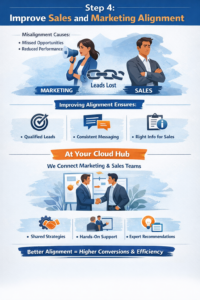
Misalignment between sales and marketing teams often leads to lost opportunities.
scale marketing without increasing ad spend
Marketing generates leads.
Sales often struggle to convert them.
This disconnect reduces overall performance.
Improving alignment ensures that:
Leads are qualified properly
Messaging is consistent
Sales teams receive the right information
At Your Cloud Hub, we work with organizations to develop shared frameworks connecting marketing and sales, providing hands-on facilitation and recommendations to better integrate these processes.
This alignment improves conversion rates and overall efficiency.
Step 5: Leverage Retargeting Instead of New Acquisition
Retargeting allows businesses to reconnect with people who have already interacted with their brand.
These prospects are more likely to convert than new visitors.
Retargeting campaigns can include:
Follow-up ads
Email reminders
Content recommendations
Because these audiences are already familiar with the brand, conversion rates are typically higher.
Retargeting maximizes the value of existing traffic instead of constantly chasing new leads.
Step 6: Increase Customer Lifetime Value
Scaling marketing is not only about acquiring new customers.
Increasing existing customer value can drive major growth.
Strategies include:
Upselling additional services
Cross-selling related products
Offering subscription models
Providing ongoing support and value
When customer lifetime value increases, businesses can grow revenue without increasing acquisition costs.
Step 7: Build Authority and Trust
Trust is critical in B2B decisions.
Prospects often research extensively before choosing a solution.
Businesses that establish authority through content, insights, and expertise gain a competitive advantage.
Authority-building strategies include:
Publishing thought leadership content
Sharing industry insights
Providing educational resources
At Your Cloud Hub, we guide clients in building authority as a key driver of long-term marketing success, helping them create and share impactful thought leadership and educational resources.
Trusted brands convert more efficiently.
Step 8: Use Data to Identify Growth Opportunities
Scaling efficiently means knowing what works and what doesn’t.
Data analysis helps identify:
High-performing campaigns
Underperforming channels
Conversion bottlenecks
For example:
If a specific content topic generates high engagement, businesses can create more content around that topic.
If certain campaigns produce low-quality leads, resources can be redirected to other campaigns.
Data-driven decisions improve marketing efficiency without increasing costs.
Step 9: Automate Repetitive Processes
Automation reduces manual work and ensures consistency.
Marketing automation can handle:
Lead follow-ups
Email campaigns
Customer onboarding
Reporting
Automation lets businesses scale communication without adding more team members.
When implemented correctly, automation improves both efficiency and customer experience.
Step 10: Focus on High-Quality Leads, Not Volume
More leads do not always mean better results.
Low-quality leads drain time and rarely convert.
Instead of focusing on volume, businesses should prioritize lead quality.
High-quality leads:
B2B marketing without ads
Match the target audience
Have clear needs
They are more likely to convert
Targeting the right audience improves efficiency and reduces wasted effort.
The Role of Organic Growth in Scaling
Organic channels such as SEO and content marketing provide long-term growth.
Unlike paid campaigns, organic traffic does not require ongoing spend.
Once content ranks or gains visibility, it continues generating leads.
At Your Cloud Hub, we help businesses build organic growth systems that steadily deliver consistent results and provide ongoing support for how to scale B2B marketing
Organic growth reduces dependence on paid advertising.
Why Systems Matter More Than Campaigns
Many businesses focus on individual campaigns rather than building systems.
Campaigns produce temporary results.
Systems drive long-term growth.
A scalable marketing system includes:
Content creation
Lead nurturing
Conversion optimization
Performance tracking
When these elements work together, marketing becomes more predictable and efficient.
Advanced Growth Systems, AI Optimization, and Revenue Efficiency Models
Scaling marketing without more ad spend needs a mindset shift.
Most companies try to grow by adding more budget, more campaigns, and more channels. But sustainable growth comes from improving the efficiency of your existing system.
In this section, we go deeper into advanced frameworks that B2B companies can use to scale marketing through optimization, systems, and smarter execution.
At Your Cloud Hub, we collaborate with clients to build robust marketing ecosystems where every customer interaction drives growth, emphasizing efficiency and smart resource use rather than larger budgets alone.
Building a Demand Generation Engine
Many B2B companies focus heavily on lead generation.
But lead generation alone isn’t enough.
A demand engine builds awareness, trust, and nurtures prospects before they enter sales.
This approach reduces dependence on paid ads.
A demand generation system typically includes:
Educational content
Industry insights
Thought leadership
Community engagement
Instead of chasing leads, businesses attract them naturally.
This creates higher-quality prospects and improves conversion rates.
Turning Content Into a Growth Asset
Content is often treated as a one-time effort.
A blog is published, shared briefly, then forgotten.
To scale marketing efficiently, content must be treated as a long-term asset.
Each piece of content should:
Address a specific problem
Target a clear audience
Support a broader topic strategy
Over time, content builds authority and attracts organic traffic.
At Your Cloud Hub, we help businesses build content systems where each article enhances overall visibility and lead-generation potential.
Repurposing Content for Maximum Impact
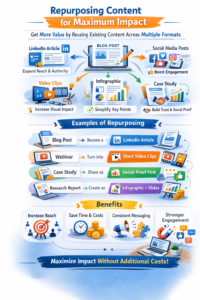
One of the simplest ways to scale without increasing spend is to reuse existing content.
Instead of constantly creating new material, businesses can repurpose content across multiple formats.
For example:
A blog post can become a LinkedIn article
A webinar can be turned into short video clips
A case study can be shared as a social proof post
Repurposing increases reach without additional production costs.
It also ensures consistent messaging across platforms.
Conversion Rate Optimization as a Growth Lever
Conversion rate optimization is one of the most powerful yet underutilized growth strategies.
Small improvements in conversion rates can lead to significant increases in revenue.
For example:
Improving landing page clarity
Simplifying forms
Strengthening calls to action
These changes can double or even triple conversion performance.
Instead of increasing traffic, businesses improve the effectiveness of existing traffic.
At Your Cloud Hub, conversion optimization is often the first step in scaling marketing systems.
Building High-Intent Funnels
Not all traffic is equal.
High-intent prospects are far more valuable than general visitors.
High-intent funnels focus on capturing users who are actively searching for solutions.
These funnels often include:
Problem-focused content
Solution comparisons
Case studies
organic growth strategies for B2B
Consultation offers
By targeting high-intent audiences, businesses can improve lead quality and conversion rates.
This reduces the need for large traffic volumes.
Leveraging First-Party Data
As privacy regulations evolve, first-party data becomes increasingly valuable.
First-party data includes information collected directly from customers and prospects.
Examples include:
Email subscribers
Website behavior data
Customer purchase history
This data allows businesses to personalize communication and improve targeting.
Personalized messaging increases engagement and conversion rates.
At Your Cloud Hub, we help businesses build data-driven systems that improve marketing performance without increasing costs.
Email and CRM Optimization
Email marketing remains one of the most cost-effective channels for B2B growth.
However, many companies underutilize their email databases.
Optimizing email systems can significantly improve performance.
Key strategies include:
Segmenting audiences based on behavior
Personalizing messaging
Automating follow-up sequences
CRM systems should also be structured to track lead activity and engagement.
When email and CRM systems work together, businesses can nurture leads more effectively.
Using AI for Marketing Efficiency
Artificial intelligence is transforming how marketing operates.
AI tools can analyze data, identify patterns, and automate decision-making processes.
Examples of AI applications include:
Content optimization
Audience segmentation
Predictive analytics
Personalized recommendations
AI allows businesses to make smarter decisions and improve efficiency.
Instead of increasing spend, companies can use AI to optimize existing campaigns.
At Your Cloud Hub, we integrate AI-driven insights into marketing systems to improve performance.
Reducing Funnel Leakage
Many marketing funnels lose prospects at various stages.
This is known as funnel leakage.
Common causes include:
Poor follow-up
Confusing messaging
Lack of trust signals
Complicated user journeys
Reducing leakage improves conversion rates without increasing traffic.
Businesses should analyze where prospects drop off and address those issues.
Even small improvements in retention can lead to significant growth.
Building Trust Through Authority
Trust is one of the most important factors in B2B decision-making.
Prospects often evaluate multiple options before choosing a provider.
Businesses that demonstrate authority are more likely to be selected.
Authority can be built through:
Expert content
Case studies
Industry insights
Client success stories
At Your Cloud Hub, we focus on authority-building B2B marketing strategy that position businesses as trusted solution providers.
Strategic Use of Partnerships
Partnerships can expand reach without increasing marketing spend.
Collaborating with complementary businesses allows companies to access new audiences.
Examples include:
Joint webinars
Co-branded content
Referral partnerships
These collaborations provide exposure to qualified prospects without additional advertising costs.
Product-Led Growth in B2B
Some B2B companies are adopting product-led growth strategies.
This approach allows prospects to experience the product before committing.
Examples include:
Free trials
Freemium models
Interactive demos
Product-led growth reduces reliance on traditional sales processes.
It also improves conversion rates by allowing prospects to evaluate value directly.
Customer Retention as a Growth Driver
Retaining existing customers is often more cost-effective than acquiring new ones.
Customer retention strategies include:
Ongoing support
Regular communication
Exclusive offers
Customer success programs
Satisfied customers are more likely to renew contracts and provide referrals.
Retention increases lifetime value, which contributes to overall growth.
Creating a Scalable Marketing System
Scaling marketing requires a system rather than isolated tactics.
A scalable system includes:
Content strategy
Lead nurturing
Conversion optimization
Data analysis
Each component supports the others.
When these elements are aligned, marketing becomes more efficient and predictable.
At Your Cloud Hub, we design systems that allow businesses to grow without constantly increasing budgets.