
More Data, Less Clarity
For years, businesses celebrated numbers that looked impressive.
High traffic.
More followers.
Growing impressions.
Increasing likes.
Dashboards were full. Reports were colorful. Meetings felt productive.
But revenue did not always follow.
In 2026, the illusion is collapsing.
At yourcloudhub, we are seeing a decisive shift. Companies are beginning to realize that visibility without conversion, engagement without intent, and impressions without influence no longer justify investment.
Vanity metrics are losing power.
Strategic KPIs are replacing them.
What Are Vanity Metrics
Vanity metrics are numbers that look impressive but fail to predictably influence decision-making or revenue.
Examples include:
• Raw traffic volume
• Social media followers
• Impressions
• Email open rates
• Page views without context
These metrics may signal activity, but they rarely signal business health.
They provide surface-level reassurance without strategic insight.
Why Vanity Metrics Survived for So Long
Vanity metrics persisted because:
• They are easy to measure
• They grow quickly
• They are visually impressive
• They create short-term excitement
But they lack depth.
As digital competition increases and AI reshapes discovery, surface-level visibility has become less meaningful.
At yourcloudhub, we now advise businesses to treat vanity metrics as context indicators rather than performance drivers.
The 2026 Reality: Attention Is Fragmented
Search behavior has changed.
AI summaries reduce clicks.
Social platforms throttle organic reach.
Paid ads are more expensive.
In this environment, traffic alone tells you very little.
Ten thousand visitors who do not convert cost more than one hundred highly qualified prospects.
The question is no longer:
How many people saw us
The real question is:
How many people moved closer to buying

KPI Shift 1: From Traffic to Qualified Traffic
Traffic still matters, but only when qualified.
Key metric to track:
• Traffic that reaches high-intent pages
• Visitors who return multiple times
• Visitors who engage beyond surface scrolling
At yourcloudhub, we emphasize behavioral segmentation.
Instead of total visitors, measure:
• Visitors who view pricing
• Visitors who complete partial forms
• Visitors who consume in-depth content
These are signals of intent.
Intent is more valuable than volume.
KPI Shift 2: From Leads to Pipeline Value
Lead volume used to dominate performance conversations.
Now the focus must shift to:
• Pipeline contribution
• Lead-to-opportunity rate
• Opportunity-to-close rate
• Average deal size
A smaller number of high-quality leads can outperform a large pool of unqualified inquiries.
The real KPI is not the number of leads generated.
It is revenue-influenced.
KPI Shift 3: From Engagement to Decision Velocity
Likes and comments no longer define impact.
Instead, track:
• Time from first touch to sales call
• Time from proposal to close
• Sales cycle compression
When content and marketing work effectively, decision-making accelerates.
At yourcloudhub, we call this velocity-based measurement.
Velocity reveals whether messaging reduces friction.
KPI Shift 4: From Content Output to Content Influence
Publishing frequency is not performance.
Key 2026 metrics include:
• Assisted conversions
• Sales references to content
• Content that drives repeat visits
• Pages that influence deal progression
Content should shorten explanations in sales conversations.
If sales teams still repeat basic education, the content is underperforming.
Influence matters more than output.
KPI Shift 5: From Cost Per Click to Cost Per Acquisition Efficiency
Paid traffic performance must now be measured by:
• Revenue per visitor
• Lifetime value impact
• Margin preservation
Lower CPC does not equal better performance.
If cheaper traffic reduces conversion quality, profitability declines.
True performance measurement connects acquisition to long-term value.
KPI Shift 6: From Impressions to Authority Signals
In 2026, authority determines visibility.
Authority signals include:
• Branded search growth
• Direct traffic increase
• Referral traffic from reputable sources
• Mentions in AI-generated summaries
These signals indicate that the market recognizes your expertise.
At yourcloudhub, authority is treated as a measurable strategic asset.
KPI Shift 7: From Email Open Rate to Revenue Per Subscriber
Open rates fluctuate due to privacy changes and AI filtering.
More meaningful email metrics include:
• Revenue generated per campaign
• Replies generated
• Conversion triggered
• Re-engagement success
Email should support revenue, not vanity reporting.
KPI Shift 8: From Social Reach to Community Activation
Follower count is no longer strategic.
Instead, measure:
• Direct inquiries from social
• Saved posts
• DM conversations
• Website visits from engaged users
Quality interaction outweighs numerical growth.
Why AI Makes Vanity Metrics Even Less Relevant
AI search reduces click volume.
AI summaries influence decisions before site visits.
This means influence often occurs before measurable traffic appears.
New KPIs must capture:
• Assisted attribution
• Multi-touch journeys
• Pipeline acceleration
Businesses that rely only on surface analytics will misinterpret performance trends.
The Operational Shift Required
Measuring better KPIs requires:
• Integrated CRM tracking
• Sales and marketing alignment
• Clear funnel mapping
• Consistent reporting standards
This is not just an analytics upgrade.
It is a structural evolution.
At yourcloudhub, we help organizations move from isolated dashboards to integrated revenue intelligence systems.
Aligning KPIs Across Departments
Marketing often measures traffic.
Sales measure revenue.
Leadership measures growth.
In 2026, these must align.
Unified KPIs include:
• Marketing-influenced revenue
• Pipeline growth rate
• Conversion efficiency
• Customer lifetime value
Alignment reduces internal friction a5nd improves decision clarity.
Industry Implications
Businesses in website development, software development, and Digital Marketing, especially, must move away from vanity metrics.
Clients increasingly demand measurable impact.
Performance reports must demonstrate:
• Revenue growth
• Operational efficiency
• Lead quality improvement
• Strategic influence
Surface-level analytics no longer justify contracts.
The Risk of Clinging to Vanity Metrics
Companies that continue focusing on:
• Traffic spikes
• Social growth
• Campaign impressions
may feel active but not effective.
Over time, this creates:
• Budget inefficiency
• Sales frustration
• Leadership confusion
• Strategic drift
Vanity metrics provide comfort.
Strategic KPIs provide clarity.
How Yourcloudhub Approaches KPI Transformation
At yourcloudhub, KPI transformation involves three core shifts:
1. Redefining success metrics around revenue impact
2. Connecting marketing data with CRM outcomes
3. Tracking velocity and authority growth
This allows businesses to make decisions based on long-term growth rather than short-term optics.
Measurement Shapes Strategy
What you measure determines what you optimize.
If you measure impressions, you optimize for visibility.
If you measure clicks, you optimize for traffic.
If you measure revenue influence, you optimize for growth.
In 2026, growth belongs to companies that measure what truly moves the business forward.
At yourcloudhub, we believe vanity metrics are not just outdated; they are harmful.
They are distractions.
The future belongs to disciplined measurement, strategic clarity, and revenue-focused KPIs.
Because when measurement improves, decision-making improves.
Why KPI Transformation Fails in Most Organizations
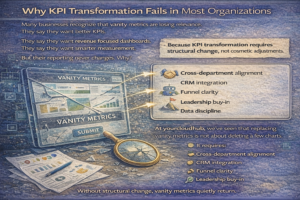
Many businesses recognize that vanity metrics are losing relevance.
They say they want better KPIs.
They say they want revenue-focused dashboards.
They say they want smarter measurement.
But their reporting never changes.
Why?
Because KPI transformation requires structural change, not cosmetic adjustments.
At yourcloudhub, we’ve seen that replacing vanity metrics is not about deleting a few charts. It requires:
• Cross-department alignment
• CRM integration
• Funnel clarity
• Leadership buy-in
• Data discipline
Without structural change, vanity metrics quietly return.
The Hidden Addiction to Surface-Level Growth
Vanity metrics create psychological comfort.
They:
• Show upward graphs
• Provide quick wins
• Impress stakeholders
• Make teams feel productive
Revenue metrics, in contrast:
• Expose inefficiencies
• Reveal weak conversion stages
• Highlight operational gaps
• Require accountability
This is why many organizations struggle to fully abandon surface-level reporting.
At yourcloudhub, we encourage leadership teams to embrace uncomfortable clarity. Because clarity drives growth.
The KPI Hierarchy Model for 2026
To replace vanity metrics effectively, businesses must understand the KPI hierarchy.
There are three levels:
Level 1: Activity Metrics
Level 2: Performance Metrics
Level 3: Outcome Metrics
Most companies stay stuck at Level 1.
Let’s break this down.
Level 1: Activity Metrics
These include:
• Content published
• Ads launched
• Emails sent
• Campaigns created
They measure effort, not impact.
Activity metrics are useful internally but should never be primary indicators of success.
Level 2: Performance Metrics
These include:
• Click-through rate
• Engagement rate
• Bounce rate
• Cost per lead
They measure the effectiveness of execution.
Performance metrics are better than activity metrics, but still incomplete.
Level 3: Outcome Metrics
These include:
• Revenue per lead
• Marketing-influenced pipeline
• Customer acquisition cost
• Lifetime value
• Sales velocity
These metrics directly impact business sustainability.
At yourcloudhub, we guide companies to prioritize Level 3 while using Level 1 and Level 2 as diagnostic layers, not strategic anchors.
Designing Revenue-Centric Dashboards
A modern KPI dashboard in 2026 should answer five core questions:
1. How much pipeline is being created
2. How fast are deals progressing
3. What percentage converts to revenue
4. What it costs to acquire customers
5. How long customers stay
Anything outside these questions is secondary.
Dashboards overloaded with impressions and follower counts distract from what matters.
Sales and Marketing Must Share KPIs
In many organizations, marketing celebrates traffic growth while sales complain about lead quality.
This disconnect destroys efficiency.
Shared KPIs include:
• Marketing-qualified opportunity rate
• Revenue influenced by campaigns
• Lead-to-close conversion percentage
• Average deal size by source
At yourcloudhub, aligning sales and marketing metrics is often the single most transformative shift businesses make.
Alignment eliminates internal blame cycles and focuses teams on revenue.
The Rise of Revenue Attribution Models
Attribution is no longer optional.
Modern tracking should identify:
• Which content influenced deals
• Which campaigns shortened sales cycles
• Which channels generate the highest lifetime value
Multi-touch attribution is essential in 2026 because buyer journeys are no longer linear.
Yourcloudhub helps businesses connect CRM data with marketing platforms to uncover true influence instead of relying on last-click assumptions.
Measuring Authority Instead of Attention
Attention is rented.
Authority is owned.
Authority KPIs include:
• Branded search growth
• Repeat direct visits
• Referral mentions
• Returning visitor ratio
• Sales calls referencing content
Authority signals indicate that your market trusts you before speaking to you.
These signals compound over time and are far more powerful than fluctuating reach numbers.
Velocity-Based KPIs: The Hidden Growth Lever
One of the most overlooked metrics in 2026 is velocity.
Velocity measures:
• Time from first interaction to pipeline entry
• Time from opportunity to close
• Time between touchpoints
Faster velocity indicates:
• Clear positioning
• Strong messaging
• Reduced friction
• High buyer confidence
At yourcloudhub, we treat velocity as a performance multiplier.
Faster decisions reduce acquisition cost and increase operational efficiency.
Profitability KPIs Over Growth KPIs
Growth without margin is unsustainable.
Instead of focusing only on:
• Revenue growth rate
• Lead growth rate
Businesses must track:
• Gross margin per acquisition channel
• Customer lifetime profitability
• Cost-to-serve metrics
• Marketing efficiency ratio
Profitability KPIs protect long-term sustainability.
Vanity growth often hides shrinking margins.
Retention as the New Growth Metric
Acquisition is expensive.
Retention drives stability.
Retention KPIs include:
• Renewal rate
• Repeat purchase rate
• Upsell conversion rate
• Churn percentage
Retention metrics are far more predictive of long-term growth than short-term traffic spikes.
Yourcloudhub emphasizes retention analysis because stable revenue reduces pressure on acquisition channels.
The Shift From Campaign ROI to System ROI
Campaign-based thinking isolates results.
System-based thinking evaluates:
• Entire funnel performance
• Lead nurturing effectiveness
• Cross-channel synergy
• Long-term revenue contribution
In 2026, growth will not be driven by a single campaign.
It is driven by integrated systems.
At yourcloudhub, we help organizations transition from campaign reporting to system intelligence.
The Danger of Misleading Short-Term Wins
A viral post may spike traffic.
A successful ad campaign may generate quick leads.
But without strong downstream conversion, these wins evaporate.
True KPI frameworks measure:
• Sustainability
• Conversion consistency
• Revenue stability
Short-term wins should never override long-term performance indicators.
Leadership’s Role in KPI Evolution
KPI transformation must start at the top.
Leadership must:
• Demand revenue-focused reporting
• Eliminate surface-level dashboards
• Encourage honest performance analysis
• Reward long-term growth metrics
Without executive alignment, teams revert to comfortable, vanity-tracking.
At yourcloudhub, we often begin KPI reform with leadership workshops before touching dashboards.
Cultural Shift: From Reporting to Learning
Modern KPI systems should support learning, not just reporting.
Ask:
• What is slowing down our sales cycle
• Which stage has the highest drop-off
• Which audience converts fastest
• What messaging reduces objections
KPIs should generate insight, not just numbers.
Learning-driven measurement fuels innovation.
AI’s Impact on Measurement
AI is changing discovery patterns.
Zero-click search reduces measurable visits.
Decision-making happens across multiple platforms.
This makes simplistic traffic metrics increasingly unreliable.
Businesses must now track:
• Assisted conversions
• Cross-channel interactions
• Behavioral signals
Yourcloudhub integrates AI-era visibility into KPI frameworks so companies do not misinterpret shifting traffic trends.
What a 2026 KPI Meeting Should Look Like
Instead of reviewing:
• Traffic growth
• Follower count
• Campaign impressions
Meetings should analyze:
• Pipeline creation trends
• Conversion efficiency
• Revenue influenced
• Churn rates
• Velocity improvements
Conversations should focus on:
• Removing bottlenecks
• Improving lead quality
• Increasing deal value
• Shortening cycles
This is how strategic growth is built.
The Long-Term Advantage of KPI Discipline
Companies that adopt revenue-focused KPIs early experience:
• Better forecasting accuracy
• Lower acquisition costs
• Higher close rates
• Stronger cross-team alignment
• Reduced operational waste
Measurement clarity compounds over time.
Vanity metrics produce noise.
Strategic KPIs produce stability.
The Era of Surface Growth Is Ending
In 2026, visibility without conversion is irrelevant.
Engagement without revenue is fragile.
Impressions without influence are empty.
At yourcloudhub, we believe KPI transformation is not about the sophistication of analytics.
It is about strategic maturity.
The companies that thrive in the coming years will not be those with the largest dashboards.
They will be the ones with the clearest understanding of what truly drives sustainable revenue.
Vanity metrics are fading.
Revenue intelligence is rising.
And businesses that embrace this shift early will build growth systems that competitors struggle to replicate.