


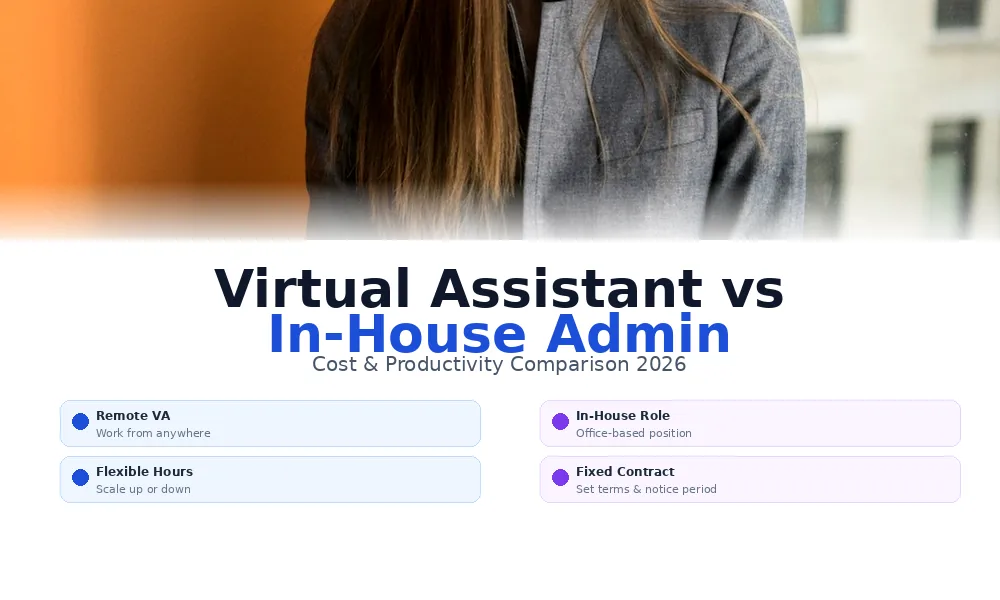
The Administrative Support Decision Every Growing Business Faces
At a predictable point in the growth of almost every business, administrative tasks begin competing seriously with revenue-generating work for the owner’s time. The question of whether to hire in-house or engage a remote virtual assistant becomes urgent and consequential. Understanding the real differences between these options — in cost, flexibility, speed, and capability — is essential before making a commitment that will define how you operate for years to come.
The True Cost of In-House Administrative Hiring
The headline salary on a job listing understates the true cost of an in-house hire significantly. In the US, a competent administrative professional earns between $40,000 and $58,000 in base salary. Employer payroll taxes add approximately 15 percent. Health insurance, paid vacation, sick leave, equipment, and office space add further overhead. The true all-in annual cost of a US-based admin hire is typically $65,000 to $85,000 — substantially above the advertised salary figure that appears in hiring budgets. In the UK, a similar calculation produces a total cost 30 to 40 percent above the salary.
What a Remote Virtual Assistant Costs
A dedicated virtual assistant from India provides equivalent administrative output at a fundamentally different cost structure. General administrative VA support starts from $5 per hour. A full-time dedicated VA typically costs between $800 and $1,500 per month. There are no employer taxes, no benefits obligations, no sick pay, no holiday pay, and no office or equipment costs. At full-time equivalent hours, the annual cost is $9,600 to $18,000 — a saving of 75 to 85 percent compared to a local hire delivering equivalent administrative output across the same range of tasks.
Flexibility as a Core Operational Advantage
In-house employment contracts are designed for stability — precisely what makes them expensive to exit when workload changes. A remote virtual assistant engagement scales with your workload by design. Increase hours during a busy quarter. Reduce hours during quieter periods. Pause during a restructure. This flexibility has significant operational and financial value for businesses where administrative demand fluctuates month to month, and it is entirely unavailable in traditional employment models at any comparable cost point.
What a Modern Virtual Assistant Handles
The scope of tasks a skilled VA handles extends well beyond basic scheduling and filing. Email management, calendar coordination, CRM maintenance, social media scheduling, research, travel booking, document preparation, customer service, and supplier coordination are all within standard VA capability. For specialised needs, businesses can complement a general VA with a remote finance expert or a digital marketing specialist, building a capable remote team at a fraction of the equivalent local staffing cost with none of the employment overhead.
Speed to Operational
Recruiting a full-time in-house admin professional typically takes four to eight weeks from job posting to start date. Onboarding adds a further two to four weeks before full productivity. A virtual assistant can be identified, briefed, and operational within 48 hours. For businesses where administrative capacity is urgently needed, this speed advantage is significant and consistently underestimated at the point where the hiring decision is being made and competing priorities are creating the most pressure on the business owner’s time.
Communication and Accountability in Practice
Professional VA arrangements use structured daily check-ins via Slack or video call, shared task management in tools like Asana or Trello, agreed turnaround times for standard task categories, and weekly performance reviews against clear deliverables. Many business owners find this structured remote accountability framework more transparent and measurable than informal in-office arrangements where physical presence is mistaken for productivity and actual output is rarely reviewed systematically.
When In-House Makes More Sense
Roles requiring physical presence — office management, reception, handling physical documents — cannot be performed remotely by definition. For these specific roles, an in-house hire remains the right answer. For the majority of growing businesses, however, the administrative tasks driving the need for support — email, calendar, CRM, research, documents, customer communication — are entirely digital and can be handled with identical quality by a skilled dedicated remote virtual assistant at a fraction of the local hire cost.
Making the Right Decision
The clearest indicator that a virtual assistant is the right choice is a genuine administrative need combined with a workload that does not justify a full-time local hire at local rates. If you need 15 to 35 hours of capable administrative support per week, no local staffing model delivers that at a cost that makes economic sense for a growing business. A dedicated remote virtual assistant covers that ground reliably, flexibly, and at a cost that frees budget for activities that directly drive business growth — making it one of the most consistently effective operational decisions among scaling businesses globally in 2026 and beyond.
The Compounding Value of a Well-Managed VA Relationship
The full value of a virtual assistant engagement becomes most apparent over the medium term, as the delegation system matures, the VA builds deep context on your business, and the time savings compound into consistent growth in high-value output. The combination of cost savings, operational flexibility, and recovered senior time makes a well-structured remote virtual assistant arrangement one of the most consistently high-return operational decisions a growing business makes. Pairing a VA with a remote finance specialist and a digital marketing professional creates a lean, capable, fully remote team delivering professional-grade output across administration, finance, and marketing at a combined cost well below equivalent local employment in any Western market.
Practical Steps to Getting Started
Moving from considering a virtual assistant to having one operational is a five-step process: identify the three to five tasks consuming the most of your time each week; document the process for each as a simple written guide; brief a shortlisted VA on these tasks with a two-week trial; review output daily and refine the guidelines as needed; and extend the engagement as confidence and scope grow. Most business owners are surprised by how quickly a dedicated remote virtual assistant reaches full operational effectiveness — typically within two to three weeks for standard administrative tasks, and four to six weeks for more complex, context-dependent work. The investment in the setup process pays for itself within the first month through recovered time, and continues delivering returns every working week thereafter as the engagement matures into a reliable, high-value working relationship.