
How IT Companies Should Approach Website & SEO in 2026
An effective website and SEO strategy for IT companies attracts high-intent leads, establishes authority, and converts technical audiences with clear, structured, and valuable content.
IT and technology companies serve markets where buyers do extensive research. Your website must not only rank but also educate, build trust, and guide prospects through their buying journey.
At Your Cloud Hub, we help technology companies design websites and SEO systems that generate qualified leads consistently rather than relying on short-term traffic spikes. Contact us today to start building a strategy that delivers long-term growth.
Why IT Companies Need a Different SEO Strategy
SEO for IT businesses differs from other industries due to complex services, longer sales cycles, and multiple stakeholders.
Technology buyers are analytical, well-versed in technical concepts, and often require buy-in from multiple stakeholders. They expect information-rich, actionable content—generic marketing is ineffective for this audience.
This makes a specialized SEO strategy crucial for technology companies.
Key differences include:
Longer sales cycles
High-value deals
Complex service offerings
Multiple decision-makers
Due to these complexities, SEO must prioritize in-depth educational content, technical clarity, and demonstrable authority over superficial keyword optimization.
The Foundation: Website Strategy for Tech Companies
Before SEO can succeed, the website itself must be optimized for user experience and conversions.
A website strategy for tech companies prioritizes clarity, structure, and conversion.
Your website should clearly answer:
What you offer
Who you help
Why are you different
Technical stakeholders lack patience for unclear or ambiguous copy. Messaging must be direct, actionable, and grounded in technical relevance.
At Your Cloud Hub, we often see that improving messaging clarity alone significantly increases conversion rates.
Structuring a High-Performing IT Website
An intelligently engineered website framework supports how technical users navigate your site and how search engines interpret it.
Essential pages include:
Homepage with clear positioning
Service pages for each offering
Industry-specific solutions pages
Case studies and success stories
Blog or resource section
Each page should serve a specific purpose within the overall IT company SEO strategy.
Service pages target high-intent keywords, blog content attracts early-stage prospects, and case studies build trust. This structure forms a cohesive system, not isolated pages.
SEO for IT Services Companies: Targeting the Right Keywords
Keyword strategy is pivotal for SEO success.
IT companies should avoid focusing only on high-volume keywords and instead prioritize high-intent keywords.
Instead, they should prioritize high-intent keywords.
Examples include:
Solution-based queries
Problem-focused searches
Service-specific terms
At this stage, SEO for IT service providers becomes about engineering precise solutions, not chasing non-specific traffic.
For example:
A keyword like “cloud migration services” may generate fewer searches than a broad term like “cloud computing,” but it attracts prospects ready to take action.
At Your Cloud Hub, we prioritize intent-driven keyword strategies to improve lead quality. Reach out to discover how your IT company can attract more qualified prospects.
Content Strategy for IT SEO
In the technical sector, content drives SEO growth by addressing use cases, technical challenges, and best practices relevant to IT audiences.
IT companies need content tailored to knowledgeable audiences, as generic content underperforms in technology markets.
Generic content underperforms in competitive technology sectors.
A strong SEO strategy for technology companies focuses on:
Educational content
Technical explanations
Solution comparisons
Industry insights
Examples of effective content include:
“How to migrate to cloud infrastructure.”
“On-premise vs cloud solutions comparison”
“Best cybersecurity practices for enterprises”
This type of content attracts informed audiences and builds authority.
Topic Clusters and Authority Building
Search engines increasingly prioritize topical authority.
Instead of publishing random articles, IT companies should build topic clusters.
A topic cluster consists of multiple pieces of content centered on a core theme.
For example:
Core topic: Cloud migration
Supporting content:
Benefits of cloud migration
Challenges in cloud migration
Cloud migration cost analysis
Best tools for migration
This structure signals expertise and strengthens the IT company’s SEO strategy.
Technical SEO for IT Websites
Technical performance is crucial to SEO success.
IT company websites require fast speed, mobile responsiveness, security, and clean code.
Search engines favor websites that deliver fast and reliable experiences.
Technical SEO ensures optimal crawlability, indexability, and semantic structure—requirements for IT-focused online platforms.
At Your Cloud Hub, technical optimization is a core component of every website and SEO strategy for IT companies. Schedule a consultation with us to ensure your site meets industry standards.
Conversion Optimization for IT Websites
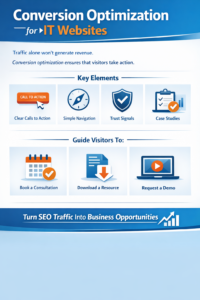
Traffic alone won’t generate revenue.
Conversion optimization ensures that visitors take action.
Key elements include:
Clear calls to action
Simple navigation
Trust signals, such as testimonials
Case studies demonstrating results
For example:
A visitor reading a blog post should be guided toward:
Booking a consultation
Downloading a resource
Requesting a demo
This transforms SEO traffic into actual business opportunities.
The Role of Case Studies in IT SEO
Case studies are one of the most powerful assets for technology companies.
They showcase real-world outcomes and enhance credibility.
A strong case study should include:
The client’s challenge
The solution implemented
The results achieved
Search engines also value case studies because they provide detailed, unique content.
Including case studies strengthens both SEO performance and conversion rates.
Building Trust Through Expertise
Trust is a crucial factor in B2B IT markets, influencing technical partner selection.
Buyers require assurance before selecting a provider.
Authority-building strategies include:
Publishing expert insights
Sharing technical knowledge
Providing actionable advice
At Your Cloud Hub, we emphasize trust as a key factor in SEO success. Contact us to learn how your website can build authority and convert more visitors.
Websites that demonstrate expertise convert more effectively.
Local and Global SEO for IT Companies
Some IT companies operate locally, while others serve global markets.
SEO strategies should reflect the target audience.
Local SEO focuses on:
Location-based keywords
Google Business profiles
Local listings
Global SEO focuses on:
Broader keyword targeting
International content strategies
Scalable content systems
A tailored approach ensures better results.
Integrating SEO With Marketing Systems
SEO must operate within a broader integrated marketing technology ecosystem.
It should connect with other marketing activities such as:
Email campaigns
Lead nurturing systems
Content marketing
Sales processes
For example:
SEO content can attract leads.
Email campaigns can nurture those leads.
Sales teams can convert them.
This integrated approach improves overall efficiency.
Measuring SEO Performance
To improve SEO results, businesses must track performance metrics.
Important metrics include:
Organic traffic growth
Keyword rankings
Conversion rates
Lead quality
Continuous performance measurement exposes optimization opportunities and highlights content gaps.
At Your Cloud Hub, we focus on metrics that impact revenue rather than vanity metrics. Speak with our team to refine your SEO measurement approach.
Common SEO Mistakes IT Companies Make
Many IT companies struggle with SEO due to common mistakes.
These include:
Focusing only on traffic instead of conversions
Publishing generic content
Ignoring technical SEO
Lack of a clear website structure
Avoiding these mistakes requires a strategic approach.
The Future of SEO for Technology Companies
SEO is evolving rapidly due to AI-driven search systems.
Future strategies must focus on:
Clear content structure
Answer-first content
Authority building
User experience
Businesses that adapt to these changes will maintain visibility.
At Your Cloud Hub, we design SEO strategies that align with both traditional search engines and AI-driven discovery. Partner with us to future-proof your technology company’s online presence.
Moving From Keyword Targeting to Search Intent Strategy
Traditional SEO focused heavily on keywords.
Modern SEO focuses on user intent instead of just keywords.
Search engines now prioritize content that matches the user’s purpose rather than just keyword usage.
For example:
A user searching for “IT infrastructure solutions” may be looking for:
Educational information
Vendor comparisons
Implementation guidance
Understanding intent allows businesses to create content that answers real questions.
A strong SEO strategy for technology companies aligns content with different types of intent:
Informational intent for early-stage research
Commercial intent for solution comparison
Transactional intent for decision-making
Matching content to intent improves both rankings and conversions.
Designing Content for AI Search and LLM Visibility
Search behavior is evolving due to AI-generated answers.
Users increasingly receive summarized responses rather than having to click multiple links.
This shift requires a new approach to SEO.
Content must now be:
Clear and structured
Answer-focused
Contextually rich
AI systems prioritize content that explains topics directly.
For example, instead of long introductions, content should begin with clear answers.
This approach strengthens both traditional SEO and AI visibility.
At Your Cloud Hub, we build content frameworks designed for both human readers and AI interpretation systems.
Creating Solution-Based Landing Pages
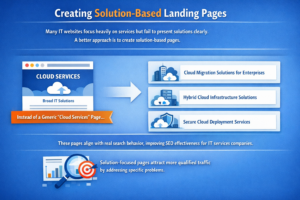
Many IT websites focus heavily on services but fail to present solutions clearly.
A better approach is to create solution-based pages.
For example:
Instead of a generic “Cloud Services” page, create pages such as:
Cloud migration solutions for enterprises
Hybrid cloud infrastructure solutions
Secure cloud deployment services
These pages align with real search behavior, improving SEO effectiveness for IT services companies.
Solution-focused pages attract more qualified traffic because they address specific problems.
Industry-Specific SEO for IT Companies
IT companies often serve multiple industries.
Creating industry-specific pages improves relevance and conversion rates.
For example:
IT services for healthcare
IT solutions for finance
Technology consulting for startups
Each industry has unique challenges and requirements.
Tailored content demonstrates understanding and builds trust.
This approach strengthens the overall IT company SEO strategy by effectively targeting niche audiences.
Building a Content Funnel for IT SEO
Content should not exist in isolation.
It should guide users through a structured journey.
A content funnel typically includes:
Top-of-funnel content for awareness
Middle-of-funnel content for evaluation
Bottom-of-funnel content for conversion
For example:
A blog article explains a problem.
A guide explores solutions.
A service page offers implementation support.
This structured approach ensures that SEO contributes directly to business growth.
At Your Cloud Hub, we design content funnels that align with buyer journeys.
Leveraging Internal Linking for Authority
Internal linking is often overlooked in SEO strategies.
However, it plays a critical role in building authority.
Internal links help search engines understand relationships between pages.
They also guide users through relevant content.
For example:
A blog post about cloud security can link to:
A detailed service page
A case study
A technical guide
This creates a connected content ecosystem.
Strong internal linking improves both rankings and user experience.
The Role of Backlinks in IT SEO
Backlinks remain an important ranking factor.
However, quality matters more than quantity.
IT companies should focus on earning backlinks from:
Industry publications
Technology blogs
Partner websites
Research reports
High-quality backlinks signal authority to search engines.
They also drive referral traffic from relevant sources.
A strategic backlink approach strengthens the overall SEO strategy for technology companies.
Conversion-Focused SEO: Turning Traffic Into Leads
SEO success is not measured by traffic alone.
The real goal is lead generation.
Conversion-focused SEO ensures that visitors take meaningful actions.
Key strategies include:
Adding clear calls to action on every page
Offering valuable resources such as guides or reports
Providing easy ways to contact sales teams
For example:
A visitor reading an article about cybersecurity should be guided toward a consultation or assessment.
This transforms informational traffic into business opportunities.
Using Data to Continuously Improve SEO Performance
SEO is not a one-time effort.
It requires continuous optimization.
Data analysis helps identify:
Which pages perform well
Which topics attract the most traffic
Where users drop off
For example:
If a blog post generates high traffic but low conversions, the call to action may need improvement.
If certain keywords drive qualified leads, more content can be created around those topics.
At Your Cloud Hub, we use data-driven insights to continuously refine SEO strategies.
Scaling SEO Through Content Systems
Many companies struggle with consistency in content creation.
Publishing content sporadically limits results.
A scalable approach involves building content systems.
This includes:
Planning content calendars
Defining topic clusters
Repurposing existing content
For example:
One piece of content can be expanded into multiple formats:
Blog articles
Social media posts
Email campaigns
This approach maximizes output without significantly increasing effort.
Aligning SEO With Sales Objectives
SEO should support business goals directly.
This requires alignment between SEO strategy and sales objectives.
For example:
If the goal is to generate enterprise clients, content should target enterprise-level challenges.
If the focus is on specific services, SEO should prioritize those areas.
Alignment ensures that SEO efforts contribute to revenue rather than just traffic.
Building Trust Through Technical Expertise
IT buyers evaluate vendors based on expertise.
Content must demonstrate deep technical understanding.
Examples include:
Detailed technical guides
Architecture diagrams
Implementation strategies
This type of content differentiates companies from competitors.
At Your Cloud Hub, we emphasize expertise-driven content to build trust and authority.