


Why Website Redesign Is a Strategic Move
A website redesign is not just about visual improvement. It is a strategic decision that directly impacts how your business attracts, engages, and converts visitors.
Many companies delay redesign because their website is still functional. But functionality is no longer enough. In today’s digital environment, your website must perform as a growth engine.
Understanding why redesigning your website is critical. A well-executed redesign improves user experience, strengthens brand credibility, and increases conversion rates.
At Your Cloud Hub, we treat redesign as a business upgrade, not just a design refresh.
When to Redesign a Website
Knowing when to redesign a website is essential for staying competitive. Businesses often wait too long, losing opportunities in the process.
Here are the key signals that indicate it is time for a redesign.
Outdated Design That Reduces Trust
First impressions matter.
If your website looks outdated, users may question your credibility before even reading your content.
Modern users expect clean layouts, intuitive navigation, and professional design.
An outdated interface creates friction and reduces engagement.
A redesign ensures your website reflects current standards and builds trust instantly.
Declining Conversion Rates
Traffic alone does not drive growth.
If visitors are not taking action, your website is underperforming.
Common conversion issues include:
Unclear messaging
Poor content structure
Weak calls to action
A strong website redesign strategy focuses on improving how users move from interest to action.
Poor Mobile Experience
Most users now access websites through mobile devices.
If your website is not optimized for mobile, you risk losing a significant portion of your audience.
Signs of poor mobile experience include:
Slow loading times
Difficult navigation
Unresponsive layouts
A redesign ensures your website is fully responsive and accessible across devices.
Slow Website Performance
Speed plays a major role in both user experience and SEO.
Slow websites lead to:
Higher bounce rates
Lower engagement
Reduced search rankings
Improving performance is one of the key benefits of website redesign.
A faster website keeps users engaged and improves overall results.
Changes in Business Strategy
Businesses evolve over time.
New services, new target markets, or new positioning require updated messaging.
If your website no longer reflects your current business direction, it may confuse potential customers.
A redesign aligns your website with your current goals and offerings.
Why Redesign Your Website: Key Benefits
Understanding why redesign your website becomes easier when you look at the benefits it delivers.
User experience determines how visitors interact with your website.
A redesigned website provides:
Clear navigation
Better content structure
Simplified user journeys
When users can easily find what they need, they are more likely to stay and engage.
Higher Conversion Rates
One of the most important benefits of a website redesign is improved conversions.
A redesign allows businesses to:
Refine messaging
Optimize calls to action
Guide users toward key actions
Better structure leads to better results.
Stronger Brand Positioning
Your website represents your brand.
A modern, well-designed website communicates professionalism and expertise.
It helps establish trust with potential customers.
A redesign ensures your brand image remains relevant and competitive.
Better SEO Performance
Search engines favor websites that provide strong user experiences.
A redesign improves:
Site structure
Page speed
Content organization
These factors contribute to better rankings.
A well-planned website redesign strategy supports both users and search engines.
Increased Engagement
Engagement reflects how users interact with your content.
A redesigned website encourages users to:
Explore more pages
Spend more time on the site
Interact with content
Higher engagement leads to stronger relationships and better conversion opportunities.
Building an Effective Website Redesign Strategy
A successful website redesign strategy requires careful planning.
Redesign should not be rushed or based solely on aesthetics.
Step 1: Define Clear Goals
Before starting, identify what you want to achieve.
Goals may include:
Increasing conversions
Improving user experience
Strengthening brand positioning
Enhancing SEO performance
Clear goals guide the redesign process.
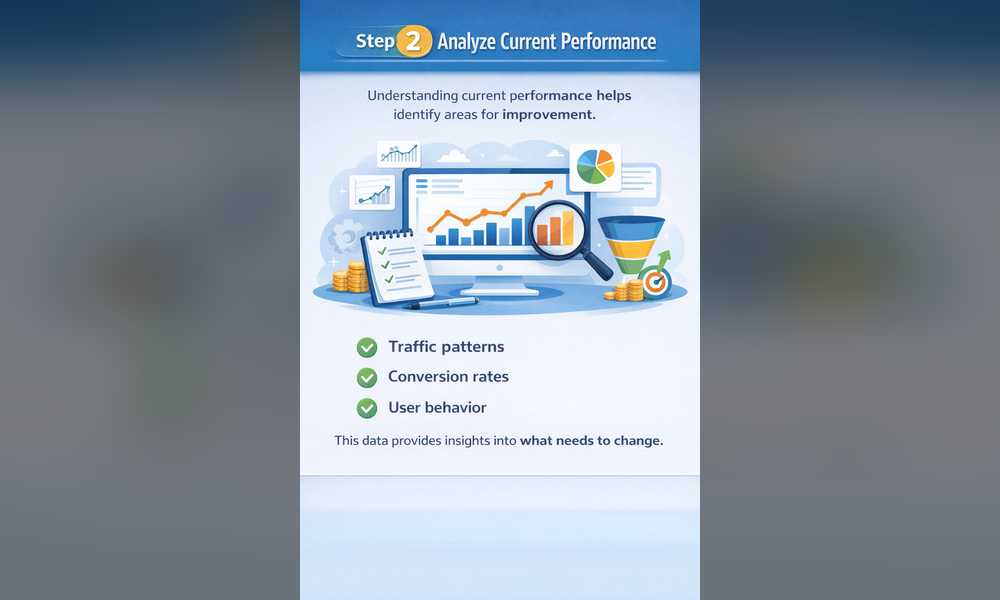
Step 2: Analyze Current Performance
Understanding current performance helps identify areas for improvement.
Review:
Traffic patterns
Conversion rates
User behavior
This data provides insights into what needs to change.
Step 3: Improve Content Structure
Content should be organized to support user journeys.
Key elements include:
Clear headings
Logical flow
Focused messaging
Content clarity is essential for both users and search engines.
Step 4: Optimize for Mobile and Speed
Mobile responsiveness and speed are non-negotiable.
A redesign should ensure:
Fast loading times
Smooth navigation
Responsive layouts
These improvements enhance user experience and SEO performance.
Step 5: Focus on Conversion Design
Every page should guide users toward action.
This includes:
Clear calls to action
Simple forms
Trust signals, such as testimonials
Conversion-focused design ensures that traffic translates into results.
Focusing Only on Design
Visual changes alone do not improve performance.
A redesign must address functionality, content, and user experience.
Ignoring Data
Redesign decisions should be based on data, not assumptions.
Ignoring analytics can lead to ineffective changes.
Overcomplicating the User Experience
Adding too many features can confuse users.
Simplicity often leads to better results.
Neglecting SEO During Redesign
Changes to website structure can impact search rankings.
Proper planning ensures that SEO performance is maintained or improved.
How Often Should You Redesign Your Website
There is no fixed timeline, but most businesses benefit from evaluating their website every few years.
Instead of waiting for major issues, continuous improvement is recommended.
Regular updates help maintain performance and relevance.
The Role of Your Cloud Hub
At Your Cloud Hub, we approach website redesign as a strategic process.
Our focus includes:
Improving user experience
Enhancing conversion performance
Aligning design with business goals
Strengthening SEO foundations
We ensure that redesign efforts contribute directly to growth.
A website redesign is not just a visual upgrade.
It is an opportunity to improve how your business performs online.
Understanding when to redesign a website and implementing a clear redesign strategy helps businesses stay competitive.
The website redesign benefits go beyond appearance.
They include better engagement, higher conversions, and stronger brand positioning.
At Your Cloud Hub, we believe that redesign should be driven by strategy, not just style.
Advanced Redesign Strategy, SEO Impact, and Conversion-Focused Execution
A successful website redesign is not just about improving how a site looks. It is about transforming how it performs across the entire customer journey.
Many businesses redesign their website but fail to see meaningful results. The reason is simple.
They focus on design instead of strategy.
To truly understand why you should redesign your website, you must look beyond visuals and focus on how the redesign impacts traffic, engagement, and conversions.
At Your Cloud Hub, we design websites as performance systems, not static pages.
Redesigning for Conversion, Not Just Appearance
One of the biggest mistakes businesses make is treating redesign as a design project.
In reality, it is a conversion project.
A well-planned website redesign strategy ensures that every page guides users toward a specific action.
This includes:
Booking a consultation
Filling out a form
Requesting a demo
Making a purchase
If users visit your website but do not take action, your website is not performing effectively.
Mapping User Journeys Before Redesign
Before starting a redesign, businesses must understand how users interact with their website.
This involves mapping user journeys.
Questions to consider include:
Where do users enter the website
What pages do they visit
Where do they drop off
What actions do they take
This data reveals friction points.
A redesign should eliminate these obstacles and create smoother pathways.
This is a critical part of a successful website redesign strategy.
Aligning Website Structure With Business Goals
Every website should support business objectives.
For example:
If the goal is lead generation, the website should prioritize forms and consultation offers.
If the goal is product sales, the website should focus on clear product pages and a streamlined checkout process.
Alignment ensures that redesign efforts contribute directly to growth.
Understanding when to redesign a website often comes down to misalignment between the website and business goals.
SEO Considerations During Website Redesign
SEO is often overlooked during redesign.
However, changes to structure, URLs, and content can impact rankings.
A strong website redesign strategy must include SEO planning.
Key considerations include:
Maintaining existing URLs where possible
Redirecting old pages properly
Optimizing new content for search intent
Improving site speed and structure
These steps ensure that the redesign improves SEO rather than harming it.
Content Optimization During Redesign
Content plays a major role in website performance.
Redesign provides an opportunity to improve content quality.
This includes:
Clarifying messaging
Simplifying language
Organizing information logically
Content should answer key questions clearly.
What do you offer
Who do you help
Why should customers choose you
Clear content improves both user experience and conversions.
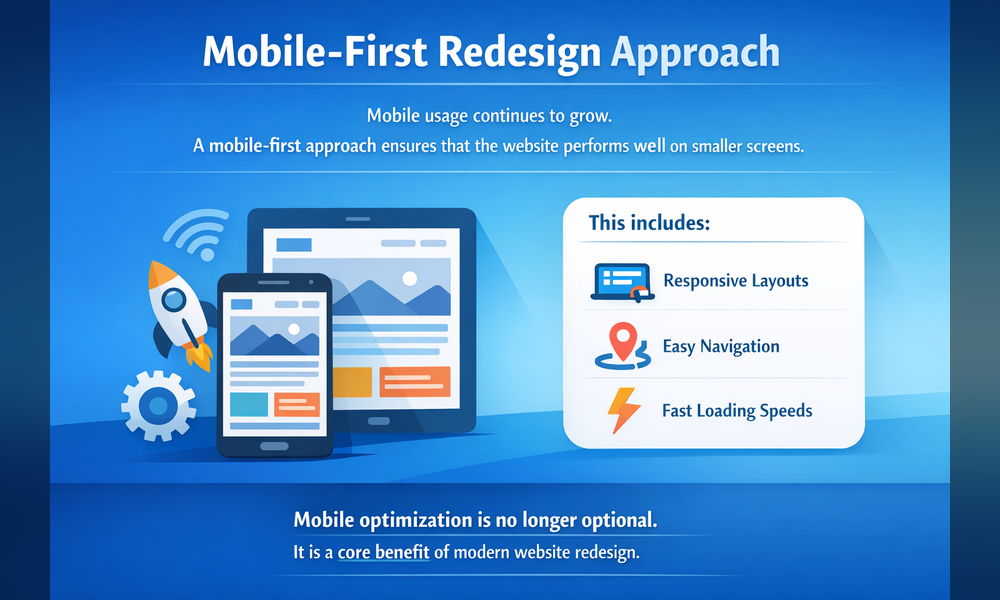
Mobile-First Redesign Approach
Mobile usage continues to grow.
A mobile-first approach ensures that the website performs well on smaller screens.
This includes:
Responsive layouts
Easy navigation
Fast loading speeds
Mobile optimization is no longer optional.
It is a core benefit of modern website redesign.
Speed Optimization as a Priority
Website speed directly affects user experience and SEO.
Slow websites lead to:
Higher bounce rates
Lower engagement
Reduced conversions
During redesign, performance optimization should be a priority.
This includes:
Optimizing images
Reducing unnecessary code
Improving server response times
Faster websites create better user experiences.
Building Trust Through Design
Trust is a key factor in online decision-making.
A redesigned website should include elements that build credibility.
Examples include:
Client testimonials
Case studies
Certifications
Clear contact information
These elements reassure users and encourage engagement.
Understanding why redesigning your website often comes down to improving trust.
Simplifying Navigation for a Better Experience
Complex navigation confuses users.
A redesign should focus on simplicity.
Users should be able to find information quickly and easily.
Clear menus, logical page structure, and intuitive design improve usability.
This leads to higher engagement and better conversion rates.
Integrating Lead Capture Systems
A website should not only inform but also capture leads.
Redesign provides an opportunity to integrate lead capture elements such as:
Forms
Call-to-action buttons
Pop-ups
Downloadable resources
These elements convert visitors into prospects.
This is one of the most valuable benefits of a website redesign.
Continuous Testing and Improvement
A redesign is not the final step.
It is the beginning of continuous improvement.
Businesses should test different elements such as:
Headlines
Calls to action
Page layouts
Testing helps identify what works best.
Ongoing optimization ensures the website continues to improve over time.
Avoiding Redesign Pitfalls
Even well-planned redesigns can fail if certain mistakes occur.
Common pitfalls include:
Ignoring user data
Overcomplicating design
Removing important content
Neglecting SEO
Avoiding these mistakes ensures better outcomes.
The Long-Term Impact of Website Redesign
A successful redesign creates long-term benefits.
These include:
Improved user experience
Higher conversion rates
Stronger brand positioning
Better SEO performance
Over time, these improvements contribute to business growth.
Extending the Strategy: Turning Your Website Into a Continuous Growth System
A website redesign should never be viewed as a one-time project.
The most successful businesses treat their websites as living systems that evolve continuously based on user behavior, data, and market changes.
Understanding why to redesign your website at a deeper level means recognizing that redesign is not an endpoint. It is the foundation for ongoing optimization.
At Your Cloud Hub, we emphasize building websites that adapt, improve, and scale over time.
From Redesign to Continuous Optimization
Once a redesign is completed, the real work begins.
Most businesses launch a new website and then leave it unchanged for years. This approach limits long-term performance.
Instead, a strong website redesign strategy should include ongoing improvements such as:
Updating content regularly
Testing new layouts and messaging
Improving user journeys
Optimizing conversion paths
Continuous optimization ensures that your website remains effective as user expectations evolve.
Using Data to Guide Improvements
Data should drive every decision after a redesign.
Key insights can be gathered from:
User behavior analytics
Heatmaps
Conversion tracking
Engagement metrics
For example:
If users frequently leave a page quickly, it may indicate unclear messaging.
If a form has low completion rates, it may be too complex.
Using data helps refine the website over time and maximize the benefits of the website redesign.
Adapting to Changing User Expectations
User expectations change rapidly.
What works today may not work tomorrow.
Businesses must stay updated with:
Design trends
Technology advancements
User behavior patterns
Regular updates keep your website relevant and competitive.
This is another reason why redesigning a website is not just about time, but about performance and relevance.
Integrating Marketing and Website Strategy
Your website should not operate independently.
It should be integrated with your marketing systems.
For example:
SEO brings traffic to your website
Email marketing nurtures leads
Sales teams convert prospects
A well-integrated system ensures that every visitor has a clear path forward.
This alignment maximizes the impact of your redesign.