


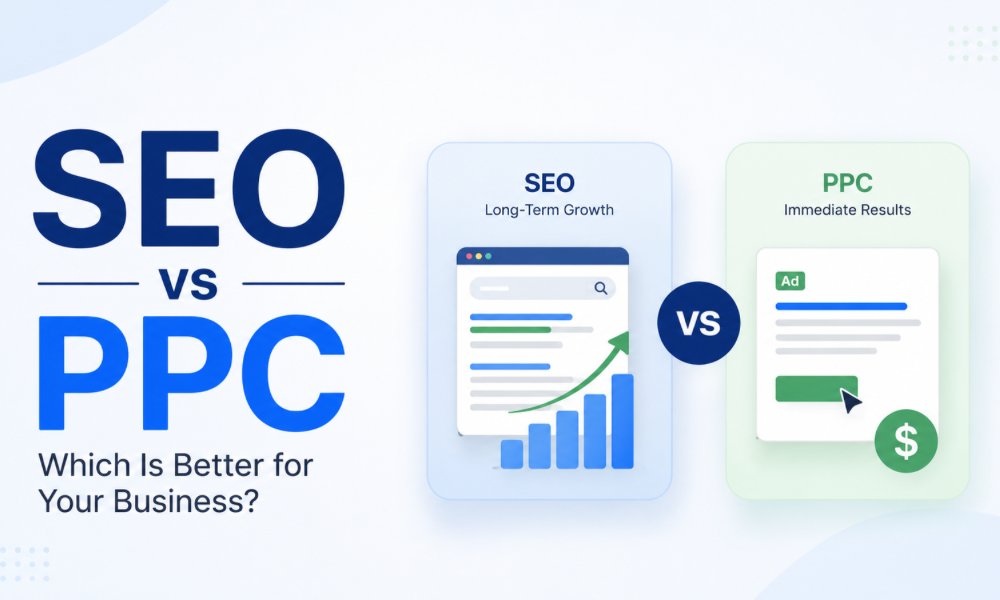
When businesses want to increase online visibility, SEO and PPC are usually among the first strategies considered. Both can attract potential customers to a website, support lead generation, and contribute directly to revenue. However, they work in very different ways. SEO focuses on earning organic visibility over time, while PPC allows businesses to pay for immediate exposure in search results.
The difficulty is deciding where to allocate your marketing budget. Some companies need leads quickly and cannot afford to wait several months for oanic visibility to improve. Others want to reduce their dependence on advertising and build a long-term source of qualified traffic. In many cases, the strongest strategy is not choosing one and ignoring the other, but understanding where each channel fits within the customer acquisition journey.
At Your Cloud Hub, we approach this decision from a business perspective rather than simply comparing traffic numbers. Whether you plan to hire SEO consultant support, hire search engine optimizer professionals, start hiring SEO expert resources, hire Google SEO expert specialists, or hire SEO expert India, the investment should ultimately help attract customers who are genuinely valuable to your business.
SEO and PPC Create Visibility in Different Ways
SEO improves the ability of website pages to appear naturally within search results. It involves technical optimization, content development, search intent research, internal linking, authority building, and continuous website improvements. Businesses do not purchase each organic click directly, but achieving competitive visibility still requires investment in people, content, technology, and expertise.
PPC works through paid placements. Businesses create campaigns around relevant searches and pay to bring users to specific landing pages. This gives marketers greater control over when and where they appear, making paid search particularly useful when immediate visibility matters.
The difference is essentially one of building versus buying attention. SEO develops an organic search asset over time, while PPC purchases access to existing search demand.
SEO Usually Takes Longer but Can Keep Creating Value
SEO is rarely the fastest way to generate new traffic. A new website entering a competitive industry may require months of consistent work before meaningful organic momentum develops. Search engines need time to discover pages, understand their relevance, evaluate authority, and compare them with existing competitors.
The advantage is that successful SEO work can continue producing results after the initial optimization. A well-developed service page can attract qualified searches repeatedly, while a useful educational article can continue bringing visitors long after publication.
Businesses that hire SEO consultant professionals should therefore view SEO as an ongoing growth investment. The objective should not be chasing temporary rankings but creating a website that becomes increasingly useful, authoritative, and visible over time.
PPC Can Put Your Business in Front of Customers Quickly
Speed is one of PPC’s strongest advantages. A business launching a new service does not necessarily want to wait until organic rankings improve before discovering whether customers are interested. Paid campaigns can create visibility much sooner and provide valuable feedback about actual market demand.
This makes PPC particularly useful for new companies, new locations, seasonal services, product launches, limited promotions, and businesses entering competitive markets.
However, immediate visibility should not be confused with immediate profitability. Paid advertising can generate clicks quickly, but landing-page quality, pricing, offer strength, follow-up speed, and sales performance determine whether those clicks eventually become customers.
SEO Helps Build Authority Around Your Industry
Modern customers rarely make important purchasing decisions after one search. They research problems, compare options, read educational information, evaluate providers, and look for evidence before contacting a company.
SEO gives businesses opportunities to appear throughout this research journey. A company can create informational content for early-stage searches, detailed service pages for solution-focused searches, comparison content for evaluation stages, and conversion pages for customers ready to act.
When businesses hire search engine optimizer expertise, this broader customer journey should influence the strategy. Ranking one commercial page is useful, but developing visibility across dozens or hundreds of relevant customer questions can create much stronger long-term authority.
PPC Gives Businesses Greater Control Over Traffic
SEO offers significant long-term potential, but businesses cannot completely control when rankings improve or which pages search engines choose to prioritize. PPC offers considerably more direct control.
Businesses can choose which campaigns receive budget, which geographic areas they target, when advertisements run, and which landing pages visitors reach. Campaigns can also be paused, expanded, or adjusted according to performance.
This flexibility makes PPC valuable for businesses that need to manage marketing around changing demand. If one service becomes particularly profitable, additional budget can be directed toward it. If another campaign produces weak leads, spending can be reduced while the strategy is reviewed.
SEO Is More Than Ranking for a Few Keywords
One of the biggest misunderstandings about SEO is that success means ranking number one for a small list of keywords. Search behavior is much broader than that. Customers use thousands of variations when researching products, problems, companies, and solutions.
A strong SEO strategy therefore develops topical relevance rather than focusing entirely on isolated phrases. It considers how service pages, educational resources, supporting articles, internal links, technical structure, and user experience work together.
Businesses beginning to hire SEO expert support should look for professionals who understand this wider picture. An SEO strategy should connect search visibility with the company’s actual services and customer needs rather than simply producing ranking reports every month.
PPC Can Be Expensive When Conversion Problems Are Ignored
Paid search is sometimes blamed when the real problem exists elsewhere in the customer journey. A campaign may successfully attract relevant visitors, yet those visitors leave because the website is slow, the offer is unclear, the landing page lacks trust, or the next action is difficult to understand.
Increasing the advertising budget in this situation simply sends more people into a weak conversion experience.
Before scaling PPC aggressively, businesses should understand what happens after the click. Landing pages should match the advertisement, communicate the offer clearly, answer important questions, and guide visitors toward a logical next action.
The strongest paid campaigns are supported by equally strong websites and sales processes.
SEO Can Reduce Dependence on Paid Customer Acquisition
A company that generates most of its leads through advertising can grow quickly, but it also becomes heavily dependent on continued advertising investment. If competition increases and click prices rise, customer acquisition costs can become difficult to control.
SEO provides another source of customer demand. Once the website develops meaningful organic visibility, qualified visitors can discover the company without every interaction requiring direct advertising spend.
This does not mean SEO eliminates marketing costs. Content needs updating, technical issues need fixing, and competitors continue improving. However, a diversified acquisition strategy gives businesses more flexibility than depending entirely on paid campaigns.
PPC Is Excellent for Testing New Opportunities
Businesses frequently make marketing decisions based on assumptions. They believe customers want a certain service, respond to particular language, or value a specific benefit. PPC can provide real-world feedback much faster.
Different offers can be tested. New geographic areas can be explored. Landing-page messaging can be compared. Commercial search themes can be evaluated before significant resources are committed elsewhere.
These insights can later improve SEO. If PPC reveals that a particular service consistently generates high-value customers, businesses can prioritize organic content around related searches.
This is one reason SEO and PPC become more powerful when they share data rather than operating as completely separate strategies.
SEO Requires Strong Technical Foundations
Excellent content alone cannot compensate for serious website problems. Search engines need to discover, crawl, understand, and appropriately index website pages before those pages can compete effectively.
Technical SEO can involve site architecture, mobile usability, page performance, internal linking, duplicate content management, structured information, indexing controls, and numerous other elements.
Businesses that hire Google SEO expert professionals should expect technical analysis to be connected with content and commercial priorities. Fixing technical issues simply because a tool reports them is not enough. The work should prioritize improvements capable of strengthening visibility, user experience, and business performance.
PPC Requires Careful Budget Management
The ability to generate traffic immediately makes PPC attractive, but it can also make wasted spending accumulate quickly. Businesses need to understand what they are willing to pay for leads and customers before scaling campaigns.
Cost per click alone provides an incomplete picture. An expensive click can be worthwhile if the customer has substantial value. A cheap click can still be wasteful if it consistently attracts visitors with little intention of buying.
Successful PPC management therefore connects advertising data with sales outcomes. The business needs to understand which campaigns produce revenue rather than simply which campaigns produce traffic.
SEO Can Support Brand Recognition Before the Sales Conversation
Organic search has another benefit that is difficult to measure through rankings alone. It creates repeated brand exposure.
A prospect may discover one article while researching a problem, encounter another page several weeks later, and eventually see the company’s service page when they are ready to purchase. By that point, the business no longer feels completely unfamiliar.
This repeated visibility can support trust before direct communication ever occurs. Strong SEO therefore contributes not only to traffic acquisition but also to brand recognition throughout longer buying journeys.
PPC Works Well for High-Intent Searches
Not every search has the same commercial value. Someone searching for general information may be months away from purchasing, while another person searching for a specific provider or service may be ready to take action immediately.
PPC allows businesses to concentrate spending around searches demonstrating stronger commercial intent.
This can be particularly valuable for businesses where a single customer has significant financial value. Paying to appear during the final stages of the buying journey may generate an attractive return even when advertising competition is expensive.
SEO Content Can Keep Working After Publication
One reason SEO can become increasingly efficient over time is that content does not necessarily stop generating value when a campaign ends. A useful guide published months ago can continue receiving impressions, clicks, links, and conversions.
Older content can also be updated rather than replaced. Businesses can improve examples, expand sections, refresh outdated information, strengthen internal linking, and optimize pages based on actual performance.
Organizations that hire SEO expert India can build scalable optimization processes that combine new content creation with ongoing improvements to existing pages, helping the website become stronger instead of constantly starting from zero.
PPC Data Can Make SEO Decisions Smarter
Paid search generates valuable information about what customers actually respond to. Businesses can see which search themes attract clicks, which messages encourage action, and which landing pages generate stronger conversion rates.
That information can influence SEO priorities. Instead of selecting organic topics based exclusively on search volume, companies can consider which terms have already demonstrated commercial value through paid campaigns.
This creates a more revenue-focused SEO strategy because optimization decisions are informed by customer behavior rather than keyword popularity alone.
SEO and PPC Have Different Risk Profiles
Both channels involve risk, but the nature of that risk differs. PPC can become expensive if campaigns are poorly targeted or conversion rates decline. SEO requires time and does not guarantee that every piece of content or optimization initiative will produce strong rankings.
Businesses should therefore avoid placing their entire growth strategy behind one channel without understanding these limitations.
A balanced approach can create greater stability. PPC provides controlled access to immediate demand, while SEO develops an organic acquisition channel capable of reducing long-term reliance on paid traffic.
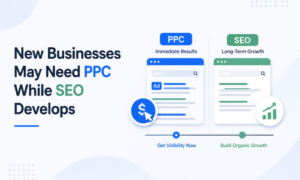
New Businesses May Need PPC While SEO Develops
For a new company with limited search authority, waiting exclusively for SEO can create a difficult early growth period. PPC can provide visibility while the organic foundation is being established.
During this period, the business can develop technical SEO, create valuable content, improve service pages, and begin building authority without sacrificing all immediate lead generation.
As organic visibility improves, the relationship between the channels can be adjusted according to performance rather than following a fixed formula.
Established Businesses Should Not Ignore PPC
A company with strong organic rankings may assume paid advertising is unnecessary. However, PPC can still support specific objectives such as new service launches, competitive searches, seasonal opportunities, remarketing strategies, or expansion into new markets.
The decision should depend on incremental business value rather than the assumption that strong SEO makes advertising irrelevant.
Likewise, a successful PPC program should not prevent a company from building organic visibility that could strengthen acquisition economics over the longer term.
Your Customer Acquisition Cost Should Guide the Decision
Marketing decisions become clearer when businesses understand customer economics. If a customer generates substantial long-term value, the company may be able to invest aggressively in paid acquisition. If margins are narrow, maintaining profitable PPC campaigns may be much more challenging.
SEO also needs financial evaluation. Competitive organic markets can require significant investment in technical improvements, content, expertise, and authority development.
The objective is not finding the cheapest channel. It is finding the combination capable of producing profitable and sustainable customer acquisition.
SEO Is Better When Long-Term Authority Is the Main Goal
Businesses focused on building lasting search visibility, educational authority, and a growing source of organic traffic should make SEO a significant part of their strategy.
It is especially valuable in industries where customers conduct substantial research before purchasing because businesses can create useful content for multiple stages of the decision process.
Over time, this visibility can become a meaningful competitive advantage that is difficult for new competitors to replicate quickly.
PPC Is Better When Speed Is the Main Goal
Businesses that need immediate traffic, want to test a new market, or have time-sensitive offers may benefit more from PPC in the short term.
Paid search provides the speed and control necessary to respond to opportunities quickly.
The important consideration is ensuring that campaigns are supported by strong landing pages, clear offers, accurate tracking, and an effective sales process.
At Your Cloud Hub, we believe the right decision should begin with the business rather than the marketing channel. Companies need to consider how quickly they need results, how much they can invest, what a customer is worth, how competitive their market is, and whether they already possess meaningful organic authority.
Whether you decide to hire SEO consultant expertise, hire search engine optimizer professionals, begin hiring SEO expert support, hire Google SEO expert specialists, or hire SEO expert India, search marketing should ultimately contribute to qualified leads, stronger customer acquisition, and sustainable business growth.