


“How much does a website cost?” sounds like a straightforward question, but there is no single number that applies to every project. A small business website, an online store, a membership platform, and a custom web application can all have completely different development requirements.
The final price depends on what the website needs to do, how it is built, how much customization is involved, who develops it, and what support is required after launch. Two websites may have a similar number of pages while having very different development costs because one requires custom functionality, integrations, and database work.
This is why understanding the individual components behind website pricing is more useful than looking for one fixed figure. Your Cloud Hub helps businesses approach website development as an investment with clearly defined requirements rather than simply comparing quotes at face value.
What Actually Determines Website Development Cost?
Several factors influence website development costs, including design complexity, functionality, technology, content, integrations, security, testing, hosting, and ongoing maintenance.
The first major factor is the website’s purpose.
A basic informational website may require a relatively simple structure with pages such as Home, About, Services, and Contact. A larger website may need user accounts, dashboards, payment processing, advanced search, booking functionality, third-party integrations, or personalized experiences.
Every additional requirement introduces more development work.
That is why defining the project’s purpose before discussing price is so important.
Website Design Is Only One Part of the Budget
Many people assume that website development is primarily about making pages look attractive.
Design is certainly important, but it represents only one part of the overall project.
A designer considers layouts, typography, navigation, visual hierarchy, responsive behavior, branding, calls to action, and user experience. Developers then turn those designs into a functional website.
Businesses may hire web designer professionals to establish the visual direction before development begins. This can be particularly useful when the company has a strong brand identity or wants a completely customized interface.
The Difference Between Design and Development
Design and development work together, but they are not the same thing.
Design focuses on how the website looks and how users interact with it. Development focuses on how the website functions behind the scenes.
A beautifully designed booking system still needs code to process bookings. An attractive ecommerce store still needs product management, checkout functionality, inventory handling, and payment integration.
Understanding this distinction helps explain why a website with relatively few pages can still have a substantial development cost.
Simple Websites Usually Have Fewer Development Requirements
A small brochure-style website generally has fewer technical requirements.
It may include several informational pages, contact forms, basic animations, responsive layouts, and straightforward content management.
Because there are fewer moving parts, the project can often be completed with a simpler development process.
However, “simple” does not mean that quality should be ignored.
The website still needs to work properly on mobile devices, load efficiently, provide clear navigation, and offer a professional experience.

Custom Websites Require More Planning
Custom websites are generally more expensive because they involve more than assembling predefined components.
A custom project may require unique page structures, specialized functionality, custom integrations, tailored dashboards, or business-specific workflows.
Before development begins, the team may need to conduct requirements analysis, create technical specifications, design user journeys, and determine how different systems will communicate.
The additional planning is part of the cost, but it can prevent much larger expenses later.
Ecommerce Websites Add Another Layer of Complexity
An online store introduces functionality that an ordinary business website does not require.
Products need to be displayed and managed. Customers need shopping carts and checkout options. Payments need to be processed securely. Orders need to be tracked, and businesses may need inventory, shipping, tax, discount, and customer account functionality.
The cost therefore depends heavily on how sophisticated the ecommerce operation is.
A small store selling a limited range of products may have relatively straightforward requirements, while a large ecommerce operation can involve substantial development and integration work.
Backend Development Can Change the Cost Significantly
The visible website is only one side of many modern web applications.
The backend handles processes such as databases, authentication, business logic, APIs, user permissions, transactions, and data processing.
A project with substantial backend requirements may therefore require specialized development expertise.
Businesses that hire backend developer professionals may need them to build or maintain systems that customers never directly see, but that are essential to the website’s operation.
This is one reason why judging a project purely by the number of pages can produce misleading cost expectations.
Integrations Increase Development Requirements
Many websites need to communicate with external platforms.
A business might connect its website with a CRM, payment processor, email platform, booking system, accounting software, analytics service, inventory platform, or marketing system.
Each integration needs to be configured and tested.
Simple integrations may require minimal work, while custom API connections can become considerably more involved.
When estimating website costs, businesses should therefore create a list of every external service that needs to communicate with the website.

Mobile Responsiveness Should Not Be Optional
A modern website needs to work across different screen sizes.
Desktop, tablet, and smartphone users may interact with the same website in very different ways.
Responsive development ensures that layouts, menus, buttons, forms, images, and other elements adapt appropriately.
Creating a responsive experience requires additional design and testing considerations, but it should be viewed as a fundamental part of modern website development rather than an optional feature.
Content Can Affect the Project Budget
Website development and website content are closely connected.
Someone needs to create or prepare page copy, product descriptions, images, videos, graphics, downloadable resources, and other materials.
If the business already has professionally prepared content, development can move more efficiently.
If content needs to be created from scratch, the project may require additional specialists and time.
Businesses should clarify whether content creation is included in a website quote or treated as a separate service.
SEO Considerations Can Influence Development
Search engine optimization should ideally be considered while the website is being built.
Page structure, URLs, heading hierarchy, metadata, internal linking, performance, mobile usability, and technical accessibility can all influence the foundation of future SEO work.
A website that ignores these considerations may require expensive improvements later.
Building a search-friendly structure from the beginning can reduce the amount of corrective work required after launch.
Custom Features Need Individual Evaluation
Features such as calculators, directories, booking systems, customer portals, membership areas, interactive tools, advanced filters, and personalized dashboards can significantly affect development costs.
The complexity of a feature matters more than its name.
For example, a basic contact form may be straightforward. A form that calculates pricing, validates multiple data sources, creates an account, sends information to several systems, and triggers different workflows is a much larger development task.
When reviewing a quote, businesses should ask what functionality is actually included rather than simply counting features.
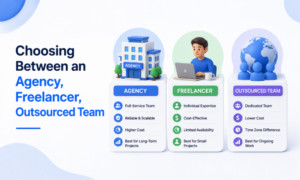
Choosing Between an Agency, Freelancer, and Outsourced Team
The development model can also influence the overall budget.
Some businesses work with agencies that manage design, development, testing, project management, and support under one arrangement.
Others choose a freelance website designer for the design component and work with developers separately.
Another option is to outsource web design or development to an external team that can provide access to multiple specialists.
Each approach has advantages and trade-offs.
An agency may provide broader project management. A freelancer can offer a more direct working relationship. An outsourced team may provide access to a wider technical skill set without requiring a permanent internal department.
Why Businesses Choose Website Design Outsource Models
When a business does not have an internal design team, website design outsource arrangements can provide flexibility.
Instead of hiring a full-time designer, the company can bring in external professionals for a specific project.
This can be particularly useful for businesses that only need website design occasionally.
However, outsourcing works best when requirements are documented clearly. The external team should understand the brand, target audience, business objectives, preferred functionality, and technical environment.
Hiring Developers in India Can Offer Flexibility
Businesses operating in different markets may consider international development teams when evaluating costs and expertise.
Companies that hire web developer in India can gain access to a large technology talent pool with experience across modern web technologies.
However, cost should not be the only selection criterion.
Businesses should also assess technical experience, communication, development practices, project management, portfolio quality, security awareness, and post-launch support.
The right developer is one who understands the business requirements and can build a reliable solution, not simply the person offering the lowest quote.
Technology Choices Affect the Budget
The technology used to build a website can influence development effort and long-term maintenance.
Some projects can be built efficiently using established content management systems. Others require custom frameworks or application architectures.
The right choice depends on what the website needs to accomplish.
Choosing technology simply because it is popular can create unnecessary complexity. Likewise, selecting the cheapest option without considering future requirements can result in expensive redevelopment.
Technology decisions should support the project’s actual needs.
Testing Is Part of Development Cost
A website is not finished when the code is written.
Testing is necessary to identify broken links, layout problems, form errors, browser compatibility issues, mobile problems, integration failures, and other defects.
More complex websites require more extensive testing because there are more possible combinations of user actions and system responses.
Testing may not be the most visible part of the project, but it plays an important role in protecting the quality of the final product.
Security Should Be Included From the Beginning
Security becomes especially important when websites process customer accounts, payments, personal information, or business data.
Developers may need to consider authentication, authorization, secure data transmission, input validation, access controls, backups, updates, and monitoring.
A website that appears inexpensive at launch can become very expensive if security weaknesses lead to downtime, data loss, or other serious problems.
Security should therefore be considered part of development rather than an afterthought.

Hosting and Domain Costs Are Separate
Website development quotes do not always include hosting and domain expenses.
The domain is the website’s address, while hosting provides the infrastructure where the website operates.
Hosting requirements vary significantly.
A simple informational website may need modest infrastructure, while a high-traffic web application may require more powerful resources, scaling capabilities, monitoring, backups, and specialized infrastructure.
Businesses should ask exactly what their development quote includes so they can estimate the full cost of ownership.
Maintenance Continues After Launch
A website requires attention after it goes live.
Software needs updates. Security vulnerabilities can emerge. Third-party integrations can change. Content becomes outdated. New functionality may eventually be required.
Maintenance can therefore be handled through a recurring support arrangement or on an as-needed basis.
Businesses should consider this when calculating the long-term cost of their website.
The cheapest initial development option is not always the cheapest solution over several years.
Why Cheap Quotes Can Become Expensive
An unusually low website quote can sometimes indicate that important components are excluded.
The quote may cover only design and basic development while leaving content, integrations, testing, SEO preparation, security, maintenance, or revisions outside the original scope.
This does not mean every inexpensive project is poor quality.
It means businesses should compare proposals based on deliverables rather than headline prices.
A detailed quote makes it easier to understand what you are actually paying for.
Get Clear About Revisions
Design and development projects often require feedback.
However, unlimited revisions can create confusion and extend project timelines.
Before starting, clarify how many design revisions are included and how additional changes are charged.
This creates a clearer relationship between the client and development team.
It also encourages stakeholders to consolidate feedback rather than requesting small changes repeatedly throughout the project.
Consider the Total Cost of Ownership
The initial development fee is only part of the financial picture.
Businesses should consider hosting, domain renewal, maintenance, security, content updates, marketing, analytics, integrations, future improvements, and potential redesigns.
A website is a long-term business asset.
The best investment is usually the solution that delivers reliable performance and remains manageable as the business grows.
How to Create a More Accurate Website Budget
Start with the basics.
Define the website’s purpose, target audience, core pages, required functionality, integrations, content requirements, and expected traffic.
Then separate must-have features from future enhancements.
This allows the development team to estimate the initial project more accurately.
It can also prevent the common problem of trying to build every possible feature during version one.
A phased approach can be more practical for businesses with limited budgets.
Website development costs cannot be understood through a single price tag. The real cost comes from the combination of design, development, functionality, integrations, content, testing, security, infrastructure, and ongoing maintenance.
A simple informational website may require a relatively straightforward process, while an e-commerce platform or custom web application can involve considerably more planning and technical expertise.
Businesses can hire web designer professionals for the visual and user-experience side, work with a freelance website designer, or outsource web design when external creative support makes more sense. Companies with technical requirements may hire web developer in India or hire backend developer specialists to handle the functionality behind the interface.
A website design outsource approach can also be useful when businesses want flexibility without building a permanent internal design department.
Ultimately, the right website budget is not necessarily the smallest one. It is the budget that provides the functionality, quality, security, scalability, and user experience the business actually needs.