


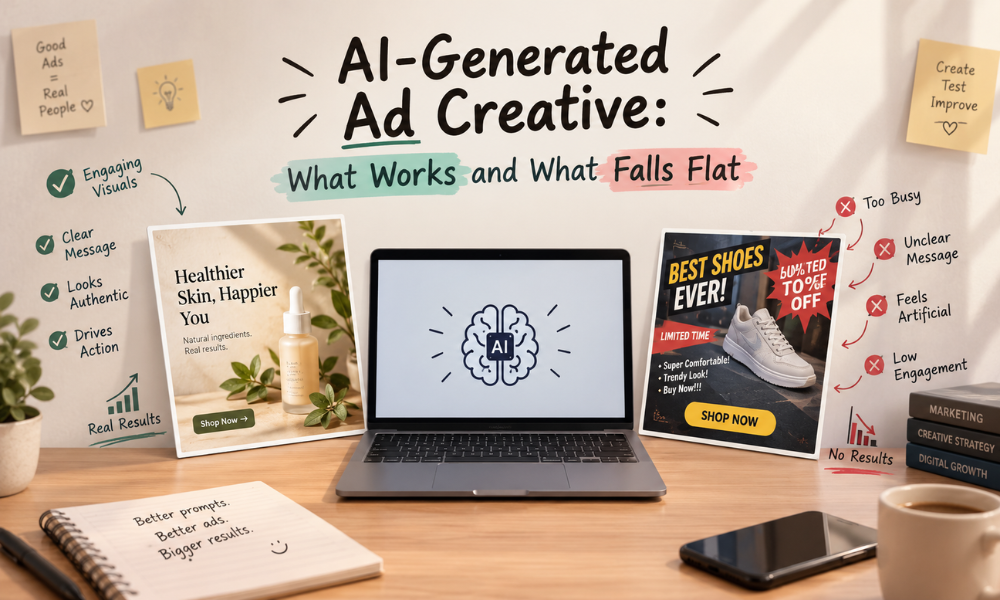
AI-generated ad creative uses artificial intelligence to help businesses develop advertising visuals, headlines, product images, videos, and creative variations for different audiences and platforms. It can speed production and make experimentation more affordable, but successful advertising still depends on understanding the brand, audience psychology, originality, and clear messaging. Businesses get the best results when AI supports human creativity rather than replacing strategic thinking.
For brands trying to produce more campaigns without increasing production costs, AI offers an opportunity to generate and test multiple creative concepts quickly. However, not every AI-generated advertisement performs well. Generic visuals, unrealistic product representations, repetitive messaging, and inconsistent branding can weaken audience trust and waste advertising budgets.
Businesses may choose to hire graphic designer professionals to combine AI-assisted production with creative judgment. Working with a remote graphic designer, a freelance graphic designer, or an online graphic designer can also help companies access specialized skills without building a large in-house team. For image-heavy campaigns, businesses may additionally hire Photoshop expert talent to refine AI outputs and prepare polished, platform-ready assets.
Understanding what makes AI-generated ad creative effective is essential for producing advertisements that attract attention, communicate value, and convert viewers into customers.
What Is AI-Generated Ad Creative?
AI-generated ad creative refers to advertising content produced partly or entirely with artificial intelligence tools. These tools can generate images, suggest headlines, create video concepts, adapt existing designs, and produce multiple variations for testing. Depending on the platform, AI may also help resize assets, remove backgrounds, generate product scenes, or tailor messaging to different audience segments.
For example, an ecommerce business selling skincare products could use AI to explore several campaign concepts: a clean product-focused image, a lifestyle scene showing a morning routine, and a promotional design highlighting a limited-time offer. A creative team could then evaluate which direction best communicates the product’s value.
The important distinction is that generating an advertisement and creating an effective advertisement are two different tasks. AI can produce an image in seconds, but it does not automatically understand a brand’s positioning, customers’ concerns, competitive advantages, or the reasons people decide to buy.
Successful campaigns therefore combine efficient production with human oversight, clear creative objectives, and performance measurement. AI should help teams develop stronger advertising hypotheses, not simply increase the number of assets they publish.
How AI-Generated Ad Creative Works
The process generally begins with a campaign objective, audience definition, and creative brief. The team identifies what the advertisement should communicate, which audience it targets, and what action viewers should take.
AI tools use these inputs to generate potential concepts, visual compositions, headlines, backgrounds, or video scenes. Designers then review the outputs, remove weak options, correct inconsistencies, and adapt selected assets to the requirements of each advertising platform.
The final creatives are launched through a controlled testing process. Performance data helps the team identify which concepts attract attention, generate qualified traffic, and contribute to conversions.
Start with a clear creative brief
AI-generated content becomes more useful when the instructions contain meaningful details. A brief should explain the product, target audience, customer problem, main benefit, brand personality, offer, and intended call to action.
Instead of requesting an attractive advertisement for a fitness product, specify whether the campaign targets beginners, busy professionals, or experienced athletes. Explain the problem being addressed and the visual style that supports the message.
A detailed brief reduces irrelevant outputs and gives designers a clearer basis for evaluating the results. It also helps maintain consistency when producing several variations for different audiences.
Generate concepts before polishing assets
The first stage should focus on exploring creative directions rather than perfecting individual images. Generate a small collection of distinct concepts, such as a problem-and-solution visual, a product demonstration, a customer-focused lifestyle scene, and a benefit-led promotional design.
Once the strongest direction emerges, the team can refine typography, composition, imagery, and messaging. This approach prevents time from being wasted polishing an idea that does not communicate the offer effectively.
A remote graphic designer can manage this process by developing concepts, reviewing AI outputs, and preparing assets that meet the campaign’s visual standards.

What Works in AI-Generated Ad Creative?
AI-generated advertising performs best when technology supports a clear message and a recognizable customer need. Attractive visuals matter, but the creative must also give viewers a reason to pay attention and understand what the business offers.
1. Visuals that communicate one clear benefit
Strong advertisements focus on a single primary message. A crowded image containing several claims, decorative elements, and competing calls to action can make the offer difficult to understand.
AI can help teams explore different visual arrangements, but each version should communicate one central benefit. For a project management tool, the message might focus on reducing administrative work. For a skincare product, it could highlight a specific supported product benefit.
The visual hierarchy should guide attention naturally from the main message to the supporting information and then to the call to action. Designers must also verify that the imagery accurately represents the product and does not imply unsupported results.
2. Authentic, audience-relevant imagery
Generic AI images often look polished but lack relevance. A stock-style image of smiling people may be visually appealing without helping the audience understand why a particular product or service matters.
More effective creative reflects the audience’s actual context. A local service business might use imagery that resembles the properties, situations, or customer concerns its audience recognizes. A business software campaign might show a realistic workflow instead of an abstract futuristic interface.
Authenticity also requires care with AI-generated people, environments, and product representations. Distorted hands, inconsistent packaging, unnatural facial expressions, and impossible product details can reduce credibility.
Businesses can hire graphic designer professionals to review these details and ensure that AI-generated imagery supports the message rather than distracting from it.
3. Multiple creative angles for testing
One major advantage of AI is the ability to explore different campaign concepts without producing every variation from scratch.
A business could test a benefit-led advertisement against a problem-focused message and a customer testimonial format. The visual design might remain relatively consistent while the main messaging angle changes.
This creates useful opportunities for learning. If the problem-focused creative consistently attracts more qualified visitors, the team can investigate whether the audience responds more strongly to that particular motivation.
However, generating dozens of nearly identical images is not the same as meaningful experimentation. Variations should represent different hypotheses about what will influence the audience, not superficial changes that provide little insight.

4. Consistent branding across formats
AI can help adapt a winning concept for square, vertical, and landscape placements. It can also assist with background variations and alternative compositions for different campaign formats.
Consistency remains essential. Colours, typography, logo placement, product appearance, and tone should align with the brand’s established identity. A collection of unrelated visual styles may make the advertising campaign feel fragmented.
A freelance graphic designer can help establish reusable creative guidelines and check that adaptations retain the same visual identity. This is particularly useful for smaller businesses that need a consistent advertising presence but do not have a full-time design department.
5. Creative that matches the landing page
An advertisement creates an expectation that the landing page must fulfil. If an AI-generated creative promises a specific discount, product feature, or business outcome, visitors should find the same offer and accurate information after clicking.
A mismatch can increase abandonment and reduce trust, even when the advertisement attracts strong engagement.
Before launching a campaign, compare the headline, offer, imagery, and call to action across the advertisement and destination page. Ensure that the landing page loads properly on mobile devices and makes the next step clear.
The goal is not simply to earn clicks. It is to attract the right audience and deliver the experience the advertisement promised.
What Falls Flat in AI-Generated Ad Creative?
AI can accelerate creative production, but several common mistakes can undermine campaign performance. Recognizing these problems early helps businesses avoid spending money promoting weak advertisements.
1. Generic visuals without a distinctive idea
One of the most common problems is producing advertisements that resemble countless other campaigns. AI may generate attractive gradients, floating objects, dramatic lighting, and polished compositions, but these elements do not necessarily communicate a compelling reason to choose the brand.
When every competitor uses similar visual styles and generic headlines, advertising becomes interchangeable. Viewers may notice the design without remembering the business or understanding its advantage.
The solution is to introduce specific brand insights, original messaging, recognizable product details, and a clear creative concept. A human designer can identify which elements make the campaign distinctive and remove decorative details that add no value.
2. Unrealistic or misleading product imagery
AI tools can alter product proportions, invent packaging details, misrepresent materials, or create features that do not exist. These errors are especially problematic for ecommerce advertisements, where customers expect visuals to represent the actual product.
Review every product image against an approved reference. Check packaging, colours, labels, dimensions, and other details that influence purchasing decisions.
When accuracy is essential, use real product photography as the foundation and apply AI to controlled tasks such as background generation, cropping, or scene variations. Businesses may hire Photoshop experts to correct imperfections and maintain realistic product presentation.

3. Too much text and too many messages
AI-assisted creative production can make it tempting to include every product benefit, promotional claim, and supporting detail in one advertisement. The result is often visually crowded and difficult to read on mobile screens.
A better approach is to prioritize the main benefit, one or two supporting details, and a clear next step. Additional information can appear in the headline, primary text, or landing page.
Review text size and contrast at the actual placement dimensions. A design that looks clear on a desktop monitor may become unreadable when displayed in a small mobile feed.
4. Unsupported claims and misleading promises
AI can generate persuasive marketing language that sounds convincing but is inaccurate or impossible to substantiate. Examples include guaranteed outcomes, exaggerated performance claims, invented testimonials, and misleading before-and-after scenarios.
Every claim must be checked against the product’s real capabilities and available evidence. Testimonials should reflect genuine customer experiences, and regulated industries may require additional compliance review.
Human approval should remain mandatory before publication. AI-generated content should never be treated as automatically accurate simply because it appears professionally written.
5. Repetitive creative and advertising fatigue
Producing more advertisements does not guarantee better results. If each variation uses the same message, composition, and visual treatment, audiences may quickly lose interest.
Creative fatigue can appear as declining engagement, rising costs, or weakening conversion performance, although these changes may also result from competition, audience saturation, or other campaign factors.
Refresh campaigns by exploring new customer problems, product benefits, demonstrations, objections, and storytelling angles. Keep a record of past experiments so teams can build on successful ideas instead of repeatedly generating minor variations.
How to A/B Test AI-Generated Ad Creative
A/B testing helps determine whether a new creative concept performs better than an existing advertisement. Instead of selecting designs based on personal preference, marketers can evaluate their impact using campaign data.
Start with a specific hypothesis. For example, a benefit-focused advertisement may generate more qualified leads than a feature-focused version because it connects more directly with the customer’s needs.
Create two meaningfully different variations and keep other important campaign settings as consistent as possible. Where practical, maintain the same audience, placement, budget conditions, and conversion objective so that the creative difference can be evaluated more clearly.
Choose the primary metric before launching. Depending on the campaign, this could be cost per qualified lead, purchase conversion rate, or return on ad spend. Supporting metrics such as click-through rate and cost per click can help explain performance, but they should not replace the business outcome.
Allow the experiment to collect sufficient data before making a decision. Small samples can produce misleading results, and performance may change as more conversions occur. Avoid declaring a winner based on a few early clicks.
After identifying a stronger concept, test additional variations that explore why it worked. For example, if a product demonstration performs well, the next experiment could compare different demonstrations or benefit statements.
An online graphic designer can help prepare consistent variations and document the changes made during each experiment, making the process more organized and repeatable.
How Human Designers Improve AI-Generated Advertising
Human designers contribute strategic judgment that automated tools cannot reliably provide on their own. They interpret the brand’s identity, understand the campaign objective, evaluate visual relevance, and determine whether the final creative communicates the intended message.
Their work also extends beyond making images attractive. Designers consider information hierarchy, readability, accessibility, cultural context, product accuracy, and the relationship between advertising and the landing page.
Businesses that hire graphic designer professionals can establish a review process in which AI generates initial concepts while people handle refinement, brand alignment, and quality assurance.
A remote graphic designer can collaborate with marketing teams through shared design files and structured feedback. A freelance graphic designer may provide flexible support for specific campaigns, while an online graphic designer can help businesses manage creative updates across digital channels.
For campaigns that depend heavily on realistic product imagery, companies may hire Photoshop expert talent to refine composites, correct image inconsistencies, and prepare final assets for publication.
The best arrangement depends on campaign volume, technical requirements, budget, and internal capabilities. What matters most is that every advertisement receives appropriate strategic and quality review before going live.