


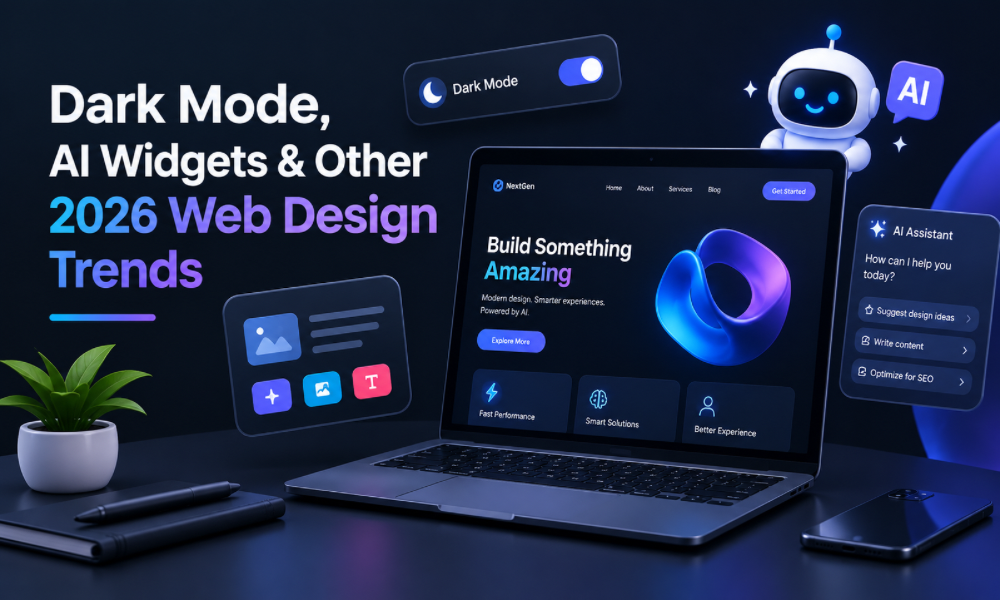
Web design in 2026 is moving beyond simply making websites look modern. Businesses are increasingly thinking about how websites should behave, communicate, personalize experiences, and support visitors across different devices and search environments.
Design decisions are now connected to accessibility, artificial intelligence, performance, interaction design, personalization, and user expectations. A website may need to answer questions through an AI assistant, adapt its interface to different preferences, load quickly on mobile devices, and still provide a memorable visual identity.
Dark mode and AI-powered widgets are two visible examples of this shift, but they are only part of a much broader change. Modern websites are becoming more interactive without necessarily becoming more complicated. The best experiences often combine sophisticated technology with simple interfaces that allow visitors to accomplish their goals quickly.
For businesses planning a redesign, these developments create both opportunities and challenges. The objective should not be to add every popular feature. Instead, businesses need to understand which trends actually improve usability, accessibility, performance, and business outcomes.
Dark Mode Is Becoming a More Thoughtful Design Choice
Dark mode is no longer simply a visual alternative that designers add because it looks impressive.
Many users now expect websites and applications to respect their device preferences. A well-implemented dark interface can provide a comfortable viewing experience in low-light environments and create a different visual atmosphere for brands that support it.
However, dark mode requires more than changing a white background to black.
Designers need to reconsider contrast, typography, borders, icons, illustrations, images, shadows, and interactive states. Colors that work against a light background may become hard to read on a dark surface.
Businesses planning to hire web designer support should therefore look for professionals who understand dark-mode systems rather than simply applying a dark color palette to an existing website.
Dark Mode Needs a Complete Visual System
A good dark-mode experience should feel intentional.
For example, a brand’s primary color may need a slightly different shade to maintain readable contrast. Secondary text may need to become brighter, while decorative elements may need to become less prominent.
Images can also require attention. A graphic designed for a bright white interface may look excessively harsh against a dark background.
This means dark mode should be considered during the design-system stage rather than treated as a final toggle added immediately before launch.
When businesses hire website designer professionals for a redesign, asking how the designer will approach light and dark interfaces can reveal whether the project is being treated as a complete user-experience system.
AI Widgets Are Moving Onto Business Websites
AI-powered widgets are becoming another important part of modern websites.
These widgets can help visitors find information, answer common questions, guide users through products, summarize services, recommend resources, or assist with basic support.
Instead of forcing visitors to navigate through multiple pages to find an answer, an AI interface can provide a conversational layer over existing website information.
But there is an important distinction between adding an AI widget and designing a useful AI experience.
The widget needs access to reliable information, clear boundaries, appropriate fallback behavior, and an interface that does not interfere with the main website experience.
AI Should Assist Rather Than Distract
An AI assistant should solve a real user problem.
If visitors frequently ask about pricing, product differences, implementation requirements, delivery timelines, or service availability, an AI widget may provide useful assistance.
But adding an AI chatbot simply because it is fashionable can create unnecessary complexity.
A visitor who wants to find a phone number or book an appointment should not have to interact with an AI assistant to accomplish a task that could be completed with one obvious button.
Good web design in 2026 is increasingly about knowing when not to use AI.
AI Interfaces Need Human-Friendly Design
AI responses can be conversational, but the interface around them still needs traditional design principles.
Users need to know where to type, what the system can answer, whether the response is still being generated, and what to do if the answer is incorrect.
There should also be clear ways to move from conversation to action.
For example, an AI assistant might answer a product question and then offer a relevant product page. A service assistant might answer a question and provide an appointment option.
The AI interaction should therefore connect naturally with the rest of the website.
Personalization Is Becoming More Contextual
Personalization used to mean little more than displaying a visitor’s name.
Modern websites can potentially adapt experiences based on meaningful context such as previous interactions, selected preferences, customer status, location where appropriate, or the content a visitor is currently exploring.
The challenge is avoiding personalization that feels intrusive.
Users generally benefit when personalization makes navigation easier or content more relevant. They may become uncomfortable when a website appears to know unnecessary details about them.
Good design should therefore balance relevance with transparency and privacy.
Websites Are Becoming More Modular
Large websites increasingly use reusable components rather than designing every page independently.
A design system might define buttons, forms, cards, navigation elements, typography, spacing, icons, alerts, and other interface patterns.
This creates consistency while making future updates easier.
If a company changes its button style, for example, a well-designed component system can allow that change to be implemented systematically instead of requiring designers to manually modify dozens of pages.
Businesses that outsource web design should ask whether the provider will create a reusable design system or simply design individual pages.
Micro-Interactions Are Becoming More Purposeful
Small animations can make interfaces feel responsive.
A button might subtly change when hovered over. A form could provide immediate feedback after submission. A navigation element might transition smoothly when opened.
These details can improve the perception of quality when used carefully.
The trend in 2026 is less about adding animation everywhere and more about using motion to communicate what is happening.
Animation should provide feedback, establish hierarchy, or guide attention.
If an animation makes the website slower or distracts users from important information, it is probably doing more harm than good.
Scroll-Based Experiences Are Evolving
Scrolling can now be used as part of storytelling.
As users move through a page, content can gradually appear, diagrams can change, products can transition, or sections can reveal additional information.
This can be particularly effective for brands that need to explain complex products or processes.
However, scroll-based experiences should remain usable.
Visitors should not have to wait through unnecessary animations before accessing important information. Mobile users should receive an equally functional experience even when complex desktop animations are removed or simplified.
Accessibility Is Becoming a Core Design Requirement
Accessibility should not be treated as a final checklist.
Typography, color contrast, keyboard navigation, focus states, alternative text, form labels, animation behavior, and content hierarchy all influence whether people can use a website effectively.
Dark mode makes this particularly important because poor contrast can become difficult to detect until the design is tested properly.
A professional website designer should consider accessibility from the beginning rather than attempting to repair accessibility problems after development.

Typography Is Taking a More Visible Role
Typography is increasingly being used as a major visual component.
Large headlines, variable fonts, carefully selected typefaces, and expressive text treatments can create strong brand identities without requiring excessive decorative elements.
However, typography still needs to remain readable.
Large or unusual type can work well for hero sections while body content benefits from simpler, highly readable styles.
The strongest designs create a hierarchy where visual personality and usability support each other.
Bento-Style Layouts Continue to Influence Web Design
Modular grid layouts have become popular because they allow websites to present several pieces of information within a structured visual system. A single section might contain a primary feature, smaller supporting benefits, statistics, images, or calls to action.
This approach can work especially well for technology companies, SaaS products, agencies, and businesses with several related offerings.
The risk is creating a collection of decorative boxes without a meaningful hierarchy.
Every module should have a purpose.
More Websites Are Designing for AI Discovery
Web design is increasingly connected to how information is understood by AI-powered search and discovery systems.
A visually attractive page can still be difficult for automated systems to interpret if important information is hidden, poorly structured, or dependent entirely on inaccessible interface elements.
Clear headings, descriptive content, logical page structures, meaningful links, structured information, and accessible text can help both users and automated systems understand a website.
This does not mean designing websites specifically for AI at the expense of people.
Instead, the trend is toward websites that are both visually engaging and structurally understandable.
Mobile Design Is Becoming More Context-Aware
Responsive design is no longer simply about making a desktop page fit a smaller screen.
Mobile visitors may interact with websites differently. They may use touch instead of a mouse, have less screen space, experience variable network conditions, or be trying to complete a task quickly.
Navigation, forms, buttons, content hierarchy, and interactive components should therefore be designed around actual mobile behavior.
When you hire web designer in India for a project serving an international audience, make sure mobile testing is included across relevant devices and screen sizes rather than relying on a single responsive preview.
Human Expertise Still Matters
The growth of AI design tools does not eliminate the need for professional web designers.
Someone still needs to understand the business, audience, brand, customer journey, accessibility requirements, content hierarchy, technical limitations, and conversion objectives.
If you hire website designer support for a redesign, the conversation should go beyond asking whether the designer can create attractive pages.
Ask how they approach usability, responsive behavior, performance, accessibility, AI integrations, and design systems.
A strong visual concept is only one component of a successful website.
When to Outsource Web Design
Not every company needs an internal design department.
Businesses may choose to outsource web design when they need specialist expertise for a redesign, new website, landing page system, ecommerce experience, or complex digital product.
Outsourcing can also make sense when internal marketing teams understand the brand but do not have the technical design expertise required to execute a modern website.
The key is establishing clear responsibilities before the project begins.
The external team should understand the business objectives, target audience, required integrations, content requirements, and expected functionality.
Working With a Freelance Website Designer
A freelance website designer can be useful for smaller projects, focused redesigns, landing pages, visual refreshes, or businesses that need flexible design support.
The right freelancer can bring specialized expertise without requiring a long-term internal hire.
However, clarify whether the freelancer is responsible only for design or also for development, accessibility testing, responsive implementation, and post-launch support.
A beautiful design file is not the same thing as a finished website.

Choosing a Designer in India
Businesses may also decide to hire web designer in India for access to a broad talent pool covering UI design, UX research, development, branding, and technical implementation.
When evaluating candidates, review actual project examples and ask how they approach responsive design, accessibility, performance, and modern web technologies.
The goal should be to find someone whose working process fits the project rather than selecting purely on price.
Clear communication and a shared understanding of project requirements can be just as important as visual design skills.
Should You Hire a Web Designer for a Redesign?
A redesign can be worthwhile when an existing website no longer reflects the brand, creates usability problems, performs poorly on mobile, or makes it difficult for visitors to complete important actions.
But redesigning a website simply because a particular visual trend is popular may not produce meaningful business value.
Before you hire web designer support, identify the actual problems with the existing experience.
Look at analytics, customer feedback, conversion paths, page performance, accessibility, content organization, and mobile behavior.
Then decide which design changes address those problems.
Build a Flexible Design System for the Future
The best 2026 websites are not necessarily the ones with the most futuristic features.
They are often the ones designed to evolve.
A modular design system can make it easier to add new content, introduce new services, incorporate AI functionality, change visual themes, and improve accessibility without redesigning the entire website.
Businesses that outsource web design should therefore ask how the final system will be maintained after launch.
The website should not become impossible to update because every page was designed as a one-off visual experiment.
What to Expect From a Modern Web Designer
A modern web designer needs to understand more than color palettes and page layouts.
They should be able to think about user journeys, responsive behavior, accessibility, performance, content structure, interaction patterns, and the role of emerging technologies.
This is particularly important when businesses hire website designer professionals for a complete digital transformation rather than a simple visual refresh.
The designer should be able to explain why a feature belongs on the website and what problem it solves.
The Role of YCH in Modern Web Design
At Your Cloud Hub, modern web design can be approached as a combination of visual experience, usability, technical performance, and business strategy.
The goal is not to add every new trend to a website.
Instead, the focus should be on understanding what users need, how the business operates, what technology can improve the experience, and which design decisions will remain useful as the website evolves.
Whether a business is considering dark mode, AI-powered interactions, improved mobile UX, a complete redesign, or a more flexible design system, the underlying experience should remain clear and user-focused.