


Artificial intelligence has changed the way businesses approach marketing. Campaigns can be personalized at a scale that would have been difficult to achieve manually. Customer behavior can be analyzed in seconds, audiences can be segmented automatically, content can be generated faster, and predictive systems can help marketers decide which prospects deserve attention.
But greater capability also creates greater responsibility.
When marketing systems use artificial intelligence to influence what people see, when they see it, and how brands communicate with them, trust becomes just as important as performance. A campaign may generate impressive engagement numbers and still damage a company’s reputation if customers feel manipulated, monitored, misled, or unfairly targeted.
Ethical AI-driven marketing is therefore not about avoiding artificial intelligence. It is about using it thoughtfully.
Businesses need to understand what information their systems use, how automated decisions are made, where human oversight is necessary, and how customers can maintain meaningful control over their interactions with a brand. Your Cloud Hub recognizes that responsible AI should support better customer experiences rather than simply maximizing clicks, conversions, or engagement.
Why Trust Has Become a Marketing Advantage
Trust has always influenced purchasing decisions, but digital marketing has made it more visible and more fragile.
Customers now interact with automated recommendations, personalized advertisements, AI-generated content, chatbots, predictive models, and algorithmic experiences across many platforms. When these systems work well, customers may find interactions more relevant and convenient.
When they become intrusive, the experience can quickly feel uncomfortable.
Imagine visiting a website once and then seeing highly specific advertisements everywhere. The customer may understand that personalization is involved, but still wonder how much information the company has collected.
This is where ethical marketing matters. Businesses need to think not only about what technology allows them to do but also about what customers reasonably expect them to do.
Transparency Should Be Part of the Customer Experience
Customers should not have to become technology experts to understand how a business uses AI.
Transparency does not mean publishing complicated technical documentation that ordinary customers will never read. It means communicating important information clearly.
If an AI system is interacting with customers, businesses should consider whether people need to know that the interaction is automated. If customer data contributes to personalization, the company should explain relevant practices in understandable language.
The objective is to reduce uncertainty.
A customer who understands why they are receiving a recommendation is more likely to view personalization as useful rather than suspicious.
Personalization Has a Boundary
Personalization can make marketing more relevant, but more personalization is not always better.
Using someone’s stated preference to recommend a product is one thing. Creating an experience based on sensitive or unexpected inferences can feel entirely different.
Marketers should ask an important question before implementing highly personalized campaigns: would the customer reasonably expect the company to use this information in this way?
If the answer is no, the strategy deserves another look.
Ethical personalization should create relevance without making customers feel watched.
AI Should Not Become an Excuse for Manipulation
Artificial intelligence can identify patterns in customer behavior that humans may overlook. This capability can be useful for predicting needs and improving communication.
However, the same capability can be used to exploit vulnerabilities.
For example, a system might identify when a customer is particularly likely to respond to pressure-based messaging. Using that information aggressively may produce short-term conversions, but it can undermine long-term trust.
Responsible marketing should distinguish between persuasion and manipulation.
The purpose of AI should be to help customers make informed decisions, not to exploit moments when they are least able to resist pressure.
Data Quality Is an Ethical Issue
AI systems learn from data, which means low-quality information can lead to poor marketing decisions.
Incomplete customer profiles, outdated records, duplicated contacts, biased historical data, or incorrect assumptions can all affect automated decisions.
A marketing team may believe that an AI model is objective because a computer generated the result. In reality, the quality of the output depends heavily on the information and assumptions behind the system.
Businesses should therefore treat data management as part of responsible AI governance.
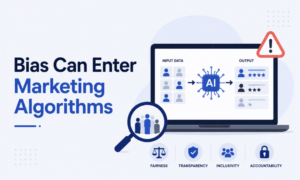
Bias Can Enter Marketing Algorithms
Bias is another major concern.
If historical marketing data reflects unequal treatment or limited representation, an AI system trained on that data may reproduce those patterns.
For example, an audience model may consistently prioritize certain groups because historical conversion data have favored them. That does not necessarily mean the model has discovered a universal truth. It may simply be learning the behavior of an imperfect historical system.
Organizations need processes for identifying these patterns.
This is one reason businesses may hire machine learning experts when developing sophisticated predictive marketing systems. Technical expertise can help teams examine model behavior, evaluate data quality, and identify potential weaknesses before automated decisions affect large audiences.
Human Oversight Still Matters
AI can process enormous amounts of information, but that does not mean every marketing decision should be automated.
Some decisions require context, judgment, empathy, or an understanding of circumstances that may not exist in the available data.
Human review can be especially important when AI systems influence high-impact customer experiences, make sensitive classifications, or generate public-facing communications.
A responsible marketing system should have clear points where people can review, correct, or override automated decisions.
AI-Generated Content Needs Editorial Responsibility
Generative AI has made it easier to produce blog articles, advertisements, emails, product descriptions, social posts, and other marketing assets.
Speed is valuable, but publishing automatically generated material without review can create problems.
AI can produce inaccurate statements, outdated information, inappropriate wording, fabricated references, or content that sounds convincing while being factually wrong.
Marketing teams remain responsible for what their companies publish.
Businesses can hire AI developers to build content systems that include validation, workflow controls, and human review rather than treating generation as a completely automatic process.
Authenticity Matters More Than Volume
One of the biggest risks of AI-driven marketing is producing enormous amounts of content that feels interchangeable.
Customers do not necessarily want more content. They want useful content.
If every company uses similar AI tools to create similar articles and advertisements, volume stops being a meaningful competitive advantage.
Brands should focus on original knowledge, genuine customer insights, real experiences, and useful perspectives.
AI can accelerate production, but human expertise should shape the substance.
Explain Automated Recommendations When Appropriate
Recommendation systems are increasingly common in digital marketing.
A customer may see a product recommendation, content suggestion, offer, or advertisement selected by an algorithm.
When appropriate, businesses can provide simple explanations about why something is being recommended.
Even a short explanation can make an automated experience feel more understandable.
The objective is not necessarily to expose the entire model. It is to provide enough context for customers to understand that the recommendation is not random.
Consent Should Be Meaningful
Consent should not become a box that customers click simply because they want access to a website.
Businesses should think carefully about whether people genuinely understand what they are agreeing to.
Marketing systems that rely on personal information should make relevant choices understandable and accessible.
Customers should also have reasonable ways to manage their preferences.
A trustworthy company does not make privacy controls intentionally confusing simply because doing so may increase the amount of data available for marketing.
Protect Customer Information
AI-driven marketing often depends on customer data, making security a fundamental part of trust.
Businesses may process names, contact details, behavioral information, purchase histories, preferences, website activity, and other information.
That data should be handled carefully.
Organizations need to understand where information is stored, who can access it, which systems receive it, and how long it should be retained.
Marketing teams should not assume that data is safe simply because it is being processed by an established AI platform.
Third-Party AI Tools Require Careful Evaluation
Marketing departments frequently use multiple external platforms.
An organization may have one tool for CRM data, another for analytics, another for content generation, and another for customer communication.
Every additional platform can create another data-handling relationship.
Before connecting customer information to an AI service, businesses should understand the provider’s security practices, data policies, access controls, and integration behavior.
Technical teams can help evaluate these considerations before sensitive information enters a new system.

AI Skills Should Include Responsible Development
Technical expertise should not be limited to building models that perform well.
Professionals developing AI marketing systems also need to understand reliability, privacy, monitoring, security, bias, explainability, and human oversight.
Companies that hire AI engineer professionals for marketing projects should consider these capabilities alongside programming and machine learning experience.
The best technical implementation is not simply the one that produces the highest model accuracy. It is the one that performs effectively while operating within clearly defined ethical boundaries.
Choosing the Right AI Development Support
Different AI projects require different levels of expertise.
A company experimenting with basic automation may need limited technical assistance. A business building predictive customer models, recommendation engines, or complex personalization systems may require deeper machine learning capabilities.
When companies search for AI developers for hire, they should evaluate more than technical portfolios.
They should ask how candidates approach data privacy, testing, model monitoring, security, bias, documentation, and human oversight.
Responsible development needs to be considered from the beginning rather than added after a system is already deployed.
AI Specialists Can Bridge Marketing and Technology
Marketing teams understand customers, messaging, campaigns, positioning, and commercial objectives.
Technical teams understand data, models, software architecture, integrations, and system limitations.
AI projects work best when these perspectives meet.
AI specialists can help bridge that gap by translating marketing goals into technically realistic systems while also helping marketers understand what AI can and cannot reliably do.
This collaboration reduces the risk of building sophisticated technology without a clear business or customer purpose.
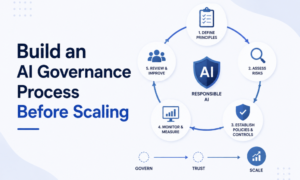
Build an AI Governance Process Before Scaling
Businesses should not wait for a major problem before creating rules around AI use.
An internal AI governance framework can define which customer information may be used, which applications require human approval, what types of AI-generated content require review, and who is responsible for monitoring systems.
The framework does not need to be unnecessarily complicated.
Clear ownership and practical guidelines can go a long way.
For example, employees might know which AI tools are approved, what information cannot be entered into external systems, when generated content requires fact-checking, and how potential model problems should be reported.
Monitor AI Systems After Launch
An AI system that works well today may not perform the same way months later.
Customer behavior changes. Data changes. Products change. Market conditions change.
Models and automated marketing workflows therefore need ongoing monitoring.
Businesses should track not only traditional performance metrics but also unusual outcomes, customer complaints, bias indicators, inaccurate recommendations, and unexpected changes in behavior.
Monitoring turns responsible AI from a one-time project into an ongoing process.
Give Customers a Way to Reach a Human
Automation is useful until customers need help that the automated system cannot provide.
A chatbot that repeatedly gives irrelevant answers can quickly damage trust.
Customers should have a reasonable path toward human assistance when automation fails or when their situation requires personal judgment.
This does not mean every interaction needs to be handled manually. It means the organization recognizes the limits of automation.
Good AI systems know when to step aside.
Measure Long-Term Trust, Not Just Short-Term Conversions
AI marketing systems are often judged through clicks, engagement, conversions, revenue, and acquisition costs.
These metrics matter, but they do not tell the entire story.
A campaign can increase conversions while also increasing complaints, unsubscribes, negative reviews, or customer distrust.
Businesses should therefore consider broader indicators of customer sentiment.
Retention, repeat purchases, customer satisfaction, complaint rates, and brand perception can provide a more complete picture.
The strongest AI marketing strategy should improve business performance without sacrificing the relationship that makes long-term performance possible.
Responsible AI Can Strengthen Brand Reputation
Ethics should not be viewed only as a restriction on marketing.
When businesses communicate openly, respect customer choices, protect information, and use personalization responsibly, those practices can become part of the brand itself.
Customers increasingly pay attention to how companies use technology.
A company that treats customers with respect can differentiate itself from competitors that use aggressive personalization or opaque automation.
Trust becomes a competitive advantage because it is difficult to manufacture after it has been lost.

Create a Culture Where Employees Can Question AI
Employees should feel comfortable questioning automated outputs.
If a marketer notices that an AI recommendation seems unusual, they should have a clear process for raising the concern.
If a developer identifies unexpected model behavior, it should be investigated rather than ignored because the system is already producing revenue.
This requires a culture where questioning technology is treated as responsible behavior rather than resistance to innovation.
AI should support human decision-making, not silence it.
The Future of Ethical AI Marketing
AI-driven marketing will continue to become more sophisticated.
Systems will become better at predicting customer needs, generating content, personalizing experiences, and automating campaign decisions.
That makes ethical considerations increasingly important.
Businesses that establish responsible practices now will be better positioned to adopt more advanced systems later.
The objective is not to slow innovation. It is to make innovation sustainable.