


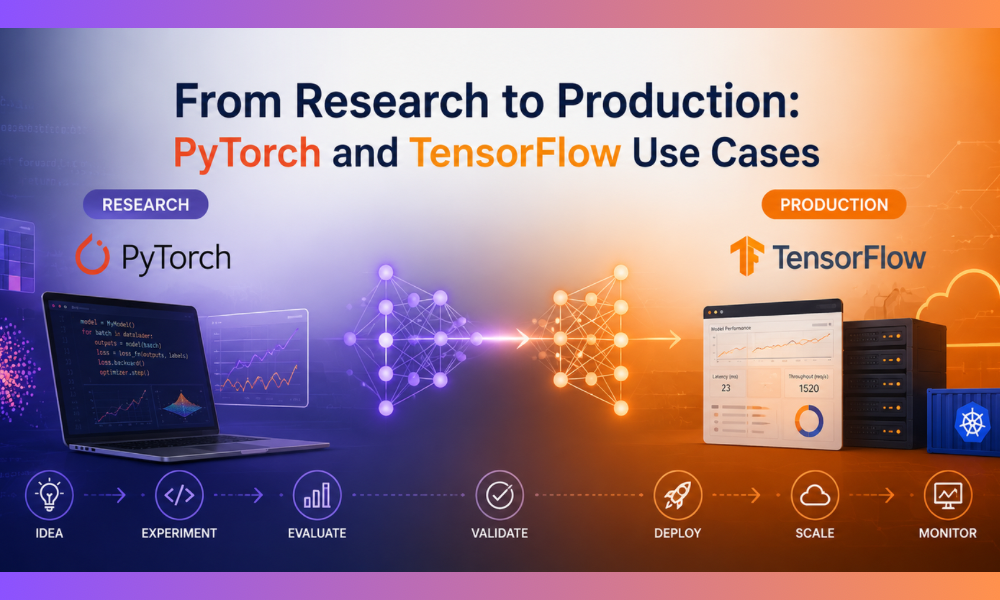
Artificial intelligence has moved far beyond research laboratories and university projects. Today, it powers recommendation engines on e-commerce websites, detects fraudulent financial transactions, assists doctors with medical diagnoses, improves customer support through intelligent chatbots, and helps manufacturers predict equipment failures before they occur. Behind many of these real-world AI applications are two of the most influential deep learning frameworks ever created: PyTorch and TensorFlow.
While both frameworks are designed to build machine learning and deep learning models, they have become popular for slightly different reasons. PyTorch is widely appreciated for its flexibility and ease of experimentation, making it a favorite among researchers and AI innovators. TensorFlow, on the other hand, has earned a strong reputation for deploying scalable AI solutions into production environments where performance, reliability, and long-term maintenance are essential.
For businesses beginning their AI journey, the choice between these frameworks is rarely about deciding which one is better. Instead, it is about understanding which framework aligns with specific project goals, development timelines, and long-term business objectives.
At Your Cloud Hub, we help organizations understand that successful AI implementation is not simply about selecting a framework. It is about creating a development strategy that takes an idea from research and transforms it into a reliable product that delivers measurable business value. Whether businesses choose Python development outsourcing, decide to hire Python developers, work with offshore Python developers, or expand their team by hiring a remote Python developer, having the right expertise is often more important than the technology itself.
Every Successful AI Project Starts With a Question, Not a Framework
One of the biggest misconceptions surrounding artificial intelligence is that businesses begin by choosing a programming framework. In reality, successful AI projects almost always begin with a business question.
Can we predict customer churn?
Can we automate document processing?
Can we recommend products more accurately?
Can we detect fraud faster?
Can we improve demand forecasting?
Technology comes later.
Once the business objective is clearly defined, developers can determine which framework is better suited to solving the problem.
This business-first mindset prevents organizations from investing in technology simply because it is popular. Instead, every technical decision supports a measurable business outcome.
Companies that invest in Python development outsourcing often benefit from experienced teams that begin with strategic planning before writing a single line of code. This approach reduces unnecessary development while increasing the likelihood of project success.
Why Researchers Often Prefer PyTorch
Innovation requires experimentation.
Researchers frequently test different neural network architectures, modify algorithms, compare multiple approaches, and adjust models based on new discoveries.
PyTorch has become one of the preferred frameworks for this type of work because it provides exceptional flexibility during model development.
Its intuitive programming style allows researchers to debug models easily, visualize computations, and modify experiments quickly without rebuilding entire systems.
This flexibility encourages creativity because developers spend less time fighting technical limitations and more time improving models.
Organizations that hire Python developers for research-focused AI initiatives often appreciate PyTorch because it accelerates experimentation while making collaboration between researchers and engineers much easier.
For startups exploring innovative AI products, this ability to iterate rapidly can become a major competitive advantage.
TensorFlow Excels When AI Moves Into Production
Developing a successful AI model is only one part of the journey.
The real challenge begins when businesses need to deploy that model into production.
Production environments require stability, scalability, monitoring, security, and consistent performance.
TensorFlow has become one of the leading frameworks for production deployment because it was designed to support enterprise-scale applications.
Businesses running AI across thousands or millions of users need systems capable of processing large amounts of data efficiently while maintaining reliable performance.
TensorFlow provides extensive tools that help organizations deploy trained models across cloud platforms, mobile applications, websites, and enterprise infrastructure.
Companies that choose to hire offshore Python developers frequently rely on TensorFlow when building AI systems intended for long-term commercial use because of its mature deployment ecosystem.
AI Development Is a Journey From Experimentation to Business Value
Many organizations assume that once an AI model produces accurate predictions, the project is complete.
In reality, building the model is only the beginning.
After research comes testing.
After testing comes validation.
After validation comes deployment.
After deployment comes monitoring.
After monitoring comes continuous improvement.
Every successful AI system evolves over time.
Customer behavior changes.
Markets shift.
New data becomes available.
Models require retraining.
Businesses that work with a hire remote Python developer often benefit from professionals who understand the complete lifecycle rather than focusing only on model development.
The ability to maintain, improve, and optimize AI systems over time frequently determines whether an AI investment delivers lasting business value.

Real-World AI Projects Often Use Both Frameworks
One interesting reality of modern AI development is that businesses do not always choose exclusively between PyTorch and TensorFlow.
Many organizations use both.
Researchers may develop and experiment using PyTorch because of its flexibility.
Once the model reaches production readiness, engineering teams may deploy optimized versions using TensorFlow or other production-focused technologies depending on infrastructure requirements.
This hybrid approach allows organizations to benefit from the strengths of each framework.
Businesses working with experienced development partners through Python development outsourcing often discover that successful AI implementation depends more on selecting the right workflow than on selecting only one framework.
Technology should adapt to business goals—not the other way around.
Choosing the Right Development Team Matters More Than Choosing the Right Framework
Business leaders often spend significant time comparing programming frameworks.
PyTorch versus TensorFlow.
TensorFlow versus another AI library.
While these technical comparisons are valuable, they often overlook a much more important factor.
The quality of the development team.
An experienced developer understands when PyTorch provides greater flexibility.
They know when TensorFlow offers better production capabilities.
They recognize situations where combining multiple technologies creates better outcomes.
Businesses that hire Python developers gain much more than coding expertise.
They gain strategic thinking, architectural planning, optimization experience, and problem-solving skills developed through real-world projects.
Frameworks evolve continuously.
Strong developers adapt alongside them.
AI Projects Need Long-Term Thinking
One of the biggest reasons AI initiatives fail is that organizations treat them as short-term software projects.
Artificial intelligence behaves differently.
Models improve through continuous learning.
Customer behavior evolves.
Business priorities change.
Data quality fluctuates.
Successful AI requires ongoing refinement.
Businesses that hire offshore Python developers frequently build long-term relationships with technical teams capable of supporting AI systems well beyond initial deployment.
Rather than delivering software and leaving, experienced developers continue monitoring model performance, improving prediction accuracy, optimizing infrastructure, and introducing new capabilities over time.
This ongoing partnership often produces significantly greater value than isolated development projects.
The Future Is About Practical AI, Not Experimental AI
Several years ago, artificial intelligence was primarily viewed as experimental technology.
Today, businesses expect practical results.
Lower costs.
Higher efficiency.
Better customer experiences.
Smarter decision-making.
Faster operations.
Whether those results are delivered using PyTorch, TensorFlow, or future frameworks becomes less important than achieving measurable business outcomes.
At Your Cloud Hub, we encourage organizations to focus less on technical buzzwords and more on solving meaningful business challenges through well-planned AI strategies.
Whether companies choose Python development outsourcing, decide to hire Python developers, collaborate with hire offshore Python developers, or expand their capabilities through a hire remote Python developers, success ultimately depends on combining the right technology with experienced people who understand how to transform research into reliable production systems.

From Prototype to Production: Where Most AI Projects Actually Struggle
Building an AI model that performs well during testing is an exciting milestone, but it is rarely the hardest part of the journey. The real challenge begins when that model has to work consistently in the real world. An AI application running inside a research environment may perform exceptionally well with clean datasets and controlled conditions, but production environments are far less predictable. New types of data appear every day, customer behavior changes, system traffic increases, and business requirements evolve continuously. A model that once achieved excellent results can gradually lose accuracy if it is not monitored and updated regularly.
This is why successful AI projects focus on much more than model development. They include data pipelines, automated testing, performance monitoring, version control, security, and ongoing maintenance. Businesses that invest in Python development outsourcing often gain access to experienced teams that understand this complete lifecycle. Instead of delivering only a trained model, they build reliable AI systems that continue performing long after deployment. At Your Cloud Hub, we encourage organizations to think beyond launching an AI solution. The real goal should be creating an intelligent system that continues learning, adapting, and delivering business value as the company grows.
Choosing Between PyTorch and TensorFlow Depends on Your Business Goals
One of the most common questions business leaders ask is whether they should choose PyTorch or TensorFlow for their AI project. In reality, there is no universal answer because every project has different priorities. A startup building an innovative AI product may value rapid experimentation and flexibility, making PyTorch an attractive choice. An established enterprise deploying AI across multiple business applications may prioritize stability, scalability, and production readiness, making TensorFlow a better fit.
Rather than asking which framework is superior, businesses should ask which one aligns with their objectives, available resources, and long-term plans. The right decision depends on factors such as project complexity, deployment requirements, available technical expertise, and future scalability. Companies that hire Python developers with practical AI experience benefit from professionals who can evaluate these factors objectively instead of recommending technology based on personal preference. The framework should always support the business strategy, not dictate it.

Why Collaboration Matters More Than Individual Technical Skills
Artificial intelligence projects are rarely completed by a single developer. Behind every successful AI application is a collaborative team of software engineers, machine learning specialists, cloud architects, data analysts, product managers, and business stakeholders working toward a shared objective. Each person contributes unique expertise, and the success of the project depends on how effectively these different disciplines work together.
This is one reason businesses increasingly choose to hire remote Python developer professionals. Remote collaboration has become a normal part of modern software development, allowing organizations to access specialized talent regardless of location. Experienced remote developers are accustomed to working within distributed teams, using collaborative development tools, participating in agile workflows, and communicating effectively across different time zones. This flexibility enables businesses to assemble stronger AI teams while maintaining development speed and quality.
Building AI Solutions That Can Grow With Your Business
Many AI projects begin with a single use case, such as automating customer support, improving product recommendations, or forecasting sales. As organizations begin seeing positive results, they often discover new opportunities to apply AI across other areas of the business. This means the underlying technology should be capable of growing alongside the organization.
Scalability is one of the biggest reasons businesses work with experienced professionals or choose to hire offshore Python developers. Developers with real-world experience understand how to build flexible architectures that support future expansion without requiring complete redevelopment. Instead of creating isolated solutions for one department, they design systems that can integrate with additional applications, larger datasets, cloud platforms, and future machine learning models. This forward-thinking approach protects technology investments while making future innovation much easier.
AI Success Depends on Continuous Learning—For Models and Teams
Artificial intelligence is constantly evolving. New research papers are published every week, innovative frameworks continue to emerge, and development practices improve at a remarkable pace. Businesses that want to remain competitive cannot rely on knowledge acquired several years ago. Continuous learning has become just as important for development teams as it is for machine learning models.
Organizations that invest in Python development outsourcing often benefit from working with specialists who actively stay current with the latest AI technologies, development methodologies, and industry best practices. This ongoing expertise helps businesses adopt new capabilities more quickly while avoiding outdated approaches. At Your Cloud Hub, we believe successful AI development is built on a culture of continuous improvement. The businesses that achieve lasting success are not necessarily those using the newest technology, but those committed to learning, adapting, and improving every stage of the AI lifecycle.

Turning AI Research Into Business Impact
The true measure of an AI project is not how advanced the underlying model appears—it is the value it creates for the business. Whether reducing operational costs, improving customer experiences, increasing efficiency, or helping teams make better decisions, successful AI should solve meaningful problems that produce measurable outcomes.
Businesses that choose to hire Python developers, collaborate with hire offshore Python developers, or expand their capabilities through a hire remote Python developer gain access to professionals who understand that technology should always support business objectives. At Your Cloud Hub, our approach focuses on bridging the gap between innovative AI research and practical business implementation. By combining technical expertise with strategic thinking, organizations can move confidently from experimentation to production and build AI solutions that continue creating value for years to come.