


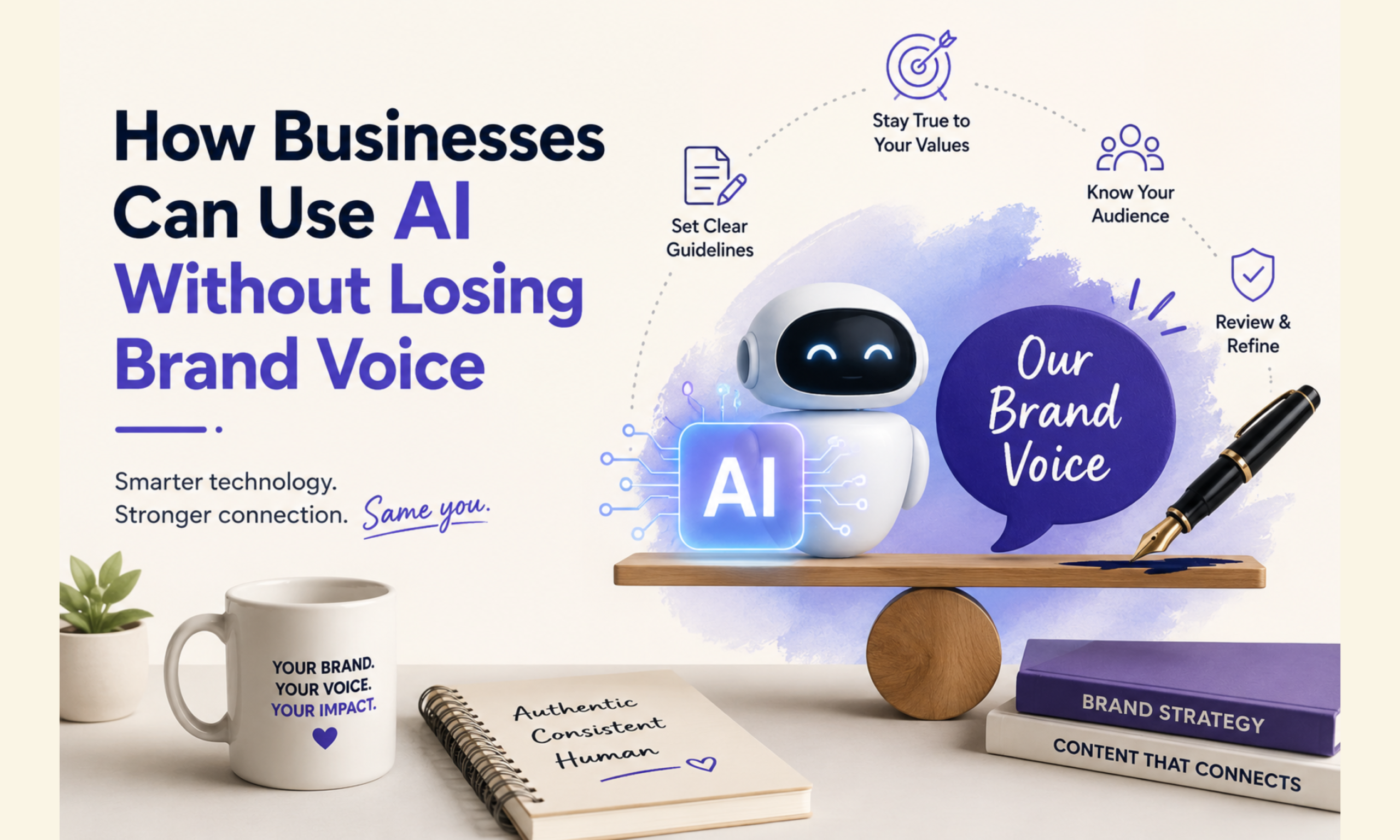
Artificial intelligence has rapidly transformed how businesses create content, communicate with customers, and manage marketing campaigns. From generating blog posts and social media updates to automating email sequences and customer support interactions, AI is helping organizations operate more efficiently than ever before.
However, as AI adoption continues to grow, many businesses face a significant concern: how to leverage AI without sacrificing the unique voice and personality that make their brands recognizable?
Customers connect with brands because of their values, messaging style, expertise, and consistency. If every piece of content sounds generic or robotic, businesses risk losing the authenticity that helps build trust and loyalty.
At Your Cloud Hub, we often see organizations embrace AI enthusiastically, only to discover that their content begins to sound similar to competitors’. The challenge is not whether businesses should use AI. The challenge is learning how to use AI strategically while preserving the human elements that make a brand distinctive.
Companies that hire AI developers, work with experienced AI specialists, or choose to hire AI engineer professionals are increasingly focused on building AI systems that enhance brand communication rather than replace it.
Why Brand Voice Matters More Than Ever
Brand voice is far more than writing style. It reflects a company’s personality, values, expertise, and relationship with its audience.
Whether a business communicates in a professional, educational, conversational, or authoritative tone, consistency helps customers recognize and trust the brand across different channels.
In today’s crowded digital marketplace, products and services often look similar. Brand voice becomes one of the most important differentiators available.
When businesses publish content that feels generic, they lose opportunities to build emotional connections with their audience.
Organizations that hire AI developers frequently discover that AI performs best when it operates within clearly defined brand guidelines. Without these guidelines, AI-generated content can become inconsistent and disconnected from the company’s identity.
Maintaining a strong brand voice ensures that every interaction reinforces trust and strengthens brand recognition.
AI Should Support Creativity, Not Replace It
One of the biggest misconceptions about artificial intelligence is that it should completely replace human content creation.
In reality, the most effective AI strategies use technology to enhance creativity rather than eliminate it.
AI excels at tasks such as:
Research assistance
Content outlining
Data analysis
Idea generation
Draft creation
Workflow automation
However, human expertise remains essential for storytelling, emotional intelligence, strategic messaging, and brand positioning.
Businesses that hire AI engineer professionals often develop systems that combine AI efficiency with human oversight. This hybrid approach allows organizations to scale content production while maintaining authenticity and quality.
The goal is not to remove humans from the process. The goal is to help human teams work more efficiently without compromising brand integrity.
Creating Brand Guidelines for AI Systems
One of the most effective ways to preserve brand voice is by creating detailed guidelines that AI systems can follow.
Many businesses use AI tools without providing sufficient context about their communication style. As a result, generated content often sounds generic because the system lacks direction.
Strong brand guidelines should include:
Tone of voice
Writing style preferences
Vocabulary choices
Industry terminology
Audience characteristics
Brand values
Messaging priorities
Organizations that work with experienced AI specialists often create extensive AI training frameworks that help systems generate content aligned with brand identity.
The more clearly businesses define their voice, the easier it becomes for AI tools to produce consistent and recognizable communication.
Human Editing Remains Essential
Even the most advanced AI systems should not publish content without human review.
Artificial intelligence can generate high-quality drafts, but it may still miss nuances related to brand personality, customer expectations, and strategic objectives.
Human editors help ensure that content reflects the company’s voice, values, and messaging priorities.
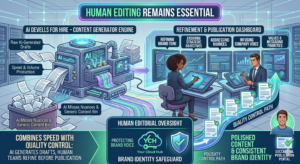
Businesses that utilize AI developers for hire frequently implement workflows where AI generates initial drafts and human teams refine them before publication.
This approach combines speed with quality control.
Human oversight helps maintain consistency while preventing content from becoming overly generic or disconnected from the brand’s identity.
At Your Cloud Hub, we view human review as one of the most important safeguards for protecting brand voice during AI adoption.
AI Can Strengthen Personalization Without Weakening Authenticity
One of the greatest advantages of artificial intelligence is its ability to personalize customer experiences at scale.
AI can analyze customer behavior, preferences, and interactions to deliver more relevant content and communication.
However, personalization should never come at the expense of authenticity.
Businesses that hire AI developers often build systems that personalize messaging while remaining consistent with established brand guidelines.
For example, email campaigns may adapt content based on customer interests while maintaining the same tone, values, and communication style across every interaction.
When implemented correctly, AI-driven personalization strengthens customer relationships because communication feels both relevant and authentic.
Training Teams to Work Alongside AI
Successful AI adoption requires more than technology implementation.
Teams must learn how to collaborate effectively with AI systems while maintaining quality standards and brand consistency.
Many businesses mistakenly assume that AI eliminates the need for content expertise. In reality, employees often become even more important because they provide strategic direction and quality control.
Organizations that hire AI engineers frequently invest in training programs that teach employees how to use AI tools effectively while preserving brand standards.
This includes understanding when to rely on AI, when to intervene manually, and how to evaluate generated content critically.
Businesses that combine skilled teams with advanced AI tools often achieve the strongest results.
Why Generic AI Content Creates Competitive Risks
As AI-generated content becomes more common, businesses face a new challenge: content homogenization.
When multiple companies use similar prompts and tools without strong brand guidelines, content begins to look and sound alike.
This creates significant competitive risks because customers struggle to distinguish between brands.
Companies working with experienced AI specialists focus heavily on differentiation strategies that preserve unique brand characteristics.
Original insights, industry expertise, customer experiences, and proprietary knowledge remain valuable because they cannot easily be replicated through generic AI generation.
The businesses that maintain distinctive voices will be better positioned to stand out as AI adoption becomes increasingly widespread.
The Future of AI and Brand Communication
Artificial intelligence will continue playing a larger role in marketing, customer engagement, and content creation.
However, the brands that succeed will not be those that automate everything.
Instead, success will belong to businesses that use AI strategically while preserving authenticity, expertise, and human connection.
Companies that hire AI developers, choose to hire AI engineer professionals, collaborate with experienced AI specialists, or leverage AI developers for hire will increasingly focus on creating systems that amplify brand voice rather than replace it.
At Your Cloud Hub, we believe the future of AI-driven marketing lies in collaboration between human creativity and machine intelligence.
Businesses that master this balance will enjoy the efficiency benefits of AI while maintaining the trust, recognition, and loyalty that strong brands require.
Why Businesses Must Build a Human-AI Collaboration Model
One of the biggest mistakes organizations make when adopting artificial intelligence is treating it as a replacement for human expertise rather than a tool that enhances it. While AI can generate content, analyze data, automate repetitive tasks, and improve operational efficiency, it still lacks the real-world experience, emotional intelligence, strategic thinking, and creativity that define strong brands. Businesses that become overly dependent on AI often find that their messaging begins to lose the depth and authenticity that customers value.
The most successful companies are building what can best be described as a Human-AI Collaboration Model. In this approach, artificial intelligence handles the time-consuming aspects of content creation and data analysis, while human teams focus on strategy, storytelling, customer understanding, and brand positioning. Companies that hire AI developers frequently create systems where AI produces initial drafts, performs research, and identifies trends, while experienced marketers and subject matter experts refine the output to ensure it aligns with brand standards. At Your Cloud Hub, we have seen that businesses adopting this collaborative approach are able to scale content production significantly without sacrificing the qualities that make their brand unique. Rather than viewing AI and human creativity as competing forces, organizations should recognize that the greatest results occur when both work together toward the same objective.
Consistency Across Channels Is Critical for Brand Preservation
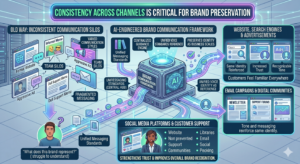
Modern customers interact with brands through numerous channels, including websites, email campaigns, social media platforms, search engines, advertisements, customer support systems, and digital communities. One of the greatest challenges businesses face is maintaining a consistent voice across all these touchpoints. When communication styles vary dramatically between channels, customers may struggle to understand what the brand represents.
Artificial intelligence can actually strengthen consistency when implemented correctly. Businesses that hire AI engineer professionals often develop centralized brand communication frameworks that guide AI-generated content across multiple platforms. Instead of having different teams create content independently, organizations can establish unified messaging standards that AI systems reference whenever new content is generated.
This consistency becomes increasingly valuable as businesses scale. A recognizable brand voice helps customers feel familiar with the company, regardless of where interactions occur. Whether a customer reads a blog article, receives an email newsletter, visits a website, or engages through social media, the tone and messaging should reinforce the same identity. Maintaining this consistency strengthens trust and improves overall brand recognition.
AI Can Help Strengthen Thought Leadership
Many business leaders worry that AI-generated content will reduce credibility and weaken industry authority. In reality, artificial intelligence can help strengthen thought leadership when used strategically.
Creating high-quality thought leadership content requires substantial research, analysis, and organization. These are areas where AI can provide significant assistance. By helping gather information, identify trends, summarize industry developments, and organize complex topics, AI allows experts to spend more time contributing unique insights and less time performing administrative tasks.
Organizations that work with experienced AI specialists often use AI as a research assistant rather than a replacement for expertise. Subject matter experts continue providing the ideas, perspectives, and strategic insights that make content valuable, while AI helps streamline the creation process.
At Your Cloud Hub, we encourage businesses to focus on combining AI efficiency with human expertise. Customers do not engage with content simply because it exists. They engage because it provides valuable knowledge, solves problems, and offers perspectives they cannot find elsewhere. AI can accelerate the production process, but genuine thought leadership still comes from people.
Customer Trust Depends on Transparency
As artificial intelligence becomes more integrated into business operations, transparency is becoming increasingly important. Customers are generally comfortable with businesses using AI to improve experiences, but they also value honesty regarding how technology is being used.
Trust is one of the most valuable assets a brand can build, and trust is often strengthened through transparency. Businesses that openly communicate their use of AI while maintaining human oversight are often viewed more favorably than companies attempting to disguise AI-generated interactions entirely.
Companies that hire AI developers frequently implement systems where AI supports customer experiences while ensuring human review remains part of important decision-making processes. This balance allows organizations to benefit from automation without creating concerns about authenticity or accountability.
Transparency also helps businesses differentiate themselves in an increasingly automated world. Customers appreciate knowing that while AI may assist with efficiency, real people remain responsible for maintaining quality, accuracy, and customer satisfaction.
AI Personalization Must Reflect Brand Values
Personalization is one of the most powerful applications of artificial intelligence, but it must be implemented carefully. While AI can deliver highly relevant content and recommendations, businesses must ensure that personalization efforts align with their broader brand identity and values.
A luxury brand, for example, may personalize experiences differently than a technology startup or a healthcare provider. The tone, messaging style, and customer interactions should remain consistent with the brand’s positioning, regardless of how personalized the experience becomes.
Businesses that leverage AI developers for hire often create sophisticated personalization systems that adapt content while preserving core brand characteristics. This ensures that every interaction feels both relevant and authentic.
The most successful personalization strategies do not simply focus on delivering the right message. They focus on delivering the right message in a way that feels consistent with the brand’s identity and customer expectations.
Why Original Insights Will Become More Valuable
As AI-generated content becomes increasingly common, original thinking will become one of the most important competitive advantages available to businesses. Generic content can be produced at scale by virtually anyone with access to AI tools. What cannot be replicated as easily are unique experiences, proprietary insights, customer stories, industry expertise, and innovative perspectives.
Organizations that hire AI engineer professionals often discover that technology works best when paired with original intellectual capital. AI can help structure and distribute information, but the ideas themselves must come from knowledgeable individuals who understand the industry deeply.