

Marketing research has always required significant time. Teams need to understand customers, monitor competitors, analyze search behavior, investigate industries, review market trends, identify content opportunities, and turn scattered information into something decision-makers can actually use.
AI agents are changing how much of this work gets done.
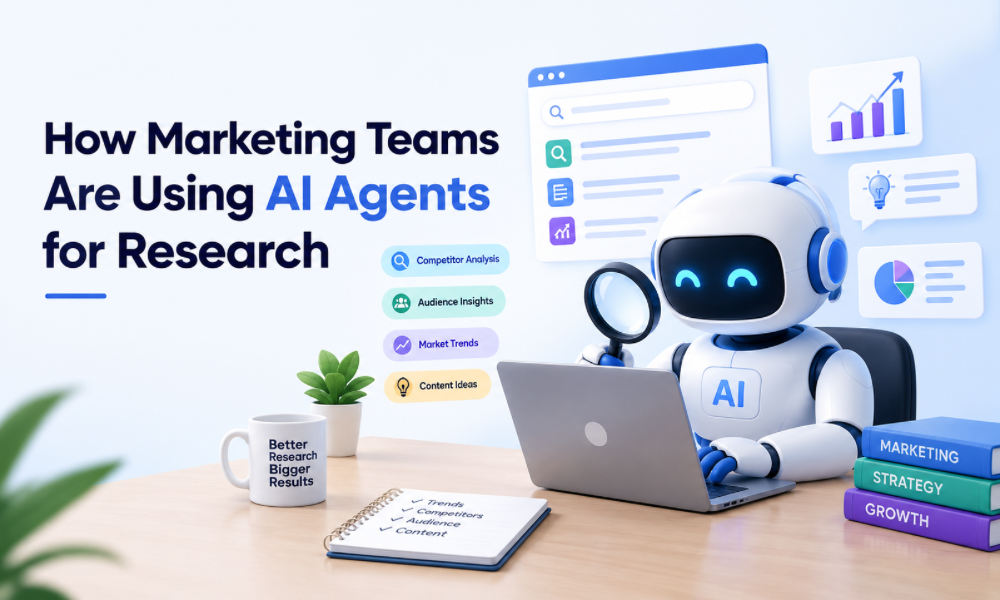
Instead of using AI only to write a paragraph or summarize a document, marketing teams are increasingly experimenting with systems that can complete multi-step research tasks. An AI agent can receive a research objective, determine what information is needed, search through relevant sources, organize findings, identify patterns, compare information, and prepare a structured output for human review.
This does not mean marketers can hand over research to an autonomous system and accept whatever it produces. Marketing research often involves ambiguous questions, conflicting information, changing markets, proprietary data, and decisions where context matters. Human judgment remains essential.
The real opportunity is to use AI agents to handle repetitive research operations. At the same time, marketers spend more time interpreting evidence, challenging assumptions, developing strategy, and deciding what the findings mean for the business.
What Is an AI Agent in Marketing Research?
An AI agent is different from a basic chatbot that responds to a single prompt.
A conventional AI interaction might involve asking a model to summarize a report. An agentic workflow can involve a broader objective such as researching a market segment, collecting information from multiple sources, comparing competitors, organizing findings, and producing a report according to predefined criteria.
The agent may break the task into smaller steps and use different tools or sources along the way.
For marketing teams, this creates an opportunity to automate parts of the research process that previously required hours of manual browsing and spreadsheet work.
The agent does not need to replace the marketer. Instead, it can function as a research assistant that continuously performs defined tasks and brings organized information back to the team.
Why Marketing Research Is a Strong Use Case for AI Agents
Research contains many repetitive activities.
A marketer may need to open dozens of competitor websites, collect product information, examine pricing pages, review customer comments, identify recurring complaints, compare features, and organize everything into a document.
Much of that work involves finding, sorting, and structuring information rather than making the final strategic judgment.
These repetitive steps are particularly suitable for agent-based workflows.
An AI system can help gather initial evidence at scale, allowing marketers to spend less time performing mechanical research and more time deciding what the evidence means.
The quality of the final result still depends heavily on the quality of the research instructions, source selection, verification process, and human interpretation.
Customer Research Is Becoming More Continuous
Traditionally, customer research might happen before launching a campaign, entering a market, or developing a product.
AI agents make it more practical to conduct smaller research exercises continuously.
An agent could monitor recurring customer questions, identify emerging themes in feedback, summarize support conversations, or organize publicly available discussions around specific problems.
Instead of waiting for a major quarterly research project, marketing teams can maintain a more current understanding of what customers are discussing.
This does not eliminate formal customer research such as interviews and surveys. It adds another layer of ongoing observation.
AI Agents Can Analyze Customer Feedback
Customer feedback contains valuable information, but it can be difficult to process when it exists across multiple channels.
Reviews, survey responses, support tickets, emails, social comments, sales notes, and community discussions may all contain clues about customer needs.
An AI agent can help organize this material into themes.
For example, it could identify recurring complaints about onboarding, frequently requested features, questions about pricing, or concerns about implementation.
The marketer can then investigate those patterns rather than reading every piece of feedback manually.
The important safeguard is to preserve the underlying evidence. An agent-generated summary should not become the only record of what customers actually said.
Researching Competitors With AI Agents
Competitive research is another area where AI agents can reduce repetitive work.
Marketing teams can define a set of competitors and specific categories they want to monitor. The agent can then collect information about positioning, service descriptions, content themes, product updates, public messaging, or other relevant areas.
The goal should not be to copy competitors.
Instead, the research can help marketers understand how companies position themselves and where the market appears crowded or underserved.
A human strategist can then interpret those observations and determine whether there is a meaningful opportunity.
Competitor Monitoring Can Become More Structured
Competitive research becomes more useful when the same criteria are monitored repeatedly.
For example, a marketing team might track how competitors describe their target audience, which problems they emphasize, what topics they publish about, and how their messaging changes over time.
An AI agent can help maintain a structured record of these observations.
This creates a historical perspective rather than a one-time competitor snapshot.
However, marketers should distinguish between what a competitor publicly states and what an AI system infers from that information. Interpretations should be clearly separated from documented facts.
AI Agents Can Research Content Gaps
Content teams often spend considerable time identifying what they should publish next.
An AI agent can help analyze existing website content, identify frequently discussed questions, compare coverage across competitors, and organize potential topics.
The result can be a research backlog containing topics grouped by customer stage, subject area, or business priority.
This is particularly useful when a company has a large content library.
Instead of manually checking hundreds of pages to determine which subjects have already been covered, an agent can help organize the information before a strategist reviews it.
Search Research Is Becoming More Complex
Search behavior is changing as users interact with traditional search engines, AI-powered search experiences, social platforms, communities, and other discovery channels.
Marketing teams therefore need to research more than individual keywords.
They need to understand the questions people ask, the language customers use, the problems behind those questions, and the types of information users expect to find.
AI agents can assist by grouping related questions and identifying recurring concepts.
A marketer can then turn those observations into content structures, topic clusters, landing pages, or broader search strategies.

AI Agents and SEO Research
SEO research has traditionally involved keyword discovery, competitor analysis, search-result analysis, content audits, technical reviews, and performance monitoring.
AI agents can assist with several of these tasks by organizing large amounts of information and identifying patterns.
However, marketers should avoid treating AI-generated recommendations as unquestionable SEO instructions.
Search behavior is contextual, algorithms change, and business goals vary.
A qualified hire SEO consultant can provide the strategic layer required to determine whether an apparent search opportunity is actually valuable for the business.
AI can identify possibilities. Human expertise helps determine which possibilities deserve investment.
Understanding Customer Intent
One of the most useful applications of AI agents is grouping customer questions according to intent.
Consider a person researching project-management software.
Early questions might focus on understanding the problem. Later questions could compare solutions, evaluate features, investigate pricing, or assess implementation requirements.
An AI agent can help organize these questions into stages.
This can give marketing teams a clearer view of the information customers need before making a decision.
The result can influence content planning, landing-page structure, email campaigns, and sales enablement.
Researching Industry Trends
Marketing teams constantly need to understand what is changing within their industries.
An AI agent can help collect information from relevant publications, reports, company announcements, research papers, and other sources.
It can then organize the information by theme or date.
This can make trend monitoring less dependent on manually checking dozens of websites.
However, trend research requires careful source evaluation. A frequently repeated claim is not automatically a verified fact. The agent should be instructed to distinguish primary research, company claims, expert commentary, and speculation.
Source Verification Is Critical
One of the biggest risks in AI-assisted research is accepting incorrect information.
An AI agent may misunderstand a source, combine information incorrectly, rely on outdated material, or produce a confident-sounding statement that cannot be verified.
Marketing teams should therefore design verification into the workflow.
Important claims should be checked against their sources, especially when they will be used in public-facing content, strategic documents, advertising, or executive reports.
AI can accelerate discovery, but acceleration without verification can simply produce errors faster.
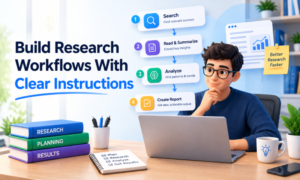
Build Research Workflows With Clear Instructions
AI agents perform better when their objectives are specific.
Instead of giving an agent a vague instruction such as “Research our competitors,” define what needs to be investigated.
Specify the companies, categories, time period, source types, output format, and questions that need to be answered.
For example, the workflow could ask the agent to examine competitor positioning across a defined set of pages and separate directly observed information from interpretation.
Clear instructions reduce ambiguity and make the resulting research easier to evaluate.
AI Agents Can Turn Research Into Briefs
Marketing teams often lose time converting raw research into something usable.
An AI agent can organize findings into a research brief containing key themes, supporting evidence, unanswered questions, and potential implications. Businesses working with AI developers for hire can also explore customized AI-agent workflows that automate this research and briefing process according to their specific marketing requirements.
Product Research Can Support Marketing
AI agents are also useful when marketing teams need a deeper understanding of products.
The agent can review product documentation, customer questions, sales materials, support conversations, and competitor information.
This can help identify which features customers discuss most often and which areas create confusion.
Marketing can then use those findings to improve messaging and educational content.
The process creates stronger communication between product, sales, support, and marketing teams.
AI Agents Can Help Analyze Reviews
Reviews can provide valuable insight into how customers describe products in their own language.
An agent can organize review data by themes such as usability, reliability, customer service, pricing, implementation, or specific features.
This can help marketers discover language that resonates with customers.
However, review analysis should preserve context. A single negative comment should not automatically become a major product insight, just as a large number of positive comments may not explain why customers are satisfied.
Human review remains important when interpreting qualitative information.
Social Listening With AI Agents
Social platforms and online communities can contain early signals about emerging conversations.
AI agents can help collect and categorize relevant discussions where the data can be accessed appropriately.
Marketing teams may use this research to identify recurring questions, emerging terminology, customer frustrations, or topics receiving unusual attention.
The purpose should be understanding the conversation rather than automatically turning every discussion into a marketing opportunity.
Privacy, platform rules, consent, and appropriate data use should remain part of the workflow.
AI Agents Can Support Research at Scale
One of the biggest advantages of agent-based research is scalability.
A human researcher can only manually inspect a limited number of sources in a given period. An automated system can potentially process much larger collections of information.
This allows marketing teams to investigate broader datasets before narrowing their attention.
But scale creates another problem: information overload.
If the agent collects thousands of observations without prioritization, marketers may simply receive a larger version of the same research problem.
Good workflows therefore include filtering, categorization, relevance criteria, and prioritization.
The Role of AI Specialists
Building a reliable agentic research system can become technically complicated when the workflow needs custom integrations, databases, APIs, authentication, monitoring, or specialized models.
This is where AI specialists can contribute.
They can help determine which research tasks are suitable for automation, how different tools should interact, and how outputs should be evaluated.
A specialist can also help design safeguards so that an agent does not automatically take actions beyond its intended scope.
The objective should be controlled automation rather than unrestricted autonomy.
When Businesses Should Hire AI Developers
A company may initially experiment with general-purpose AI tools for research. As requirements become more sophisticated, however, it may need custom development.
Businesses may hire AI developers when they want agents to connect with internal systems, proprietary datasets, customer databases, analytics platforms, or specialized research tools.
Custom development can make sense when the workflow needs to operate repeatedly rather than as an occasional manual experiment.
The investment should be evaluated based on the amount of repetitive work being replaced and the strategic value of the resulting research.
Working With an AI Engineer
An AI engineer can focus on the technical architecture behind an agent-based research system.
That may include model selection, retrieval systems, tool integration, data pipelines, evaluation frameworks, and system reliability.
Businesses looking to hire AI engineer support should clearly define what the agent needs to accomplish before development begins.
The most effective implementation usually starts with the research workflow rather than the technology.
First, identify the repetitive process. Then determine which parts can safely be automated.
AI Developers for Hire for Specialized Research Systems
Some organizations need short-term expertise rather than a permanent internal team.
AI developers for hire can support projects such as competitive intelligence systems, automated research pipelines, customer-feedback analysis, content research platforms, or internal knowledge assistants.
Before engaging external developers, define ownership of data, system access, documentation, maintenance, and security responsibilities.
The goal is to build something the marketing team can actually use rather than creating a technically impressive system that requires constant developer intervention.