


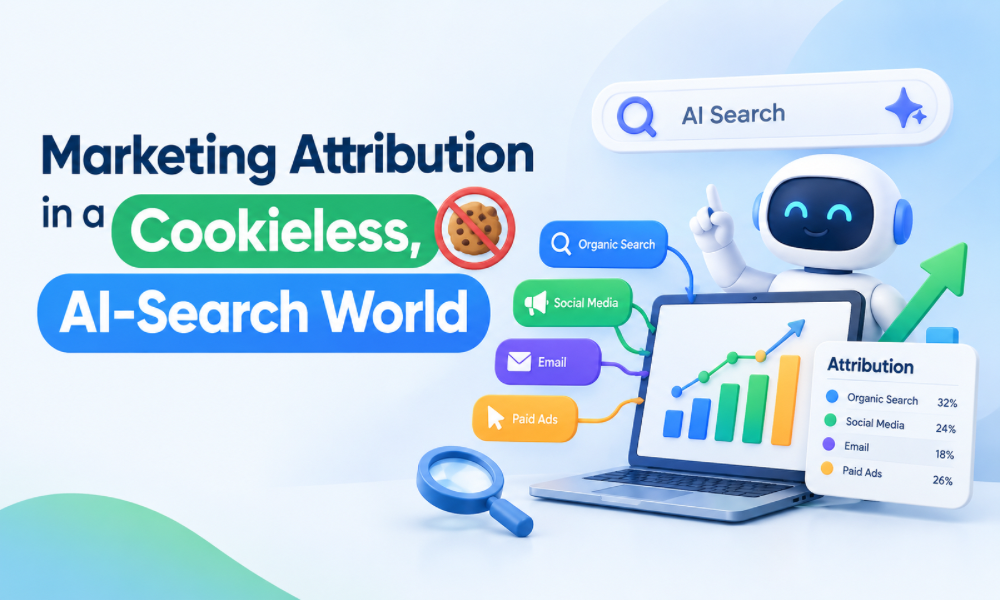
Marketing attribution has always been an imperfect science. Businesses want to know which campaign generated a lead, which channel influenced a purchase, and where marketing budgets are actually producing results. In the past, marketers could rely heavily on cookies, referral data, advertising platforms, and analytics tools to connect a user’s journey from the first visit to conversion.
That journey is becoming harder to reconstruct.
Privacy changes, browser restrictions, consent requirements, fragmented devices, dark traffic, and the growing influence of AI-powered search are changing how people discover businesses. Someone might see a brand in an AI-generated answer, research it later through Google, visit the website directly, watch a video, return through an email, and finally convert after speaking with sales.
A conventional last-click report may assign that conversion to the final interaction while ignoring much of the journey that happened beforehand.
This does not mean attribution is becoming useless. It means businesses need to rethink what they expect attribution data to accomplish.
What Is Changing in Marketing Attribution?
Traditional attribution attempts to connect marketing interactions with business outcomes. Depending on the model, credit may be assigned to the first touchpoint, last touchpoint, several interactions, or a combination of them.
The problem is that modern customer journeys are rarely linear.
A prospect may interact with paid advertising, organic search, social content, an email newsletter, an AI-generated recommendation, a review site, and a company’s website before becoming a customer. For a business like Your Cloud Hub, these multiple touchpoints can make it challenging to understand which marketing interactions contribute to a final conversion. Some of those interactions can be measured directly, while others may be difficult or impossible to connect to an individual conversion.
Why Cookies Are No Longer a Complete Foundation
Cookies historically helped marketers recognize returning browsers and connect website interactions over time. But privacy expectations and technical changes have reduced how much businesses can depend on browser-based tracking.
Some users block tracking technologies. Others decline consent. Browsers and platforms impose restrictions. People also switch between phones, laptops, tablets, and other devices.
As a result, the analytics system may see several disconnected interactions when they actually belong to one customer journey.
The challenge is not simply collecting more data. Businesses need to determine which data they can collect responsibly and which signals are reliable enough to support decisions.
AI Search Adds Another Layer of Complexity
AI-powered search creates a particularly interesting attribution problem.
A user may ask an AI system a question such as “What should I consider when choosing an accounting firm?” The AI response might summarize information from several sources and cite businesses, publications, guides, or other websites.
The user may never click the citation.
Instead, they may remember a company name, search for it later, visit its website directly, or mention the company to a colleague.
From the perspective of conventional analytics, the eventual website visit may appear to be direct traffic or branded search. The original AI interaction may never be recorded as the source of that interest.
This creates what can be described as an AI influence gap between discovery and measurable website activity.
Direct Traffic Does Not Always Mean “No Marketing Influence”
Direct traffic is often interpreted too literally.
A visitor who enters a URL manually is clearly arriving without a conventional referral parameter. But that does not tell you why the person decided to visit.
They might have heard about the company from a podcast, seen it in an AI-generated answer, received a recommendation from someone, encountered it in a community, or remembered the brand from an earlier advertising interaction.
Analytics can report how someone arrived at a website without necessarily explaining everything that influenced the decision to arrive.
This distinction becomes increasingly important as customer discovery moves across channels that do not always pass traditional referral information.
Build a Measurement Strategy Around Business Outcomes
The solution is not to chase an attribution percentage for every interaction.
Start with the outcomes that matter to the business.
Depending on the organization, these might include qualified leads, booked consultations, completed purchases, recurring customers, application submissions, or revenue.
Then identify the meaningful events that lead toward those outcomes.
A website visit by itself may have limited business value. A completed form, qualified lead, product trial, appointment, or purchase can provide much stronger measurement signals.
The objective is to connect marketing activity with meaningful outcomes wherever available data allows.
First-Party Data Becomes More Valuable
As third-party tracking becomes less dependable, first-party data becomes increasingly important.
First-party data is information collected directly through interactions with your business, subject to applicable privacy and consent requirements. This can include website events, CRM records, customer transactions, email engagement, form submissions, and other business-owned signals.
The value comes from connecting these signals thoughtfully.
For example, a CRM can contain information about when a lead entered the sales pipeline and eventually became a customer. Analytics can provide information about website interactions. Advertising platforms can provide campaign-level information.
Connecting these systems can create a more useful picture than relying on one platform’s attribution report.
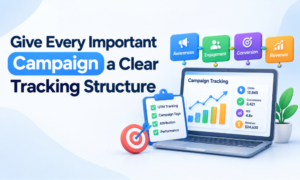
Give Every Important Campaign a Clear Tracking Structure
A cookieless environment does not eliminate the need for campaign tracking.
UTM parameters and consistent naming conventions remain useful for understanding where measurable traffic originates. Campaign names, sources, mediums, content variations, and other parameters should follow a standardized structure.
Without consistency, marketing reports quickly become difficult to interpret.
One team might label a campaign “Spring Promo,” another might use “SpringPromotion,” while a third uses an entirely different naming system. These small inconsistencies can fragment reporting and make comparisons unnecessarily difficult.
A strong measurement framework begins with disciplined data collection.
Google Analytics Still Has an Important Role
The shift away from cookies does not mean analytics platforms have stopped being useful.
Google Analytics can still help businesses understand website behavior, acquisition patterns, conversions, events, landing pages, engagement, and other measurable interactions.
The important difference is how businesses interpret the information.
Instead of treating analytics as a perfect map of every customer touchpoint, use it as one component of a broader measurement system.
Businesses with complex tracking requirements may choose to hire Google Analytics expert support to design measurement structures, audit existing implementations, and connect analytics data with broader business objectives.
Why Google Tag Manager Matters
Tracking becomes much harder to maintain when tags are added directly to a website without a clear system.
Google Tag Manager can help organizations manage tracking configurations and deploy measurement tags in a more structured way. It can also support event tracking and integrations when implemented correctly.
However, adding more tags does not automatically produce better attribution.
An organization may have dozens of tracking events but still be unable to answer basic questions about lead quality or revenue. The important issue is whether the data being collected is useful, accurate, and connected to actual business decisions.
A Google Tag Manager expert can help audit event structures, tracking triggers, variables, and implementation logic so that measurement is designed intentionally rather than accumulated over time.
Create a Consistent Event Taxonomy
An analytics implementation becomes much more valuable when important events have clear definitions.
For example, a business should know exactly what qualifies as a lead, what qualifies as a qualified lead, and what constitutes a completed conversion.
If different teams interpret these events differently, reports become unreliable.
A standardized event taxonomy creates shared language across marketing, analytics, sales, and leadership. Everyone can understand what a particular event means and why it matters.
This also makes future analytics improvements easier because new tools can be mapped to an established measurement framework.
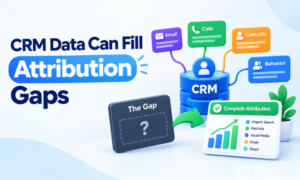
CRM Data Can Fill Attribution Gaps
Website analytics often ends when a visitor leaves the site.
A CRM can continue the story.
A person may submit a form, become a sales-qualified lead, have several conversations with a sales representative, and eventually purchase. Website analytics alone may not provide the complete picture of what happened after the initial conversion.
Connecting CRM outcomes with marketing acquisition data can help businesses evaluate channels based on the quality of leads they generate rather than simply the number of form submissions.
This distinction is particularly important for businesses where customer value varies substantially between leads.
Think Beyond Last-Click Attribution
Last-click attribution is easy to understand because it assigns credit to the final measurable interaction.
But simplicity can become misleading when customer journeys involve multiple interactions.
Imagine a prospect first discovers your business through organic content, returns through a branded search, interacts with an email, and finally clicks a paid advertisement before converting.
A last-click report may assign the conversion to paid advertising.
That does not necessarily mean paid advertising created the demand by itself.
It means paid advertising was the final measurable interaction recorded by that attribution model.
The distinction is crucial when deciding how to allocate future budgets.
Use Multiple Attribution Perspectives
Rather than searching for one perfect attribution model, businesses can examine performance from several perspectives.
First-touch analysis can help identify channels associated with initial discovery. Last-touch analysis can show what frequently appears near conversion. Position-based or data-driven approaches can provide additional perspectives where the available data supports them.
None should automatically be treated as absolute truth.
Different models answer different questions.
The important question is not “Which model is universally correct?” but rather “What business question are we trying to answer with this measurement?”
AI Search Requires Brand-Level Measurement
Traditional attribution tends to focus on clicks and sessions.
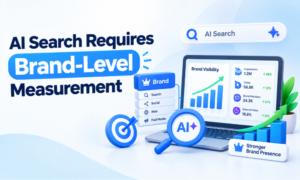
AI search makes brand visibility itself more important.
A company may appear in AI-generated responses without receiving an immediate website visit. Therefore, businesses should consider tracking indicators such as brand mentions in relevant AI environments, citation frequency where observable, branded search trends, referral patterns, and changes in direct traffic alongside conventional acquisition metrics.
These measurements do not prove that an AI interaction caused a conversion.
They provide additional context that can be investigated alongside other evidence.
Build a Controlled AI Search Testing Process
Businesses can periodically test realistic customer questions across relevant AI search experiences.
The prompts should reflect actual commercial and informational questions rather than promotional queries designed to mention the brand.
Record whether your company appears, which sources are cited, which competitors appear, and whether the information presented about your business is accurate.
Over time, these observations can become part of a broader search visibility report.
This approach does not create perfect attribution. It creates another source of evidence about how potential customers may encounter your brand.
Attribution Should Include Offline Interactions
Modern attribution can become overly focused on digital activity.
Yet many businesses generate conversions through phone calls, meetings, events, referrals, sales representatives, physical locations, and other offline interactions.
If someone researches a company online and later calls the business directly, the final conversion may never be fully connected to the original digital journey.
Call tracking, CRM records, unique campaign identifiers, customer surveys, and sales-team data can help bridge some of these gaps.
The goal is not to force every offline interaction into a digital tracking system. It is to capture enough context to understand how marketing contributes to revenue.
Ask Customers How They Found You
Sometimes the simplest data source is the customer.
A short question such as “How did you hear about us?” can reveal discovery channels that analytics cannot capture reliably.
Customers may mention a friend, podcast, AI tool, YouTube video, Google search, online community, advertisement, or another source.
However, when qualitative customer feedback is combined with quantitative analytics, it can reveal patterns that would otherwise remain invisible.
Don’t Confuse Correlation With Causation
Attribution reports can create an illusion of certainty.
Suppose conversions increased after a particular campaign launched. That does not automatically prove the campaign caused the entire increase.
Other factors may have changed at the same time: seasonality, pricing, market conditions, brand awareness, product launches, competitor activity, or changes in search behavior.
More advanced measurement approaches can use experiments, holdout groups, incrementality testing, and other methods to investigate causal impact where practical.
This is especially useful when marketing budgets are large enough that small attribution errors can significantly influence investment decisions.
When to Hire a Google Analytics Expert
Complex organizations can quickly accumulate tracking requirements across websites, landing pages, advertising platforms, CRM systems, forms, call tracking, ecommerce systems, and other tools.
At that point, bringing in a certified Google Analytics expert can help establish a more structured measurement approach.
The role should not simply involve creating reports. The specialist should understand what the business needs to measure, how events should be defined, how data flows between systems, and where attribution limitations exist.
A good analytics implementation should make decision-making clearer rather than simply produce more numbers.

Working With a Google Analytics Consultant
Some businesses may not need a permanent analytics team.
A freelance Google Analytics consultant can be useful for a specific tracking audit, migration project, analytics implementation, dashboard redesign, or measurement strategy.
The advantage of a focused engagement is that the project can be defined around a concrete problem. For example, the business may need to understand why reported conversions differ between advertising platforms and analytics, or why CRM revenue cannot be connected to acquisition channels.
Once the measurement foundation is corrected, internal teams can often maintain the system with appropriate documentation and governance.
What to Look for When You Hire a Google Analytics Expert
Before you hire a Google Analytics expert, establish what you actually need measured.
Someone experienced in basic website reporting may not necessarily have the expertise required for complex attribution across CRM, advertising, ecommerce, offline conversions, and server-side or consent-aware measurement.
Ask prospective specialists to explain how they would approach data quality, conversion definitions, attribution limitations, privacy considerations, and cross-platform discrepancies.
The objective should be a measurement framework that reflects your actual customer journey.