


Search is no longer limited to a list of blue links. People are increasingly asking AI systems to research products, compare services, explain complicated subjects, summarize sources, and recommend what to consider next. While ChatGPT receives significant attention, platforms such as Perplexity and Claude are also changing how people discover and consume information.
For businesses, this means search optimization must extend beyond traditional rankings and beyond a single AI platform. The goal is to create content and digital experiences that different AI systems can understand, retrieve, evaluate, and potentially reference. This requires strong content, technical accessibility, clear entity relationships, and genuine expertise.
Why AI Search Requires a Broader Optimization Strategy
Traditional SEO largely focuses on helping search engines understand pages and determine where they should appear for particular queries. AI search introduces another layer because systems may retrieve information from multiple sources and construct an answer around a user’s specific question.
A person might ask for the best software for a particular business problem rather than searching for a specific product page. An AI system may then examine several sources before generating a response. Businesses therefore need to think about whether their information is useful and understandable within a broader research journey, not simply whether one page ranks for one keyword.
Perplexity Changes How Users Discover Information
Perplexity is designed around conversational research, where users can ask questions and receive synthesized answers supported by sources. This creates an opportunity for businesses that publish detailed, reliable information around the subjects they genuinely understand.
Content should therefore provide enough context for individual sections to stand on their own. Definitions, comparisons, explanations, examples, and supporting facts should be clearly presented instead of buried inside vague or overly promotional writing. When information is easy to interpret independently, it becomes more useful in environments where AI systems retrieve specific passages.
Claude Highlights the Importance of Clear Context
Claude can be used for long-form analysis, document understanding, writing assistance, and complex reasoning. Although businesses should not treat every AI system as having identical retrieval behavior, the broader lesson is important: content needs to communicate meaning clearly.
Pages filled with disconnected keywords do not provide much useful context. A stronger article explains the subject logically, establishes relationships between concepts, and answers the questions a reader is likely to ask next. Clear writing gives AI systems more meaningful information to interpret than keyword repetition ever could.
Do Not Optimize for One AI Platform
One of the biggest mistakes businesses can make is treating AI optimization as if there were a single ranking system. Different platforms can use different combinations of search, retrieval, indexing, models, sources, and other signals.
Instead of trying to reverse-engineer one platform, businesses should build a strong underlying information architecture. Pages should be accessible, accurate, well-structured, internally connected, and genuinely useful. Those fundamentals create a stronger foundation across multiple AI-powered discovery experiences.
Make Every Important Page Understandable on Its Own
AI systems may retrieve a passage from the middle of a page rather than relying exclusively on the page’s introduction. This makes section-level clarity increasingly important.
Each major section should explain its subject without depending excessively on surrounding paragraphs. Headings should accurately describe the information underneath them, while paragraphs should answer a specific question or develop a clear idea. This approach improves readability for humans while also making individual content passages easier to interpret.
Build Content Around Real Research Journeys
Users rarely have only one question. Someone researching AI implementation may begin by asking what a technology does, then investigate its advantages, limitations, implementation requirements, costs, security considerations, and potential providers.
A useful content strategy anticipates this progression. Instead of creating isolated articles that target unrelated keywords, businesses can build connected resources covering different stages of the research process. This gives users a reason to explore the site and establishes broader topical depth.
Demonstrate Expertise Instead of Just Mentioning It
AI search makes it increasingly important for businesses to demonstrate knowledge through the substance of their content. Saying that a company is experienced does not provide much evidence by itself.
Practical explanations, technical examples, original observations, carefully qualified recommendations, and transparent methodology can demonstrate expertise more effectively. Businesses should explain not only what something is but also how it works, where it can fail, and which circumstances may require a different approach.
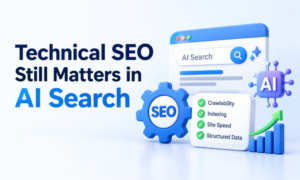
Technical SEO Still Matters in AI Search
The growth of AI search does not make traditional technical SEO irrelevant. AI systems still need access to information before they can potentially retrieve or interpret it.
Problems involving crawling, indexing, rendering, broken links, poor site architecture, duplicate pages, or inaccessible content can reduce the ability of search systems to discover important information. Businesses should therefore continue maintaining strong technical foundations while expanding their optimization strategy to account for conversational and AI-driven discovery.
Structured Information Gives Content More Context
Structured data can help communicate information about a page and the entities represented on it. While businesses should not assume that adding schema automatically produces visibility in AI-generated answers, structured information can complement a broader strategy of making content easier to interpret.
More importantly, the visible content itself should remain clear and accurate. Structured data should reinforce what the page actually says rather than being used as a shortcut for adding information that users cannot find on the page.
Entity Relationships Matter More Than Isolated Keywords
AI systems need to understand relationships between people, organizations, products, services, technologies, locations, and concepts. This makes entity clarity increasingly important.
For example, a technology company should make it clear what services it provides, which technologies it specializes in, what industries it serves, and how those services relate to specific business problems. Consistency across pages helps create a more coherent picture of the organization.
Build a Strong Knowledge Network Across Your Website
Internal linking can do more than distribute authority between pages. It can help establish relationships between related subjects. A technical article might connect naturally to a broader service explanation, while a research-focused article can reference a deeper guide covering implementation considerations.
These connections should follow the user’s interests. When internal links are created because the topics genuinely relate to each other, the website becomes easier to navigate, and its overall subject structure becomes clearer.
Optimize for Questions, Not Just Search Phrases
People interacting with AI search often use complete questions and detailed prompts rather than short keyword combinations. This changes how businesses should think about content planning.
Instead of producing a page around a single phrase, consider the questions that surround the underlying topic. What problem is the user trying to solve? What alternatives might they compare? What objections could they have? What information would help them make a decision?
Answering these questions naturally can create much more useful content than forcing a keyword into every heading.
Original Research Can Create Stronger Search Assets
Businesses have an opportunity to create content that cannot easily be replicated by competitors. Surveys, internal observations, anonymized performance trends, original frameworks, experiments, case studies, and expert commentary can all provide unique value.
Original information gives AI search systems something more substantial to discover than another generic summary of an existing topic. It can also strengthen the brand’s reputation with human readers who are looking for evidence rather than recycled advice.

Avoid Writing Content Solely for AI Citations
It can be tempting to create content specifically because a business wants an AI system to mention its brand. That approach can quickly produce unnatural pages that prioritize perceived machine signals over actual usefulness.
A better strategy is to create authoritative resources that would be valuable even if no AI system ever referenced them. Strong content, accurate information, clear organization, and a trustworthy website provide benefits across traditional search, AI discovery, referrals, and direct user research.
AI and SEO Teams Need to Work Together
AI search optimization sits at the intersection of content, SEO, technology, analytics, and user experience. A content team may understand the audience, while technical specialists understand website architecture and AI professionals understand how modern systems process information.
Businesses looking to hire AI engineer talent may benefit from involving technical expertise when building AI-focused search strategies, especially when the work involves retrieval systems, structured knowledge, automation, or custom AI applications.
Know When to Bring in AI Development Expertise
Some businesses only need to improve their public-facing content. Others may want to build internal knowledge systems, AI assistants, retrieval pipelines, or tools that make company information easier to access.
In these cases, AI developers for hire can contribute beyond conventional SEO. They can help organizations understand how information is stored, retrieved, structured, and delivered within custom AI experiences. This can be particularly valuable for companies whose competitive advantage depends heavily on proprietary knowledge or large information repositories.
Traditional SEO Expertise Still Has a Role
AI search does not eliminate the fundamentals of search optimization. Search engines still need to discover, crawl, interpret, and index websites, and businesses still need to understand technical health, content quality, search intent, and site architecture.
This is where businesses may choose to hire SEO consultant support when their existing strategy needs to expand into newer search environments. The objective should be to connect established SEO principles with the changing ways people discover information rather than treating AI search as a completely separate discipline.
Strengthen Your Google Search Foundation
Google remains an important part of the broader search ecosystem, even as users adopt AI interfaces. A website that ignores conventional search visibility may be limiting its ability to be discovered in the first place.
Businesses that need deeper technical or strategic support may hire Google SEO expert guidance to identify weaknesses in indexing, content organization, search intent, technical implementation, and overall organic visibility. Those improvements can complement an AI-search strategy rather than compete with it.
Do Not Forget Search Intent
Whether a person uses Google, Perplexity, Claude, ChatGPT, or another discovery interface, there is usually an underlying intent behind the question. They may want to learn, compare, evaluate, solve a problem, or make a purchase.
A successful content strategy starts with that intent. Businesses should avoid producing pages simply because a keyword has search volume. The more important question is whether the page provides the information someone actually needs at that point in their decision-making process.
Think Like a Search Engine Optimizer, But Write for People
Businesses may still hire search engine optimizer professionals to improve their organic strategy, but modern optimization requires a wider perspective than rankings alone.
The strongest approach combines technical accessibility with useful content, meaningful internal connections, trustworthy information, and a clear understanding of the audience. AI search makes these fundamentals more important because systems need reliable information to construct useful responses.
Measure Visibility Across Multiple Channels
Traditional rankings are no longer enough to understand how a brand is being discovered. Businesses should consider organic traffic, branded searches, referral traffic, engagement, conversions, and other indicators of content performance.
AI-driven discovery can also be difficult to measure perfectly because not every user journey is visible through conventional analytics. For that reason, businesses should focus on a collection of signals rather than expecting one metric to explain their entire search presence.
Keep Improving as AI Search Evolves
AI search is still developing, and today’s interfaces may not represent how users search several years from now. New models, retrieval systems, interfaces, and search behaviors will continue to influence digital discovery.
The safest long-term strategy is not chasing every platform-specific trick. It is building a website that consistently publishes valuable information, maintains strong technical foundations, demonstrates real expertise, and makes important concepts easy to understand.
For businesses such as Your Cloud Hub, this broader approach creates an opportunity to position technical knowledge as a genuine search asset. By combining AI expertise, strong SEO foundations, useful content, and a well-structured website, businesses can prepare for a search environment where discovery happens through many different interfaces rather than one traditional search box.
The Future of Search Is Bigger Than ChatGPT
Perplexity, Claude, ChatGPT, Google, and emerging AI search experiences represent different parts of a much larger shift in how people find information. Businesses should not build their entire strategy around trying to appear in one particular AI answer.
Instead, they should make their digital information easy to discover, understand, evaluate, and trust. When content answers real questions, demonstrates expertise, connects related subjects, and sits on a technically sound website, it has a stronger foundation for visibility across the evolving search ecosystem.
The future of SEO is therefore not simply about optimizing for AI. It is about building an information-rich digital presence that both traditional search engines and AI-powered discovery systems can meaningfully understand.

Build Topic Clusters Around Your Core Expertise
AI search benefits from websites that demonstrate depth rather than publishing a collection of unrelated articles. If a business specializes in AI development, for example, its content can cover AI implementation, machine learning applications, automation, model development, data processing, AI security, and business use cases.
These subjects can be connected through a deliberate topic structure. A detailed guide can introduce the broader subject while supporting articles answer narrower questions. This creates a content ecosystem where individual pages support one another and gives search systems more context about the site’s areas of expertise.
Make Comparisons More Useful
Comparison searches are particularly common in conversational search because users often ask AI systems to help them choose between technologies, services, or approaches. Simply declaring one option better than another usually provides limited value.
A stronger comparison explains where each option works well, where it may have limitations, what type of user should consider it, and which factors can change the decision. Balanced content is more useful because it helps readers understand the reasoning behind a recommendation rather than giving them an unsupported conclusion.