


Search is becoming less dependent on simple keyword matching. Modern AI systems can interpret language, connect related concepts, summarize information, and pull specific content to answer detailed questions. As this shift continues, businesses are paying closer attention to how they present information on their websites.
This brings structured data and unstructured content into the conversation. Structured data gives machines information in a defined and recognizable format, while unstructured content uses natural language to explain ideas, processes, experiences, and opinions. Neither approach is a complete replacement for the other. For businesses preparing for AI-driven search, the real advantage comes from using both strategically.
What Structured Data Actually Does
Structured data is a standardized way of describing information so that machines can interpret specific details more easily. On websites, it can communicate information about organizations, articles, products, services, events, authors, and other entities.
For example, a page may contain a business name, publication date, author, service information, and other details within its visible content. Structured data can provide an additional machine-readable representation of some of these details. It gives systems more explicit signals about what particular information represents.
However, structured data should not be viewed as an AI ranking shortcut. Its value comes from improving clarity and supporting the information already presented on the page.
Why Unstructured Content Remains Important
Most of the useful knowledge on the internet exists as natural language. Blog posts, research articles, case studies, tutorials, service pages, interviews, and guides explain ideas in ways that predefined data fields cannot fully capture.
A paragraph can explain why an AI implementation failed, how a company solved a technical problem, or when one technology is more appropriate than another. This contextual information is extremely valuable because AI systems need more than isolated facts to understand a subject.
For this reason, businesses should not reduce their content strategy simply because AI systems are becoming more sophisticated at processing structured information.
AI Models Need Context Along With Facts
Imagine a website has structured information identifying a company as an artificial intelligence services provider. That tells a system something useful about the organization, but it does not explain the company’s approach, areas of specialization, implementation process, or the types of business problems it solves.
Those details usually exist in natural-language content. Articles, case studies, service descriptions, and technical resources provide the context that helps explain the facts.
This is why the strongest AI-search strategy combines machine-readable information with detailed human-readable information.
Structure Does Not Mean Everything Must Become Code
When people hear “structured data,” they sometimes assume that websites need to turn all their information into rigid data fields. That is not the objective.
A page can remain conversational and engaging while still being highly organized. Descriptive headings, short sections, meaningful paragraphs, internal links, clear terminology, and logical content progression all create structure without making the writing feel mechanical.
This editorial structure can be particularly useful when AI systems need to identify individual passages within a longer document.
Make Important Information Easy to Identify
AI-driven retrieval can involve finding specific information within a larger resource. If a page discusses ten different subjects without clear separation, determining the relevance of individual sections can become more difficult.
A better approach is to give each major idea its own meaningful section. If a guide covers AI implementation costs, security, data requirements, and deployment challenges, each subject should be clearly identified rather than mixed.
This also creates a better reading experience because visitors can quickly locate the information that matters to them.
Use Headings That Explain the Topic
Generic headings can weaken the clarity of a page. A heading such as “Important Considerations” gives little information about what follows. A heading such as “How Data Quality Affects AI Model Performance” immediately establishes context.
Descriptive headings help users scan content and provide clearer topical signals to systems processing the page. This is a simple editorial practice that can improve both usability and information organization without requiring complicated technical implementation.
Structured Data Cannot Replace Expertise.
A website can have perfectly implemented markup and still provide little value. Structured information can describe a page, but it cannot manufacture knowledge.
Businesses operating in technical industries should focus on demonstrating expertise through useful explanations, practical examples, original research, and accurate recommendations. If a company wants to establish authority around AI, its website should contain meaningful evidence of that expertise.
Organizations that hire machine learning experts can also use that expertise to contribute deeper technical insights to their content strategy, particularly when publishing resources about complex AI and machine learning subjects.
Natural Language Helps Explain Relationships
AI systems are increasingly capable of understanding relationships between concepts. Natural-language content is particularly useful for explaining those relationships because it can show how one idea affects another.
For example, an article can explain how data quality influences machine learning results, how model selection depends on the business objective, or how retrieval architecture affects an AI application’s responses.
These relationships are difficult to communicate through isolated structured fields alone. Detailed content gives them meaning.
Build a Clear Entity Structure
Businesses should make it easy to understand who they are, what they do, and how their different services relate to one another. Important entities should be represented consistently throughout the website.
For an AI development company, this might mean clearly connecting its organization with AI engineering, machine learning, software development, data-related services, industries served, and relevant technical capabilities.
A coherent entity structure helps prevent the website from appearing as a collection of disconnected topics.
Keep Business Information Consistent
AI systems may encounter information about a business across different pages and external sources. Inconsistent descriptions can make it harder to establish a clear understanding of the organization.
Business names, services, areas of expertise, author information, and other important facts should be maintained carefully. The wording does not have to be identical everywhere, but the underlying information should remain accurate and consistent.
This is useful for users as well. People are more likely to trust a company when its digital presence communicates a clear and consistent identity.
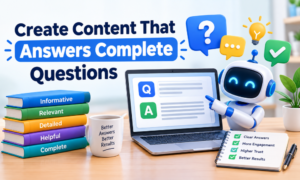
Create Content That Answers Complete Questions
AI search users often ask detailed questions rather than entering a short keyword. A user might ask how machine learning can be implemented, what type of model would be appropriate, how much development could cost, or what challenges a business should expect.
Content should therefore go beyond definitions. A strong resource can explain what something is, why it matters, how it works, when it should be used, what limitations exist, and what mistakes should be avoided.
This creates more opportunities for individual sections of the content to answer specific user needs.
Connect Related Pages Naturally
Internal linking can help establish relationships between different pieces of information. A broad article about artificial intelligence can link to more specialized resources covering machine learning, AI engineering, data preparation, automation, or implementation.
The purpose should not be to add links simply for SEO. Each link should provide additional context or help the visitor explore a related subject.
Over time, this creates a connected information architecture where individual articles contribute to a larger body of knowledge.
Consider How AI Retrieves Information
Traditional SEO often focuses heavily on whether an entire page ranks for a query. AI-powered search can introduce a more granular experience in which a specific passage becomes relevant to a user’s question.
This makes concise explanations particularly valuable. A paragraph should communicate a complete idea rather than relying on vague statements that require several paragraphs of context to understand.
The goal is not to make every paragraph artificially short. It is to make each section meaningful enough that its purpose remains clear when encountered independently.
Do Not Overuse Structured Markup
More markup does not necessarily mean better optimization. Adding unnecessary or inaccurate structured data can introduce complexity without providing meaningful value.
Businesses should prioritize structured information that accurately represents important entities and page types. The markup should reflect the visible content rather than making claims that are difficult for users to verify.
Accuracy and consistency should always take precedence over adding every possible property.
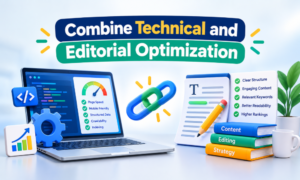
Combine Technical and Editorial Optimization
Preparing a website for AI search is both a technical and content challenge. Technical teams need to ensure that important information can be discovered, rendered, and accessed, while content teams need to ensure that the information itself is useful and understandable.
Organizations looking to hire machine learning developer talent may need a different type of expertise when building custom AI systems, but the same principle applies: technical architecture and information quality need to work together.
A technically sophisticated system cannot compensate for poor information, just as excellent content cannot perform effectively if important pages are inaccessible.
When to Hire ML Developers for AI Projects
Businesses developing their own AI applications may need to hire ML developers to work on the systems behind information processing and retrieval. Their responsibilities can include developing machine learning pipelines, classification systems, recommendation engines, retrieval components, or other specialized applications.
This is different from simply improving website content. The objective becomes creating an AI system that can work with the organization’s own information and deliver useful results according to specific business requirements.
AI Development Requires Quality Data
AI applications are heavily dependent on the information they process. Inconsistent terminology, duplicate records, outdated documents, and poorly organized datasets can affect the quality of the resulting system.
Companies that hire AI developers should therefore consider data organization as part of the project rather than treating it as a secondary task. Before building advanced AI functionality, teams should understand what information exists, where it is stored, how reliable it is, and how it needs to be prepared.
Bring in an AI Engineer for Complex Architectures
For projects involving multiple systems, large datasets, retrieval mechanisms, or custom AI applications, businesses may choose to hire AI engineer expertise. An AI engineer can help connect models, data, software components, APIs, and business requirements into a practical architecture.
This can become especially important when the business wants to create an internal knowledge assistant or intelligent search experience. The challenge is no longer simply storing information; it is making relevant information available to the right user at the right time.
Think Beyond Website Markup
AI optimization should not become synonymous with schema implementation. Structured data is only one component of a much broader digital information strategy.
Businesses also need to consider website architecture, content organization, internal linking, technical accessibility, authorship, entity consistency, content freshness, and the overall usefulness of their resources.
A website that combines these elements provides a stronger foundation than one that relies heavily on markup while neglecting its actual content.
Use Original Information Wherever Possible
AI systems have access to enormous quantities of similar online material. Publishing another generic explanation of a common topic may provide limited differentiation.
Original research, internal findings, expert perspectives, case studies, experiments, and practical examples can make content more distinctive. These resources demonstrate that the business is contributing knowledge rather than simply repeating information already available elsewhere.
This can also give readers a stronger reason to trust and return to the website.
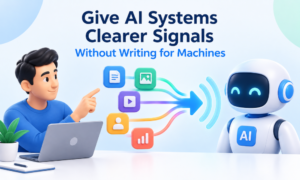
Give AI Systems Clearer Signals Without Writing for Machines
There is an important difference between making content understandable to machines and writing content exclusively for machines. The first approach improves information clarity. The second can result in unnatural writing and keyword-heavy pages.
Businesses should always begin with the reader. Explain concepts clearly, organize information logically, and answer genuine questions. Technical optimization can then reinforce that content rather than dictate how it should be written.
Think of Your Website as a Knowledge System
A modern business website can function as more than a marketing brochure. It can become a structured collection of knowledge about the organization, its expertise, customers, technologies, services, and industry.
When these pieces are connected logically, visitors can navigate from broad concepts to detailed resources. Search systems can also encounter consistent information across multiple pages.
This approach is particularly valuable for technology companies because expertise often spans several interconnected subjects.
Structured Data and Unstructured Content Work Best Together
The debate over which format AI models “prefer” can lead businesses toward the wrong question. Structured data and natural-language content solve different information problems.
Structured data can make certain facts and entities more explicit. Unstructured content provides depth, context, reasoning, examples, and expertise. Neither can fully replace the other.
The better strategy is to use structured data where it genuinely adds clarity while investing heavily in high-quality content that explains the subject in a way people can understand.
Prepare for Search Beyond Traditional Rankings
AI-powered search is changing how information is discovered. Users may increasingly receive answers that combine information from several sources rather than visiting a single page from a conventional search result.
That does not make traditional SEO obsolete. It makes strong fundamentals more important. Websites still need to be technically accessible, well organized, relevant, trustworthy, and useful.
Businesses that prepare now can create an information foundation capable of supporting both traditional search and emerging AI-driven discovery.

The Future Favors Clear, Connected Information
There is no single formatting method that guarantees an AI model will select, cite, or recommend a particular website. Search and AI systems evolve continuously, and their retrieval processes can differ.
What businesses can control is the quality of the information they publish. By combining accurate structured data with clear natural-language content, meaningful internal connections, strong technical foundations, and genuine expertise, they can make their digital presence easier to understand across multiple discovery environments.
For organizations building advanced AI capabilities, working with the right technical professionals can strengthen this foundation further. Whether a business chooses to hire machine learning experts, hire ML developers, hire AI developers, or hire AI engineer support, the underlying principle remains the same: AI works best when the information behind it is reliable, organized, contextual, and useful.