


AI-powered email personalization helps businesses deliver relevant messages to different subscribers based on their interests, behaviour, preferences, and interactions with a brand. Instead of sending the same email to an entire mailing list, marketers can use artificial intelligence to tailor subject lines, content, product recommendations, and send times for different audience segments. When implemented strategically, this approach can improve engagement, strengthen customer relationships, and make email marketing more efficient as subscriber lists grow.
Traditional personalization often relies on basic details such as a subscriber’s name or location. AI lets businesses analyze larger amounts of customer data and identify patterns that help them deliver more relevant communication. However, successful personalization requires more than automated content generation. Businesses need accurate data, useful segmentation, clear campaign objectives, and responsible use of customer information.
Companies looking to improve their campaigns may hire email marketing experts who understand both AI tools and email strategy. Others may hire email marketing consultant specialists to build personalized customer journeys, optimize campaign performance, and connect marketing automation with broader business goals. For businesses using specific email platforms, a hire Mailchimp expert can also help align AI-driven personalization with existing audience data and campaign workflows.
What Is AI-Powered Email Personalization?
AI-powered email personalization uses artificial intelligence, machine learning, and data analysis to adapt email communication to individual subscribers or meaningful audience groups. These technologies can help marketers understand customer behaviour, predict interests, recommend relevant content, and automate decisions across large campaigns.
For example, an online retailer may identify subscribers who repeatedly browse running shoes but have not completed a purchase. Instead of sending those subscribers a generic store newsletter, the business could share relevant product information, sizing guidance, or a carefully timed offer based on their interactions and marketing preferences.
A software company could use similar methods to send educational resources to new users, feature announcements to active customers, and renewal information to subscribers approaching the end of their plans.
The key advantage is relevance. Subscribers receive communication that better reflects their needs instead of being treated as one undifferentiated audience.
AI does not automatically know what every customer wants. Its recommendations depend on the quality of available information, the design of the marketing system, and the accuracy of the assumptions being made. Human review remains important to ensure that messages are useful, appropriate, and consistent with the brand.
How AI Personalizes Email Campaigns at Scale
AI personalization works best when customer data, audience segmentation, content production, and campaign automation operate together. Each component contributes to a more relevant subscriber experience.
1. Analyzing subscriber behavior
AI tools can help analyze signals such as email clicks, previous purchases, website visits, product interests, and engagement with earlier campaigns. Depending on the available integrations and consent settings, these signals can reveal patterns that basic demographic segmentation may overlook.
For instance, two subscribers with similar ages and locations may have very different interests. One might regularly read educational content, while the other responds primarily to product announcements. Behaviour-based analysis can help marketers create more relevant experiences for both.
However, businesses should collect only information that serves a clear purpose and is permitted under applicable privacy requirements. Data should be accurate, appropriately secured, and used in ways subscribers would reasonably expect.
2. Creating more useful audience segments
Traditional email marketing often divides subscribers into broad groups based on location, age, or purchase history. AI can help identify more specific patterns, such as customers likely to need a product refill, subscribers who prefer educational resources, or prospects who have shown interest in a particular service category.
These segments allow businesses to develop campaigns around customer needs rather than sending identical messages to everyone.
For example, a digital marketing agency could distinguish between subscribers interested in SEO, paid advertising, website development, and marketing automation. Each group could receive relevant case studies, practical guides, and service information.
Segmentation should remain practical. Creating hundreds of tiny audience groups can make campaigns difficult to manage and may produce unreliable insights when each segment contains very few subscribers.
3. Generating and adapting email content
AI writing tools can help produce subject line options, introductory paragraphs, product descriptions, recommendations, and calls to action. Marketers can use these capabilities to develop different versions of a message for different audience segments.
A financial education business, for example, might send beginners a simple explanation of a topic while providing more experienced subscribers with advanced resources. The overall campaign objective remains consistent, but the level of detail changes according to the audience’s likely needs.
AI-generated content should always be reviewed for factual accuracy, tone, originality, and relevance. Automated writing can become repetitive or generic when prompts lack context. The objective is to make content more useful, not merely to generate more emails.
Benefits of Using AI for Email Personalization
Higher relevance and stronger engagement
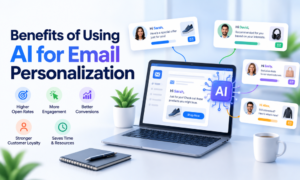
Subscribers are more likely to find an email useful when its content addresses their interests or current needs. Personalized recommendations, relevant educational resources, and context-aware messaging can encourage meaningful interactions.
However, personalization does not guarantee higher open rates or conversions. Results depend on the audience, offer, message quality, timing, and other campaign factors. Businesses should test their assumptions rather than treating AI recommendations as proven improvements.
More efficient campaign production
Creating individual campaigns for multiple audience groups can require significant time and coordination. AI can accelerate repetitive tasks such as drafting subject lines, adapting content, summarizing campaign results, and generating initial variations for testing.
Marketing teams can then devote more time to strategy, creative development, customer research, and performance analysis.
Businesses that hire email marketing expert professionals can use this efficiency to develop a more structured process in which AI handles appropriate repetitive tasks while people oversee messaging quality and campaign decisions.
Better customer lifecycle communication
Email personalization becomes particularly valuable when businesses consider the entire customer journey rather than individual campaigns.
New subscribers may need welcome messages and educational content. Prospects evaluating a product may benefit from comparisons and case studies. Existing customers might need onboarding guidance, relevant upgrades, or renewal reminders.
AI can help determine which content may be useful at each stage, provided the business has reliable data and clearly defined communication rules.
More informed marketing decisions
AI-powered analytics can identify engagement patterns, compare audience segments, and highlight changes in campaign performance. These insights can help marketers understand which topics resonate, where subscribers lose interest, and which messages deserve further testing.
The value comes from combining analysis with business judgment. A pattern in the data may suggest an opportunity, but marketers should verify whether it reflects genuine customer intent before changing their strategy.
Real-World Examples of AI-Personalized Email Campaigns
The most useful applications connect personalization to a specific customer need or business objective.
Ecommerce product recommendations
An online store can use purchase history and relevant browsing signals to recommend products that complement previous purchases. Someone who bought a camera might receive information about compatible accessories, while a returning customer could receive recommendations related to previously viewed categories.
Recommendations should be relevant and appropriately timed. Repeatedly promoting an item a customer has already purchased, or sending too many promotional messages, can undermine the experience.
SaaS onboarding and retention
A software company can personalize onboarding based on the features a new user explores, the setup steps they complete, and the guidance they request.
A user who has not completed account configuration might receive a helpful tutorial. An active user could receive advanced tips or information about features relevant to their usage.
These campaigns should support the user’s goals rather than automatically sending sales messages after every interaction. Product activity data should be handled transparently and in accordance with applicable privacy requirements.
B2B lead nurturing
Business-to-business sales cycles often involve multiple decision-makers and extended evaluation periods. AI can help marketers organize leads according to their interests, previous engagement, and stage in the buying journey.
A prospect who downloads a guide about operational efficiency might receive related resources, while someone who requests a service consultation may need information about implementation, pricing, or case studies.
A hire email marketing consultant strategy can help connect these signals to a sensible nurturing sequence, ensuring that automation supports the sales process without making every interaction feel like a generic pitch.
Customer re-engagement
Businesses can use engagement data to identify subscribers who have become less active. Instead of sending the same discount to everyone, marketers can test different approaches, such as useful educational content, product updates, preference management options, or carefully selected incentives.
The goal should be to restore genuine interest. If subscribers no longer want to receive marketing communication, businesses should make unsubscribing easy rather than continuing to increase message frequency.
How to Implement AI Personalization Without Overcomplicating Campaigns
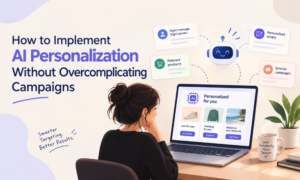
Successful implementation starts with a clear objective. Businesses should decide whether they want to improve qualified conversions, increase repeat purchases, strengthen onboarding, or reduce subscriber inactivity. Each goal requires different data, messaging, and success metrics.
Next, review the data already available. Check whether subscriber records are accurate, consent information is maintained, duplicate contacts are handled appropriately, and relevant customer interactions can be connected to the email platform.
Begin with a small number of high-value use cases. A welcome sequence, relevant product recommendations, or a lead nurturing campaign may provide a better starting point than attempting to personalize every message immediately.
Define the rules that govern each workflow. Specify when a subscriber enters a sequence, what triggers the next message, and when communication should stop. For example, a purchase should normally remove a subscriber from an abandoned-purchase sequence related to that completed transaction.
Test the workflow with sample contacts before activating it. Confirm that personalization fields populate correctly, links work, messages display properly on mobile devices, and subscribers receive the appropriate content.
Businesses looking to hire email marketing consultants should prioritize professionals who can connect strategy, data quality, automation, and measurement rather than focusing exclusively on AI tools.
Using Mailchimp and Other Platforms for AI Personalization
Email platforms provide the infrastructure for managing subscribers, designing campaigns, segmenting audiences, and automating communication. The available AI capabilities vary by platform, plan, integrations, and feature availability, so businesses should verify which functions are supported before designing their workflows.
Mailchimp, for example, offers email marketing and automation capabilities that businesses can use to organize audiences, build customer journeys, and evaluate campaign performance. Depending on the account and available features, marketers may also have access to AI-assisted content or optimization tools.
A hire Mailchimp expert can be useful when a business needs help organizing audience data, configuring segments, creating automated journeys, or improving campaign reporting. An experienced specialist can also identify gaps in the existing setup before adding more automation.
AI does not have to replace the email platform’s existing segmentation or automation features. In many cases, the most practical approach is to use platform-native tools for routine workflows and introduce additional AI capabilities where they solve a specific problem.
Before selecting additional tools, assess integration requirements, data access, costs, privacy controls, and the team’s ability to maintain the system over time.

How to Measure AI-Personalized Email Performance
Personalization should be evaluated using business outcomes rather than the number of automated messages or AI-generated variations produced.
Important metrics include click-through rate, conversion rate, revenue per recipient, qualified leads, repeat purchases, unsubscribe rate, and spam complaint rate. The appropriate measures depend on the purpose of the campaign.
Open rates can provide limited directional information, but privacy features and automated email activity can make them unreliable as a standalone measure of success. Businesses should prioritize metrics that more directly reflect meaningful engagement and conversions.
A/B testing can help determine whether personalized content performs better than a suitable control. For example, a business could compare a relevant product recommendation against its standard newsletter format while keeping other important campaign conditions as consistent as possible.
Tests should run long enough to collect meaningful evidence, and teams should avoid declaring a winner based on a small number of conversions. Where possible, a randomized holdout group can help estimate whether personalization contributes incremental value beyond what would have happened anyway.
Review results by segment and customer lifecycle stage. A strategy that improves repeat purchases may not produce the same outcome for new subscribers. Continuous measurement helps marketers refine their approach based on actual performance.
When Should You Hire an Email Marketing Specialist?
Businesses may benefit from outside expertise when their email lists are growing, campaigns are becoming difficult to manage, or automation is producing inconsistent results.
When you hire email marketing expert professionals, look for experience in segmentation, lifecycle strategy, campaign testing, analytics, and marketing automation. The right specialist should understand the business objective behind each campaign and explain how success will be measured.
A decision to hire email marketing consultant support may be appropriate when you need an audit, a personalization strategy, or help improving a specific customer journey. Companies managing several campaigns or complex integrations may benefit from ongoing support, making it practical to hire email marketing consultants who can coordinate strategy and execution.
For businesses already using Mailchimp, a hire Mailchimp expert arrangement may be useful for platform configuration, audience organization, automation, and reporting.
An Email Marketing Hire should be based on the skills and responsibilities required, not simply on familiarity with AI tools. Strong specialists combine technical knowledge with customer understanding, clear communication, and a disciplined approach to testing.

Conclusion
AI can make email personalization more scalable by helping businesses analyze customer behaviour, organize audience segments, adapt content, and automate relevant communication. Its greatest value comes from delivering useful messages at the right stage of the customer journey rather than generating endless variations for the sake of volume.
To achieve sustainable results, businesses need reliable data, thoughtful segmentation, responsible privacy practices, human quality control, and meaningful performance measurement. Start with a few well-defined use cases, test the outcomes, and expand only when the evidence supports the investment.
Whether a business chooses to hire email marketing expert professionals, hire email marketing consultants, or hire Mailchimp expert support, the priority should be building a strategy that connects AI capabilities with genuine customer needs.